What Are Baroque Pearls? (Definition & Meaning)
Baroque Pearls are pearls with erratic, unbalanced, asymmetrical, non-spherical and free-form shapes. Their forms can show minor irregularities or they can be noticeably ovoid, curved or lumpy. They can also look like a stick or a cross. The shape of a baroque pearl is caused by disproportionate deposits of nacre around the nucleus.
Table Of Contents
- 1) What Are Baroque Pearls? (Definition & Meaning)
- 2) Are Baroque Pearls Real?
- 3) How to Tell if a Baroque Pearl Is Real
- 4) How Common Are Baroque Pearls?
- 5) Pearl Shape Classification Explained
- 6) How Do Baroque Pearls Form?
- 7) Tahitian & South Sea Baroque Pearls
- 8) Sub-Type Of Baroque Pearls
- 9) Factors Determining Value Of a Baroque Pearl
- 10) Baroque Pearls in the Renaissance Era
- 11) Caring for Your Baroque Pearls
- 12) Baroque Pearls FAQ

|
2) Are Baroque Pearls Real?Back To Top |
Baroque pearls are absolutely real pearls. The term “baroque” refers only to their irregular, non-spherical shape. These pearls form naturally inside mollusks just like round pearls. The difference lies in how nacre is deposited during growth, resulting in unique and asymmetrical forms rather than perfectly round shapes.
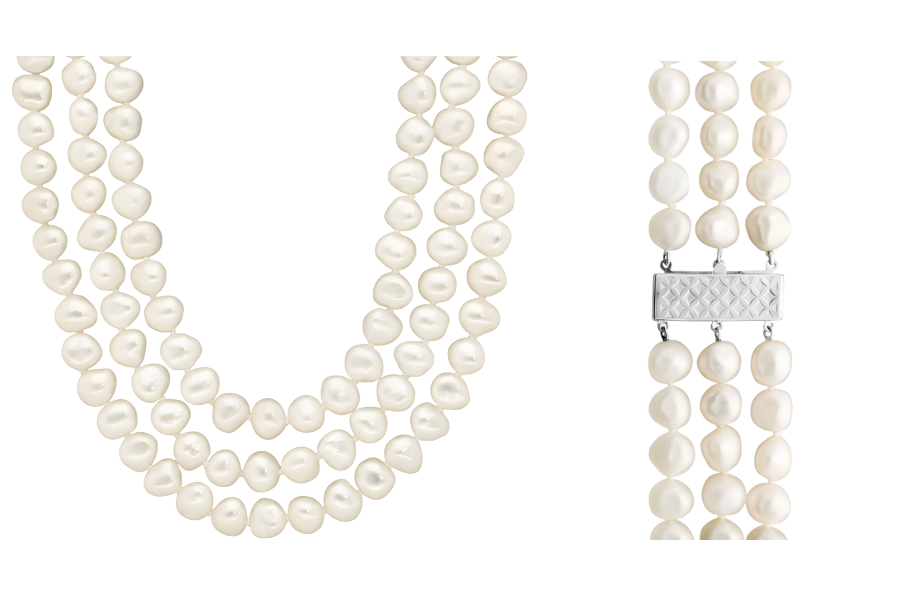
Sterling Silver Freshwater Cultured Baroque Pearl Necklace |
|
|
Fall For The Details. Click On The Image To Learn More About This Sterling Silver Freshwater Cultured Baroque Pearl Necklace! |
If you’re wondering whether they are truly authentic, look at the biology behind them. Nature rarely works in perfect circles. Whether formed in saltwater oysters or freshwater mussels, baroque pearls are made of the same calcium carbonate and organic protein (conchiolin) as their round counterparts.
The only real distinction is how the pearl grows within the mantle tissue. Because they are 100% genuine, they share the same durability, organic origin, and structural integrity as any fine pearl. If you want a natural gemstone rather than a uniform, factory-perfect bead, baroque pearls offer something refreshingly real.
You can confirm their authenticity through their physical traits — their weight in the hand, the cool temperature when first touched, and the complex way they reflect light. In every measurable sense, they are real pearls.
|
|
3) How to Tell if a Baroque Pearl Is RealBack To Top |
Authenticating a baroque pearl requires observing natural nacre characteristics, luster behavior, and physical cues. While traditional methods can offer guidance, professional verification remains the most reliable approach.
Decoding the Nature of Genuine Nacre
You can often distinguish a natural treasure from a factory imitation by its complex surface. Real nacre develops in microscopic layers over several years. These organic layers interact with light in ways that synthetic coatings simply cannot mimic. When you examine the surface, you should see small variations in texture that prove the pearl grew inside a living organism.

|
3.a) The Tooth TestBack To Top |
This is the classic old-school method. Real pearls are composed of microscopic layers of nacre that resemble overlapping shingles under magnification. This layered structure creates a slightly gritty or sandy texture when gently rubbed against a tooth. Fake pearls made of glass or plastic are usually coated with smooth lacquer and feel slick or waxy.
Understanding the Grit Factor
Testing your jewelry this way feels a bit strange at first, but your teeth are sensitive enough to detect microscopic friction. If you feel a sensation similar to fine sand, you likely hold a genuine piece of nature. Plastic beads slide across your enamel without any resistance because they lack the crystalline structure of calcium carbonate. You should perform this test very gently to avoid any risk of scratching the surface of your gem.
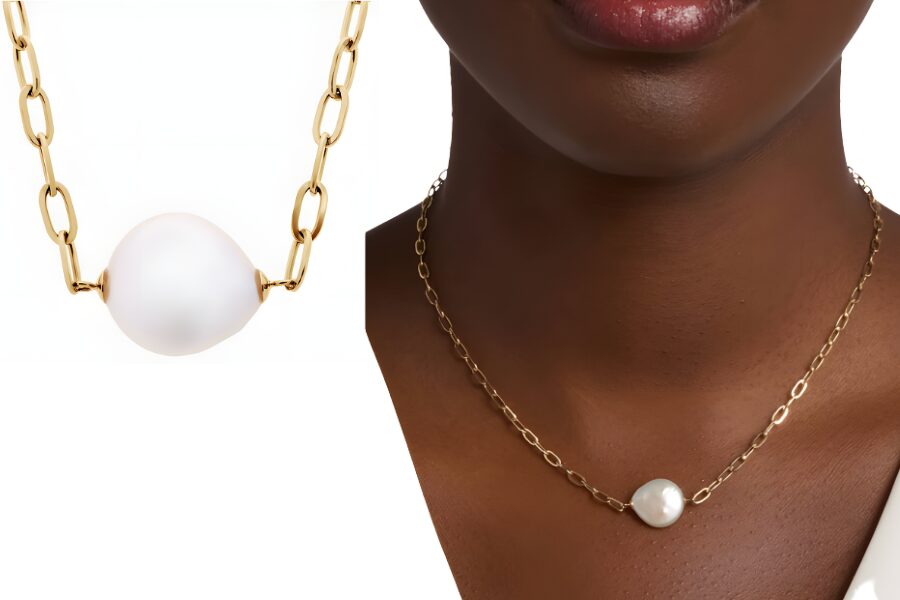
14k Yellow Gold Paperclip Necklace With Baroque Pearl |
|
|
Click On The Image To See What Makes This 14k Yellow Gold Paperclip Necklace With Baroque Pearl A True Head-Turner! |
|
|
3.b) Luster and DepthBack To Top |
Authentic pearls display a “glow from within” because light travels through semi-translucent layers of nacre before reflecting back. Imitations typically show surface-level shine that appears flat or painted on.
Evaluating the Optical Glow
Your eyes can sense the difference between a superficial shine and true luster. A real baroque pearl acts like a tiny mirror with depth, pulling your gaze into its center. Because the surface of these pearls is uneven, the light scatters in various directions, creating a beautiful play of color. Cheap imitations often look too perfect or have a plastic-like glare that stays on the very top of the bead.
|
|
3.c) The Gemologist AdvantageBack To Top |
Professionals use 10x magnification loupes to inspect surface texture and look for the natural scaly pattern of nacre. In some cases, X-rays are used to identify internal growth rings, which confirm natural formation.
Utilizing Advanced Diagnostic Tools
If your jewelry carries significant emotional or financial value, seeking an expert opinion gives you peace of mind. A jeweler looks for the “fingerprints” of the ocean that are invisible to the naked eye. They can spot the difference between a natural formation and a clever human-made shell pearl. Using high-powered magnification allows them to see the tiny ridges and valleys that define a real organic gemstone.
|
|
3.d) Additional Physical Cues for Baroque PearlsBack To Top |
Examining the Integrity of the Drill Hole
Real pearls have sharp, clean drill hole edges. Fakes often show chipped coating or visible separation between the outer layer and inner bead.
You can learn a lot about a gem by looking at its entry point. When a jeweler drills into a genuine organic pearl, the nacre remains bonded to the core. This creates a crisp, well-defined circle. If you see jagged edges or a thin film peeling away from the hole, you likely hold a bead with a synthetic coating. You should use a magnifying glass to check if the color remains consistent all the way into the center of the pearl.
Testing the Natural Thermal Reaction
Real pearls feel cool when first touched and take a few seconds to warm against the skin. Plastic imitations feel room temperature immediately.
Your skin serves as a surprisingly accurate sensor for authenticity. Because calcium carbonate conducts heat slowly, a genuine baroque pearl pulls warmth away from your body at first. This initial chill is a hallmark of many organic gemstones. If a necklace feels warm the moment it touches your neck, it probably consists of plastic or resin. Nature has a way of staying refreshing and cool until it adjusts to your personal body heat.
Measuring the Density and Heft (Weight)
Genuine pearls have noticeable heft. If a large baroque pearl feels unusually light, it may be hollow or plastic.
You should trust the feeling of weight in your palm when evaluating a strand. Real pearls possess a density that gives them a characteristic “bounce” and solid presence. Even a single large baroque gem should feel substantial rather than airy. If a piece of jewelry looks massive but weighs almost nothing, it fails the basic test of physical composition. High-quality imitations made of glass might mimic this weight, but plastic versions always give themselves away by being too light.
Identifying the Iridescent Overtone
Authentic baroque pearls often display orient, a subtle rainbow-like iridescence within folds and contours. Imitations usually have uniform, flat color.
You can find the true beauty of this pearl in its hidden colors. As you rotate the gem under a bright light, look for soft flashes of pink, green, or blue dancing across the surface. This secondary color, known as orient, occurs when light diffracts through the irregular ridges of the pearl. A fake bead usually displays one flat, stagnant color across its entire surface. Finding these shimmering shifts in tone confirms that your pearl grew through a slow, natural process beneath the waves.
|
|
3.e) A Note on Modern “Shell Pearls”Back To Top |
Shell pearls are manufactured from crushed mollusk shell powder shaped into beads and coated with nacre-like material. Because they contain real shell components, they may pass the tooth test. However, they are not naturally formed pearls. Natural baroque pearls display organic irregularity—nature rarely produces two identical shapes.
Distinguishing Between Man-Made and Organic Growth
You might find yourself confused by the convincing appearance of shell pearls in the current market. Since these beads use actual mollusk material, they mimic the weight and initial grit of the real thing. However, you should remember that these are essentially factory products. Humans control every step of their creation, which results in a lack of soul and character. A natural baroque pearl is a wild child of the sea, whereas a shell pearl is a disciplined product of a laboratory. If you look closely, you will see that these manufactured beads lack the spontaneous ridges and deep, complex personality found in an authentic find.
Identifying the Lack of Individual Character
Nature has a messy, beautiful way of creating gemstones that no machine can truly copy. When you compare a strand of shell pearls to genuine baroque gems, the difference becomes clear through the lack of variety. Because they are molded, shell pearls often appear too similar to one another in their “irregularity.” You should look for the unique story told by a natural pearl’s surface. Real baroque pearls often feature tiny bumps or “pits” that occur during their years of growth. These features are not flaws; they are the birthmarks of a genuine ocean-born treasure that hasn’t been ground down or reshaped by human hands.
|
|
4) How Common Are Baroque Pearls?Back To Top |
The most prevalent type of these pearls are baroque freshwater pearls. Less than ten percent of freshwater pearls are round. The vast majority of them are baroque. Furthermore, saltwater, cultured and natural pearls can all come in baroque shapes. Even some Akoya pearls, renowned for their round shapes, do come in baroque shapes.
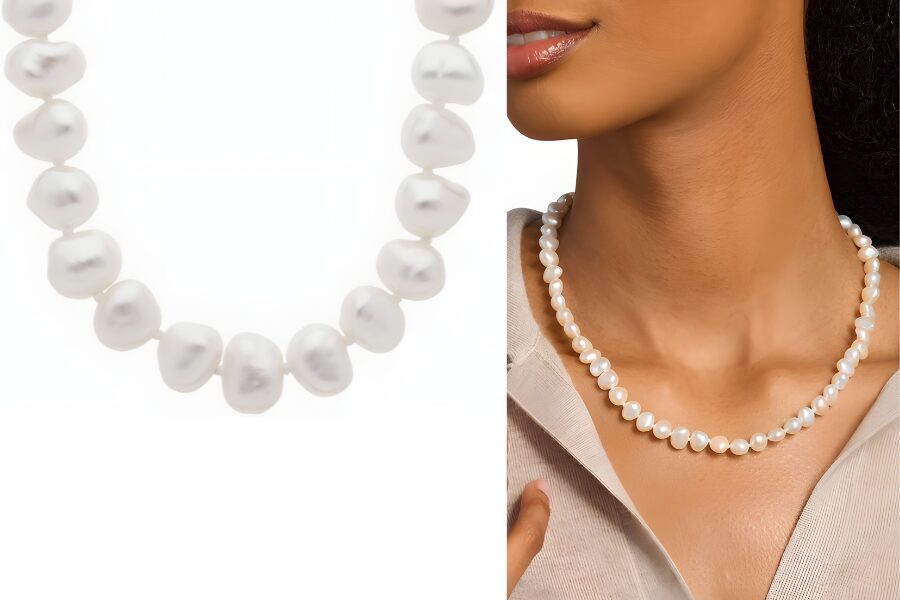
Sterling Silver Baroque Freshwater Cultured Pearl Necklace |
|
|
Discover Every Angle Of This Sterling Silver Baroque Freshwater Cultured Pearl Necklace. Click On The Image To View! |
Understanding Freshwater Abundance
You might assume that finding a high-quality pearl is like finding a needle in a haystack, but baroque varieties actually dominate the market. Since freshwater mussels can produce dozens of gems at once, the internal pressure frequently results in these wonderful, non-spherical shapes. While traditional media often highlights the perfectly symmetrical orb, the ocean spends most of its time crafting these unique, abstract forms. This abundance makes them an accessible entry point for anyone starting a jewelry collection. You get the benefit of a genuine organic gemstone without the extreme price tag often attached to perfectly round specimens.
Encountering Rarity in Saltwater Varieties
While freshwater sources provide the bulk of these gems, you will find that saltwater baroque pearls carry a different kind of prestige. In the salty depths where oysters grow, the conditions usually favor more symmetrical growth. However, when a saltwater pearl emerges with a lumpy or curved silhouette, it possesses a heavy, thick nacre that creates an incredible glow. Even the legendary Akoya oysters, which farmers carefully manage to produce roundness, sometimes yield these rebellious “drop” or “twin” shapes. These rare saltwater accidents provide you with a stunning mix of high-end luster and adventurous, one-of-a-kind geometry.
|
|
5) Pearl Shape Classification ExplainedBack To Top |
Jewelers typically classify pearls into spherical, symmetrical, and baroque categories based on surface geometry.
Decoding the Geometry of Organic Gems
Understanding how experts group these treasures helps you appreciate the vast diversity of the pearl market. While most people envision a simple white orb, nature actually works with a much larger palette of silhouettes. These classifications allow jewelers to sort millions of harvested gems into distinct groups based on their external lines. Your personal style usually dictates which of these categories resonates most with your wardrobe and aesthetic preferences.
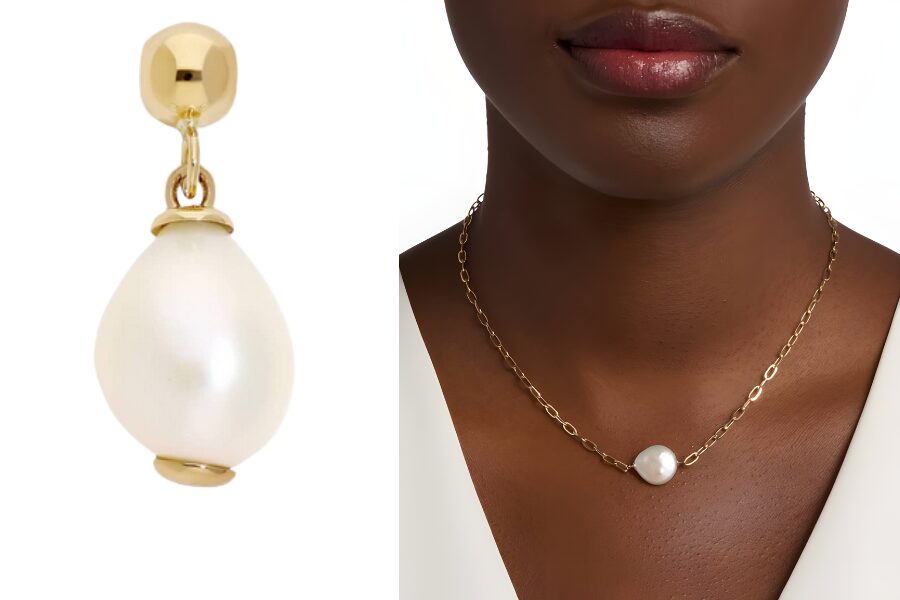
14k Yellow Gold Baroque Pearl Charm |
|
|
Click On The Image To Reveal Full Specs & Shine Of This 14k Yellow Gold Baroque Pearl Charm! |
|
|
5.a) Spherical ShapesBack To Top |
The most familiar Spherical Shapes are perfectly round pearls or almost round pearls.
Appreciating the Classic Spherical Form
You likely recognize these as the traditional standard for elegance and formal wear. Achieving a truly spherical form requires a rare alignment of biological factors inside the mollusk. These gems roll smoothly in any direction because their dimensions are equal from every angle. When you invest in a spherical strand, you are wearing a shape that symbolizes timeless sophistication and balance.
|
|
5.b) Symmetrical ShapesBack To Top |
Symmetrical Shapes are well-balanced and consistent. If you happen to slice this pearl into halves, each half would be a mirror image of the other.
Finding Balance in Linear Designs
Think of these as the middle ground between a perfect circle and a wild freeform shape. This category includes teardrops, ovals, and buttons that look intentional and polished. You will notice that while they aren’t round, they possess a pleasing equilibrium that makes them ideal for matching sets like earrings. Their predictable lines offer a sense of order that many collectors find quite calming and professional.
|
|
5.c) Baroque ShapesBack To Top |
Baroque shapes are shapeless. They are irregular and asymmetrical. Nevertheless, they are delightfully gorgeous and versatile. They will complement virtually every ensemble in your wardrobe.
Embracing the Beauty of Fluid Forms
You should view these gems as wearable pieces of abstract art. Since they lack uniform symmetry, they catch the light in unpredictable ways, showing off different flashes of color as you move. These pearls break the rules of traditional jewelry by proving that asymmetry can be just as striking as a perfect circle. Their unconventional nature allows you to express your own unique personality without saying a word. You can easily pair them with a casual denim jacket or a high-end evening gown because their organic look feels at home in any setting.
|
|
6) How Do Baroque Pearls Form?Back To Top |
Baroque pearls form when irregular internal conditions inside a mollusk disrupt symmetrical nacre deposition.
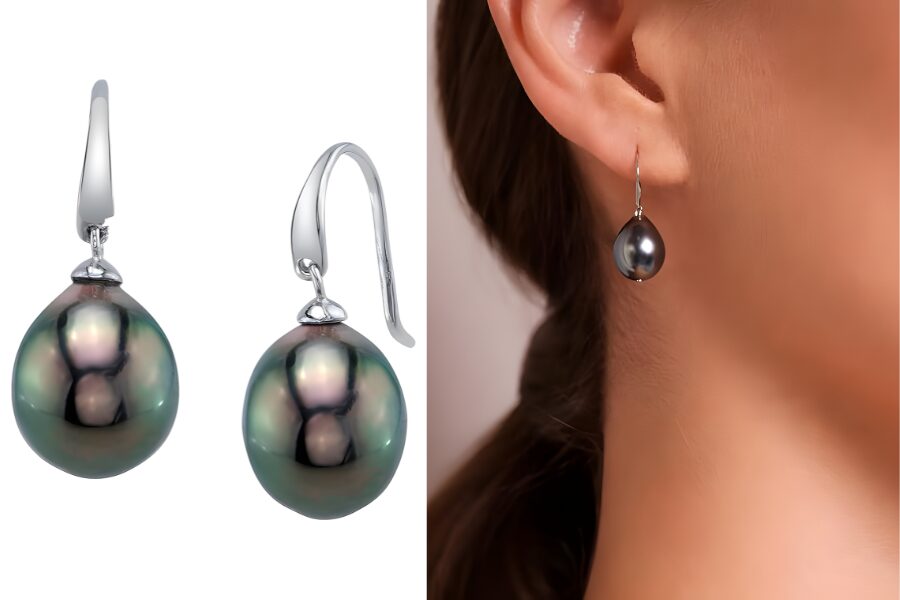
Each Baroque pearl has a marvelously unique shape. Each and every piece is One-Of-A- Kind creation. This is because the shape of a pearl is molded by a number of unpredictable factors occurring inside the oyster as the pearl develops.
Baroque Black Tahitian South Sea
|
|
|
Click On The Image To Reveal Full Specs And Shine Of This Baroque Black Tahitian South Sea Cultured Pearl Earrings! |
Embracing the Chaos of Natural Growth
You should think of a pearl’s growth as a years-long dance between the mollusk and a tiny intruder. Unlike a factory that follows a blueprint, the ocean operates with a beautiful lack of predictability. Every current, temperature shift, and movement of the host oyster leaves a permanent mark on the gem. When you wear a baroque pearl, you are carrying the physical history of that specific oyster’s life. This organic process ensures that your jewelry remains as individual as your own fingerprint, as no two biological journeys ever follow the exact same path.
|
|
6.a) Shape Of The NucleusBack To Top |
The growing pearl acquires the shape of its nucleus. Nucleus is the irritant which gets placed inside the oyster naturally or by man (in case of cultured pearl). The irritant triggers the formation of pearl. A round nucleus results into a near round pearl. A misshapen nucleus will give birth an asymmetrical pearl.
Following the Internal Template
Your pearl effectively builds itself around a foundation. If the starting grain of sand or implanted bead has a jagged edge or a flat side, the layers of nacre will naturally follow those contours. While pearl farmers try to encourage roundness by using spherical beads, nature often has other plans. You might find that a tiny, irregularly shaped piece of shell or coral becomes the heart of a stunning masterpiece. This initial spark sets the stage for everything that follows, dictating whether the final result will be a classic orb or a wild, abstract silhouette.
|
|
6.b) Position Inside The OysterBack To Top |
The position of the pearl inside the oyster also impacts the shape of the forming pearl. If the pearl forms pressed against the hard shell, it will result in a pearl flattened on that side. Moreover, pearl development does not always occur in soft-tissue areas. In this area, the expanding pearl sac grows regularly without encountering significant resistance and results in a round pearl. But, pearl cysts often get implanted in muscular tissues. The developing pearl is not able to overcome the resistance of hard muscle fibers. It assumes an irregular baroque shape.
Navigating the Internal Obstacles
Real estate is everything, even inside a shell. If a pearl begins its life in the soft mantle, it has plenty of room to expand in all directions, often leading to a more circular form. However, if the cyst settles near the tough, muscular parts of the oyster, it must fight for every millimeter of space. You can see the result of this struggle in the flattened surfaces or elongated “tails” of many baroque gems. These shapes are essentially a map of the resistance the pearl encountered while trying to grow within its cramped and powerful living quarters.
|
|
6.c) Pressure PointsBack To Top |
If a pressure happens to be exerted constantly at a particular point on the forming pearl it becomes a ringed or circled pearl. It is variously described as circled-round or ringed-oval.
Creating Parallel Ridges Through Friction
You will sometimes notice distinctive rings or grooves that wrap around the middle of a pearl like tiny Saturn-like belts. These “circled” features occur when the pearl rotates in a specific way or faces consistent pressure from the oyster’s internal movements. This constant friction carves out unique pathways in the nacre as it hardens. Far from being a flaw, these rings add a rhythmic, tactile quality to the gem that you can feel with your fingertips. They serve as a visual record of the physical forces that acted upon the pearl during its long development.
|
|
6.d) Formative EnvironmentBack To Top |
The finest environment for a round pearl to grow exists inside the shell of a healthy mollusk. The organism is at peace with itself and thus remains internally passive. But a pearl only starts to form when mantle tissue becomes displaced or irritated (or as Simplified folklores say when a foreign particle wedges in the body of an oyster). The particle causes constant irritation and triggers the secretion of nacre which coats irritating object known as the nucleus.
At the same time the oyster relentlessly tries to eject the extraneous object. The perpetual struggle pushes, shoves and shifts the nucleus. The movement causes the nacre to be coated in irregular layers, and a baroque pearl is born. However, if the seeding nucleus does not cause too much of irritation, there is little internal tussle, and a round pearl is born.
Born Through Internal Conflict
It helps to view a baroque pearl as the ultimate symbol of resilience. The oyster does not want this intruder inside its body and spends years trying to push it out through muscular contractions. This internal “tug-of-war” ensures that the nacre layers never settle perfectly. Instead, they become thick, uneven, and full of character. You are essentially wearing the result of a biological battle. When the oyster is too successful at shoving the nucleus around, it creates the dramatic, bumpy surfaces that define the baroque aesthetic.
|
|
6.e) Two NucleiBack To Top |
At times a second foreign particle, lodges itself besides the main nucleus. The pearl sac covers both particles resulting in a twin pearl.
Witnessing the Fusion of Gems
You occasionally find pearls that look like two separate gems fused together in a permanent embrace. This happens when two distinct irritants settle so close to one another that the oyster’s defense mechanism treats them as a single unit. As the nacre layers grow, they bridge the gap between the two nuclei, creating a “twin” formation. These are among the most fascinating baroque shapes because they possess a dual personality. They offer a rare glimpse into a double event beneath the waves, resulting in a joined silhouette that no human jeweler could ever truly replicate.
|
|
6.f) Type Of NucleiBack To Top |
A good number of cultured fresh water pearls are baroque. This happens because a lump of mantle tissue from another donor mollusk is used as a nucleus instead of a perfectly round bead.
Cultured saltwater pearls can also turn out be baroque-shaped because of any of the above factors. However, they are more likely to be shaped like a teardrop on account of the spherical beads used as the seeding nucleus.
Comparing Tissue and Bead Foundations
Your choice between freshwater and saltwater pearls often comes down to the core material used during farming. Freshwater mussels usually receive a soft piece of donor tissue, which gives the pearl total freedom to grow into a lumpy, solid-nacre masterpiece. Saltwater oysters are typically given a hard, round bead which acts as a guide. This is why you see so many teardrop and “drop” shapes in saltwater collections; the pearl tries to stay round because of the bead but eventually develops a “tail” as the oyster pushes it through its tissue. Both methods result in stunning, non-spherical treasures with their own distinct visual language.
|
|
7) Tahitian & South Sea Baroque PearlsBack To Top |
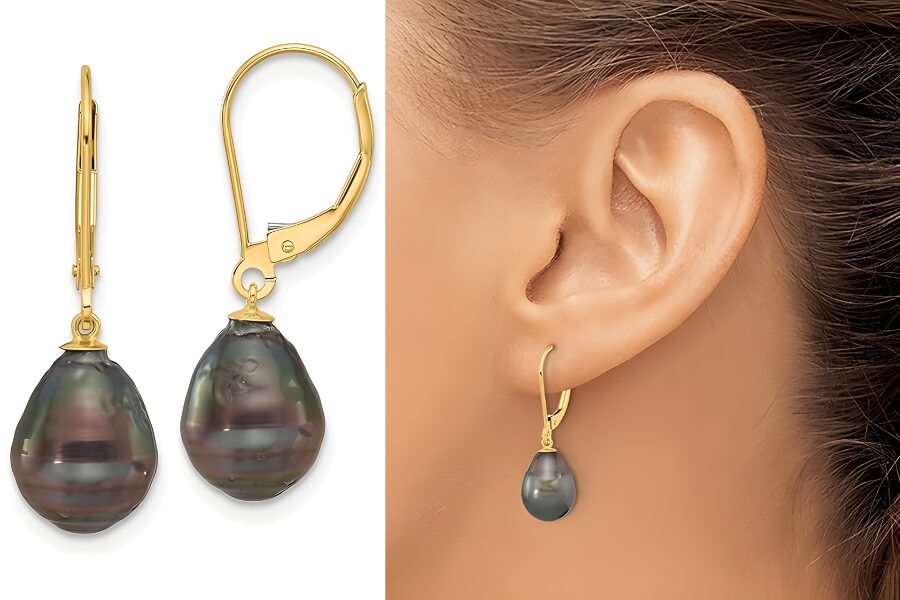
Among baroque pearls, Tahitian and South Sea varieties are generally considered the most valuable due to their size, nacre thickness, and rarity. While these two are also types of cultured saltwater pearls, they have to spend a lot of time inside the mollusk to gather nacre depth. The extended time periods increase the chances of formation of a baroque pearl. As such, Tahitian pearl farm harvests often yield a significant percentage of baroque and semi-baroque pearls.
14k Yellow Gold Baroque Tahitian
|
|
|
Turn Heads With This 14k Yellow Gold Baroque Tahitian Pearls Dangle Earrings. Tap The Image To Explore! |
Saltwater Excellence and Value
You should recognize that the worth of these gems stems from more than just a famous name. These treasures represent the peak of luxury in the pearl market. Because nature rarely produces perfect spheres, you find a certain raw honesty in these irregular shapes. They carry a significant price tag because they originate from specific saltwater oysters that require extreme care and a pristine environment.
The Patience of Nacre Development
You might think of nacre as the pearl’s skin, and these varieties have some of the thickest in the world. The oysters live in deep, nutrient-rich waters for several years to build this glow. This slow growth creates a luster that cheaper pearls simply cannot mimic. When you hold one, the weight and the cool temperature against your skin tell the story of its long journey under the sea.
Natural Formation and Artistic Shapes
A long stay inside an oyster often pushes a pearl out of a perfectly round alignment. You are essentially watching a slow-motion dance between the mollusk and the ocean. Any tiny shift or bit of natural debris can nudge the pearl into a teardrop or winged shape. This organic process gives your jewelry its one-of-a-kind personality that no factory can replicate.
High Yields of Irregular Beauty
Farmers embrace these gorgeous mistakes because they happen so frequently in high-end farming. Instead of fighting nature, the industry celebrates these unique silhouettes as a hallmark of authenticity. You get to enjoy a wide variety of shapes that speak to the wild nature of the South Seas. Each harvest brings a fresh wave of creative possibilities for your personal style.
|
|
8) Types Of Baroque PearlsBack To Top |
Even though baroque pearls are shapeless, some of them happen to share certain common features. Based on these shared features, baroque pearls are categorized into many sub-types.
Celebrating Unique Formations
You might assume that shapeless means without character, but the opposite is true for these gems. Every sub-type offers a new way to appreciate the wild creativity of the ocean. Instead of seeking a single standard of perfection, you can explore a wide variety of silhouettes that reflect your personal taste. Identifying these shared features helps you navigate the diverse landscape of organic jewelry.
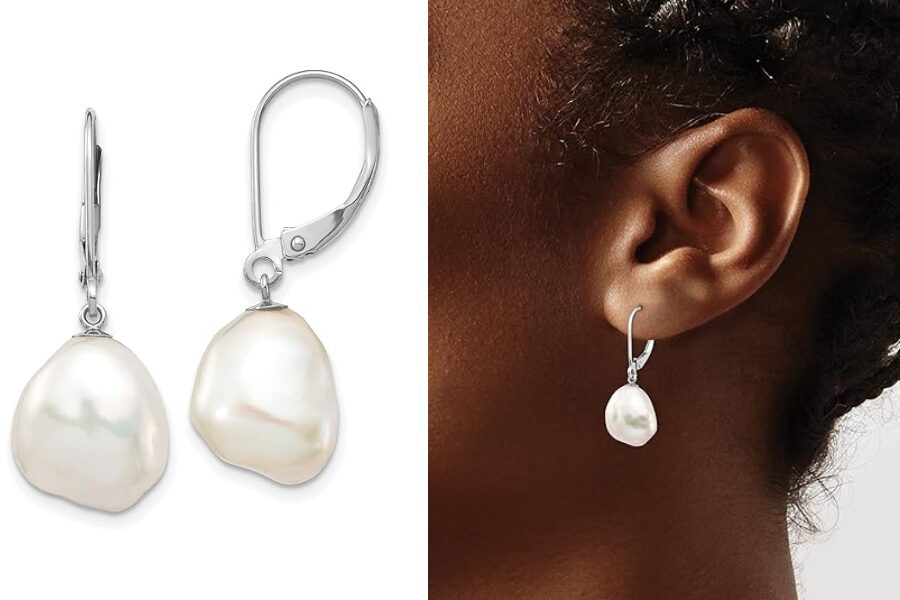
14k White Gold Natural Baroque
|
|
|
Tap The Image To Take A Closer Look At This 14k White Gold Natural Baroque Freshwater Pearls Earrings |
H4 Classifying Nature’s Art
By grouping these pearls based on their looks, farmers and jewelers make it easier for you to find a matching set. While no two are identical, these categories give you a helpful starting point for your collection. You get to enjoy the best of both worlds: a recognizable style and a one-of-a-kind stone. This classification system turns a chaotic harvest into an organized gallery of natural art.
|
|
8.a) Coin PearlsBack To Top |
These pearls are flat and round with very smooth surfaces. Their large flat surface areas reflect light well. Reflecting light imparts a dazzling luster to this gems. Baroque pearl necklaces and baroque pearl earrings crafted out of coin pearls are highly appreciated in the world of jewelry.
Capturing The Light
The flat shape of a coin pearl acts like a tiny mirror resting against your skin. You get a massive amount of surface area that catches every ray of sunshine or candlelight in the room. This makes them a top choice when you want a piece of jewelry that truly glows from across the room. Their smooth finish ensures they feel comfortable and sleek throughout the day.
Versatility in Modern Design
Designers love using these flat discs because they lay beautifully against the chest or ears without rolling around. You can wear them in a simple strand or as bold drop earrings that frame your face with light. Their round yet flattened silhouette offers a contemporary twist on the traditional pearl look. It is a smart way to update your style while keeping a classic aesthetic.
|
|
8.b) Potato PearlsBack To Top |
Potato Pearls are typically rounded and irregular, often resembling small pebbles. They are squarish or round lumps akin to potatoes. These are very suitable for creating baroque pearl bracelets & baroque pearl necklaces.
Earthy and Organic Charm
As the name suggests, these pearls have a humble and lumpy look that feels incredibly authentic. You won’t find any cold, industrial perfection here; instead, you get a warm and approachable gem. Their small size makes them perfect for everyday wear, adding a touch of the sea to your casual outfits. They remind you that beauty often hides in the most irregular and unexpected places.
Perfect for Layering
Because they are generally smaller, these pearls work wonders when you want to layer multiple bracelets or necklaces. You can mix and match them with other gemstones to create a textured, bohemian look. Their sturdy and compact shape means they can handle the bumps of daily life better than larger, more delicate varieties. They are the workhorses of the baroque pearl family.
|
|
8.c) Twin PearlsBack To Top |
At times nature transpires to envelop two nuclei in the same pearl sac inside the body of the mollusk. Both the nuclei are simultaneously swathed in the nacre secreted by that organism. As a result, two pearls grow fused together within the same pearl sac, creating what are known as twin pearls. The two pearls fuse together with the bonding nacre. The twins may be identical in shape and size or one might be smaller than the other. Twin pearls are excellent for crafting baroque pearl stud earrings as they turn out to be elegant jewelry pieces.
Double the Beauty
Imagine the surprise of finding two pearls fused together by a single layer of shimmering nacre. You are looking at a rare biological event where two separate starts become one beautiful finish. This natural bonding creates a silhouette that is impossible to replicate by hand. It adds a layer of depth and intrigue to your jewelry that standard single pearls just cannot match.
Symbolic and Elegant Studs
These “conjoined” gems make for fascinating conversation pieces when worn as earrings. You can choose a pair where the twins are identical for a balanced look or pick an asymmetric set for a bit of edge. They symbolize partnership and connection, making them a thoughtful gift for someone special in your life. Their unique structure ensures that your studs will stand out in a sea of round beads.
|
|
8.d) Stick PearlBack To Top |
Stick pearls are elongated and narrow like a stick. They are usually flat. Stick pearls make stunning gems. Their unusual shape makes them ideal for crafting statement jewelry pieces.
Vertical Elegance
These long, slender gems pull the eye upward and add a sense of height to any design. You can think of them as the “abstract art” of the pearl family because of their sharp, linear profile. They break away from all traditional jewelry rules, offering a bold alternative for the fashion-forward wearer. Their flat surfaces still provide plenty of space for that signature pearl luster to shine.
Creating Statement Art
If you want to turn heads, a fringe of stick pearls is a guaranteed way to do it. They jingle softly and move with you, creating a dynamic piece of jewelry that feels alive. You can find them in everything from architectural necklaces to edgy, dangling earrings. Their narrow shape allows designers to get creative with fan-like patterns and geometric layouts.
|
|
8.e) Cross PearlsBack To Top |
Cross Pearls are rare naturally occurring symbolic shapes among baroque pearls. While developing, they take the shape of a cross. As such, they are best for shaping jewelry with religious connotations.
Natural Icon
Finding a pearl that naturally grows into the shape of a cross feels like a small miracle from the sea. You don’t need a jeweler to carve this symbol; the mollusk does all the work for you over several years. This makes each piece feel sacred and deeply personal to the person wearing it. It is a beautiful intersection of natural biology and spiritual expression.
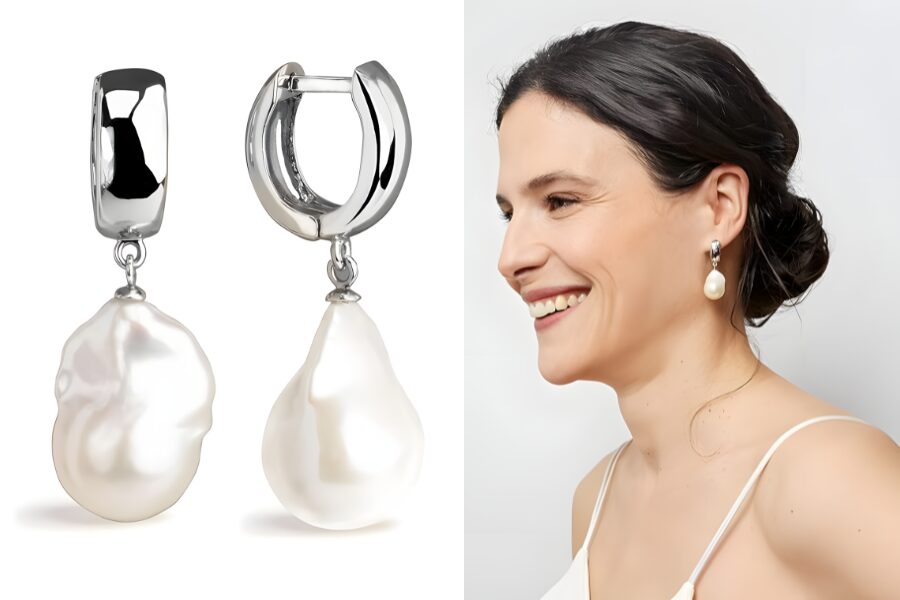
Large Baroque White Fresh Water
|
|
|
Click On The Image To See Why This Large Baroque White Fresh Water Pearl Earrings Stands Out! |
Rare and Revered Treasures
Because these shapes are so rare, they are highly sought after by collectors who value symbolic gems. You will often see them featured as the centerpiece of a pendant where their natural form can be fully appreciated. They offer a quiet, organic way to display your faith without relying on mass-produced metal charms. Owning one means carrying a piece of the ocean’s own devotion.
|
|
8.f) Rice PearlsBack To Top |
As evident from the name, Rice Pearls are small baroque pearls bearing close resemblance to grains of rice. They are round pearls that could not achieve perfection in shape. They are popularly drilled on their central axis and stringed together to fashion out baroque bracelets & baroque necklaces.
Tiny Grains of Luster
These pearls might be small, but they pack a significant visual punch when grouped together. You can see how their slightly elongated shape creates a textured look that round seeds can’t achieve. They represent a “near miss” in the world of round pearls, but their unique rice-like form is a victory for anyone who loves detail. Their delicate size makes them incredibly comfortable for long-term wear.
Classic Stringing Techniques
By drilling through the center, jewelers can create thick, lush strands that look like shimmering fabric. You can wrap these strands multiple times around your wrist or neck for a rich, layered effect. They are affordable enough to use in large quantities, allowing you to go for a high-volume look without breaking the bank. These pearls prove that even small imperfections can lead to a stunning final product.
|
|
8.g) Heart PearlBack To Top |
Heart Pearls are very special baroque pearls that have assumed the popular heart shape. They are very much in demand in the world of jewelry for making baroque pearl pendants with romantic overtones.
Nature’s Romantic Silhouette
You can find a sweet surprise in the way these pearls grow into a symbol of love. While a perfect heart shape is a rare gift from the sea, the soft curves of these gems create an unmistakable romantic vibe. You should look for the gentle indentation at the top that gives these pearls their identity. They offer a much softer and more organic feel than a machine-cut stone ever could.
Meaningful Gifts and Charms
Choosing a heart pearl tells a story of affection that is as unique as the gem itself. You can wear these as a single pendant to keep a sentimental reminder close to your chest. Because no two hearts are exactly the same, your piece of jewelry carries a one-of-a-kind message. They turn a simple accessory into a cherished token of a special bond.
|
|
8.h) Egg PearlsBack To Top |
These pearls are egg-shaped with wider bottom & narrower top. They are often drilled vertically to conserve and emphasize their inimitable shape.
Classic Ovoid Elegance
Egg pearls offer a sturdy and substantial look that feels great in your hand. You can easily distinguish them by their bottom-heavy shape, which provides a sense of stability and fullness. This silhouette is a favorite for those who want a bit of heft in their jewelry without the strictness of a perfect circle. They represent a classic bridge between traditional round pearls and the more extreme baroque shapes.
Bold Settings and Pendants
You can use the wider base of these pearls to create stunning focal points in your designs. They sit perfectly in a bezel setting or as the main drop on a heavy gold chain. Their smooth, curved surfaces provide a large canvas for light to dance across, showing off the quality of the nacre. Choosing an egg shape gives your jewelry a sense of heritage and timelessness.
|
|
8.i) Teardrop PearlsBack To Top |
As opposed to Egg Pearls these pearls feature very narrow bottoms & wide tops. This creates an amazing resemblance to tear drops. Teardrop pearls are delicate gems mainly used for adorning luxury-earrings.
Sophisticated and Fluid Lines
Teardrop pearls bring a sense of high-end drama to your jewelry collection. You will notice how the weight sits at the bottom, creating a graceful taper that mimics a falling drop of water. This symmetry makes them feel more balanced than other baroque types while keeping that natural, non-round edge. They catch the light beautifully as they sway, drawing attention to your jawline and face.
The Ultimate Choice for Drop Earrings
You can see why designers prioritize these shapes when they want to create elegant evening wear. The elongated form provides a sleek look that lengthens the neck and adds a touch of class to any outfit. Whether you choose a large statement pair or small delicate drops, these pearls stay securely in style. Their timeless appeal ensures they remain a staple in your jewelry box for a long time.
|
|
8.j) Leaf PearlsBack To Top |
Leaf pearls are wafer thin baroque pearls with uneven bumpy surfaces. They are used in an extensive array of jewelry ranging from bracelets to necklaces & earrings.
Botanical Beauty in Nacre
You might mistake these thin gems for actual foliage dipped in silver or gold. Their paper-thin profile and wavy edges give them a delicate, ethereal quality that stands out from thicker pearls. When you wear them, you carry a piece of the ocean that looks like it belongs in a forest. This crossover between sea and land creates a fascinating look for anyone who loves nature-inspired art.
Textures That Tell a Story
The uneven surface of a leaf pearl adds a layer of grit and realism to your jewelry. You can feel the ridges and dips that catch the light at different angles, making the pearl look alive. These textures ensure that your necklace or bracelet never looks flat or boring. They work best in designs that celebrate movement and organic imperfection.
|
|
8.k) Keshi PearlsBack To Top |
On rare occasions, the host mollusk rejects and expels the implanted nucleus. Yet the pearl sac may continue secreting nacre. When this happens, the resulting pearl forms without a bead nucleus and consists almost entirely of solid nacre. These are known as Keshi pearls.
We can make out that these are rare type of baroque pearls. Keshi pearls occur in a wide variety of colors and are evenly oriented. They appear elongated & display an astounding luster. The shiny luster makes these pearls ideal for jewelry and they remain in high demand.
The Happy Accidents of the Sea
You are looking at a gem that literally refused to follow the rules of farming. When the oyster spits out the man-made core, it decides to create something entirely out of its own essence. This makes Keshi pearls some of the most authentic cultured pearls you can own. Because they lack a solid center, they often grow into wild, flat, or flared shapes that defy explanation.
Unmatched Radiance and Glow
Since these pearls consist of nothing but solid nacre, their shine is often blinding. You get a deep, metallic luster that goes all the way through the stone. This poppy seed gem might be small, but its intense glow makes it a favorite for high-end designers. You can find them used in intricate clusters that sparkle like a galaxy of tiny stars.
|
|
9) Factors Determining Value Of a Baroque PearlBack To Top |
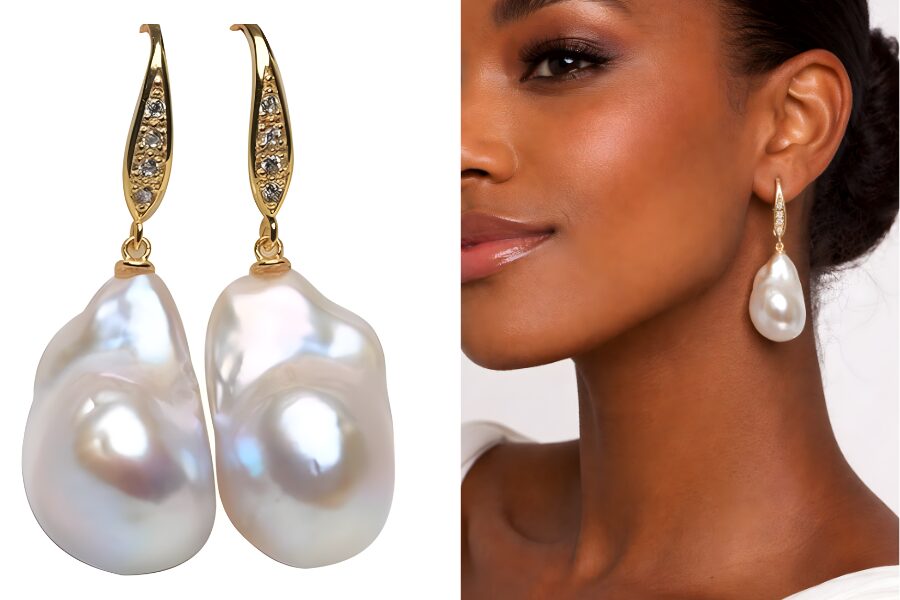
Baroque pearls vary widely in value depending on several quality factors. Unlike perfectly round pearls, their worth is not determined by symmetry alone. Instead, aspects such as shape, size, luster, surface quality, nacre thickness, and pearl type collectively influence pricing and desirability in the jewelry market.
Sterling Silver Zircon Inlaid Freshwater
|
|
|
Click On The Image To Reveal Full Specs And Shine Of This Sterling Silver Zircon Inlaid Freshwater Baroque Pearl Earrings! |
Breaking the Symmetry Mold
You might assume that a lack of perfect roundness makes a pearl cheap, but the opposite is often true in the modern market. Buyers today crave something that looks like it actually came from the ocean rather than a factory mold. While traditionalists stick to spheres, you can find incredible character in these uneven surfaces. This shift in taste means that personality often outweighs simple geometry when you look at a price tag.
Decoding the Pricing Puzzle
Pricing these gems feels like solving a mystery where every piece of the puzzle matters. You have to look at the whole picture to understand why one irregular bead costs more than a handful of others. It is a collective game of traits where a single stunning feature can elevate the entire piece. When you shop, remember that a high score in luster can sometimes make up for a smaller size.
|
|
9.a) Shape as a Value DriverBack To Top |
Shape is a significant factor affecting the evaluation of pearls. In case of traditional pearls higher value is attributed to the most well-rounded pearl. However, baroque pearls are irregular in shape. So, they are evaluated according to any specific shape they might have assumed. As discussed above, cross pearls command value for jewelry with religious connotations while heart shapes appreciate in value for jewelry with romantic overtones.
Identifying Intentional Silhouettes
You can find hidden stories in the way a pearl twists and turns during its growth. If a pearl accidentally resembles a recognizable object, its value shoots through the roof for niche collectors. A pearl that naturally mimics a teardrop or a bird wing becomes a tiny piece of organic sculpture. Your jewelry becomes much more than an accessory because it carries a shape that may never appear in nature again.
Cultivating Symbolic Worth
People love to attach meanings to the items they wear every day. You see this clearly when a pearl forms into a cross or a heart, creating an instant emotional bond. These “meaningful” shapes allow you to express your faith or your love through a lucky twist of biology. Because these occurrences are rare, you should expect to pay a premium for such specific symbolism.
|
|
9.b) Importance of Pearl OriginsBack To Top |
The type of a baroque pearl is also a key factor influencing its value. Since freshwater baroque occur in abundance, they are relatively less valuable. Baroque Akoya pearl is very valuable on account of its rarity.
Scarcity in the Saltwater Market
You need to understand that not all water is equal when it comes to pearl farming. Freshwater mussels are like overachievers, often producing dozens of pearls at a single time. This high volume keeps your costs down but also makes those pearls less exclusive. In contrast, saltwater oysters are much more stingy with their output, making their rare baroque creations highly coveted.
The Akoya Rarity Factor
Akoya pearls are famous for being round, so finding a baroque one is like finding a needle in a haystack. You are essentially buying a rare glitch in a system designed for perfection. Collectors jump at these because they offer the famous Akoya mirror-shine but with a rebellious, non-round attitude. Owning one means you have something that most traditional harvests try to avoid.
|
|
9.c) Scale and ImpactBack To Top |
Size is a common factor for evaluating both, the traditionally round pearls as well as the baroque pearls. Others factor remaining similar, a larger pearl is always more valuable than a smaller pearl.
Growing Against the Odds
Size matters because it proves the oyster survived and thrived for a long time. You can imagine the risks involved in keeping a mollusk healthy in the open sea for several years. A larger pearl is a trophy of endurance against predators and changing water temperatures. When you see a massive baroque pearl, you are looking at years of patient layers building up one by one.
Visual Presence on the Skin
Big pearls naturally grab more attention when you walk into a room. You get a much larger canvas for light to play across when the surface area increases. Because they are harder to find and take longer to grow, these giants command the highest prices in the shop. Smaller pearls might be delicate, but the big ones carry the real “wow” factor you might be looking for.
|
|
9.d) ColorBack To Top |
Once again, a vast variety of baroque pearls are white. Unusual or rare colors often command higher prices than common white varieties in certain markets. Pearls with high silvery overtones, pink, salmon and other dark colored pearls are more precious for the reason that they are rare.
Moving Beyond Basic White
While classic white pearls remain a staple, the rare hues are where the real excitement lives. You might find that a pearl with a deep salmon glow or a dark, moody tone stands out far more in your jewelry box. These colors occur less often in nature, making them a prize for anyone who wants to break away from the traditional look. Rare shades often reflect your unique personality better than a standard white bead.
The Allure of Silvery Overtones
Silver overtones can make a pearl look like it was dipped in liquid moonlight. You should look for that extra layer of color that sits on top of the main body shade. This secondary “overtone” adds depth and makes the gem look three-dimensional. Because these specific visual effects are difficult to find, they naturally pull a higher price from collectors who know what to look for.
|
|
9.e) LusterBack To Top |
A pearl’s luster is ascertained according to its ability to reflect light. Coin pearls are able to reflect more light because of their larger surface area making them more lustrous. Keshi pearls reflect more light due to their high nacre content. They are almost 100% nacre. Thus they are exceedingly lustrous. Consequently, they command value on the basis of this particular attribute.
Mastering the Mirror Effect
Luster is the heartbeat of a pearl, determining how much it truly shines when you wear it. You want a surface that acts like a mirror, reflecting your surroundings with sharp clarity. If the reflection looks blurry or dull, the pearl lacks the “inner fire” that makes high-quality gems so captivating. This glow is what separates a piece of fine jewelry from a simple costume bead.
The Brilliance of Keshi and Coin Shapes
Keshi pearls are basically solid gems of pure nacre, which is why they practically glow in the dark. Because they lack a centered bead, the light travels through them in a way that creates an intense, watery shimmer. Coin pearls also win the luster game by offering a wide, flat surface that catches every stray beam of light. You get a massive amount of “flash” for your money with these specific varieties.
|
|
9.f) Surface QualityBack To Top |
Flattened portions or abrasions on the surface of the pearl effect its quality and diminishes its value. Well rounded smooth surface on the other hand commands greater value.
Assessing the Exterior Texture
Even though you are buying a baroque pearl, you still want the surface to feel refined. Tiny scratches or flat spots can break the flow of light and make the pearl look damaged rather than artistic. You should run your eyes over the surface to ensure the imperfections look like natural “beauty marks” rather than ugly scars. A smooth, healthy-looking skin is a sign of a high-quality organic gem.
Valuing a Clean Finish
A clean surface tells you that the oyster was healthy and the water was clean during the growth cycle. While bumps and ridges are part of the baroque charm, you want those features to be glossy and polished. When the surface is smooth, the luster appears much stronger and more consistent. You will notice that the most expensive baroque pearls still maintain a certain silkiness to the touch.
|
|
9.g) Quality Of NacreBack To Top |
Nacre is the organic iridescent secretion of the mollusk that forms and coats the pearl. Quality of nacre is the most important value contributing factor of a pearl. Thick nacre having more depth and more solid nacre make a pearl more valuable.
Understanding the Organic Foundation
Nacre is the very soul of the pearl, built layer by layer over several years of growth. You are essentially looking at thousands of microscopic crystals stacked on top of each other to create that famous glow. If this coating is too thin, the pearl will look chalky and might even peel over time. High-quality nacre ensures that your investment stays beautiful for decades instead of fading away.
The Depth of a True Gem
Thick nacre gives a pearl a sense of inner depth that you can almost see into. This “solid” quality is what gives the pearl its weight and its ability to handle everyday wear. You want a pearl that feels substantial and looks like the color goes all the way to the core. This depth is the ultimate mark of a luxury pearl that was given enough time to reach its full potential.
|
|
10) Baroque Pearls in the Renaissance EraBack To Top |
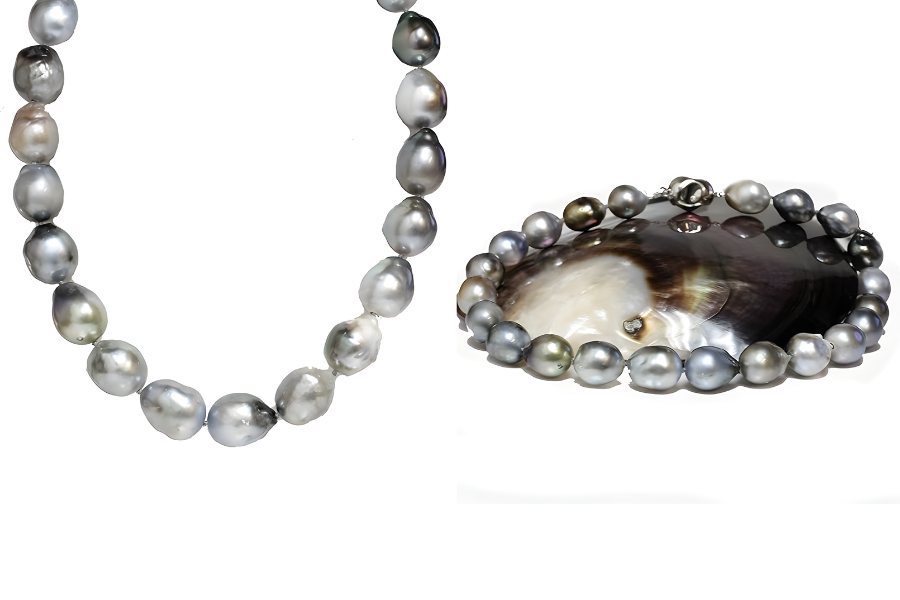
Baroque pearls were greatly treasured by jewelers of the Renaissance era. They viewed these pearls as extraordinary gems of exquisitely unique shapes. They arranged baroque pearls into forms of mythical figures in jewelry pieces.
Diamond Tahitian South Sea
|
|
|
Click On The Image To Discover Why This Diamond Tahitian South Sea Baroque Pearl Necklace Is A Top Pick! |
Artistic Vision of the Renaissance
You can imagine how the master jewelers of the 15th to 17th centuries looked at these irregular gems with absolute wonder. While modern tastes sometimes lean toward perfection, these historical artisans saw endless possibilities in a single lumpy pearl. They believed that the natural shape of the stone should dictate the final piece of art. This approach turned every necklace and pendant into a miniature sculpture that no one else could own.
Breathing Life into Mythical Figures
Imagine a pearl so perfectly irregular that it looks like the curved back of a dragon or the rounded belly of a sea creature. You see this creative spark in how they transformed organic shapes into legendary characters from ancient stories. These designers did not try to hide the bumps or ridges; instead, they highlighted them to give their gold-worked figures a realistic, three-dimensional feel. Each piece became a small, wearable window into a world of myth and magic.
The Legend of the Canning Jewel
One such excellent exhibit is a piece believed to be from the sixteenth century. It is well-known as the Canning Jewel and can be found today in Victoria & Albert Museum in London. The Canning Jewel is a sculptural pendant characteristic of the Renaissance period that lasted from the 15th to 17th centuries AD. A large centerpiece baroque pearl forms the torso of a merman sea-figure. It has the body of a man and the tail of a fish. The figure is elaborately mounted in enameled gold set with pearls, table-cut diamonds & Indian rubies.
Craftsmanship and Regal Materials
You should take a close look at the staggering level of detail found in these historical masterpieces. The way the merman’s torso flows naturally into a shimmering fish tail shows the incredible skill of the goldsmiths. By surrounding the central pearl with precious rubies and diamonds, they elevated the irregular gem to a status of pure royalty. This combination of natural ocean beauty and intense human craft creates a powerful visual impact that still draws crowds in museums today.
Timeless Choice for Connoisseurs
Baroque pearls are among the most intriguing organic gems available in the world of jewelry. They make a great choice for connoisseurs who appreciate uniqueness in their gems. Moreover, these free form gems allow jewelry designers an untamed expression of creativity. The pearls remain highly sought after for their distinctive shapes & colors.
Embracing Untamed Creativity
You can find a sense of freedom when you choose a gem that refuses to follow a standard pattern. Because these pearls do not come from a factory mold, they offer a rebellious beauty that round beads simply cannot match. You get to wear a piece of history and nature combined into one striking accessory. Your jewelry becomes a conversation starter that celebrates your eye for rare and distinctive character.
|
|
11) Caring for Your Baroque PearlsBack To Top |
You must treat these organic treasures with specific attention to maintain their radiant glow. Proper maintenance ensures your unique gems remain as luminous as the day you bought them. Following a few simple steps will protect the delicate nacre from environmental damage and wear.
|
|
11.a) Daily Wear Habits for LongevityBack To Top |
Adopting a smart routine prevents harmful chemicals from touching the porous surface of your pearls. You should always consider how your daily beauty products interact with these sensitive saltwater and freshwater gems. Making small changes to your dressing habits saves the luster from fading prematurely.
The Gold Standard of Dressing
You should always follow the golden rule of jewelry: make your pearls the last thing you put on and the first thing you take off. This simple habit keeps your gems away from a direct hit of hairspray, perfume, or makeup. These common beauty products contain acidic elements that slowly eat away at the calcium carbonate in the nacre. By waiting until your perfume dries, you create a safe environment for your jewelry to shine. When you return home, remove your necklace or earrings before starting your skincare routine to keep them pristine.
Managing Moisture and Sweat
While pearls grow in water, they do not enjoy a trip to the shower or the local swimming pool. Chlorine acts like a harsh bleach that strips away the natural oils and “orient” of the stone. You also want to avoid wearing them during a heavy workout because your sweat is naturally acidic. If you do notice a bit of moisture on them, a quick wipe with a soft cloth does wonders. Think of your pearls as a delicate silk dress that prefers a dry, controlled climate rather than a humid bathroom.
|
|
11.b) Safe Storage SolutionsBack To Top |
Giving your pearls a dedicated home prevents physical damage from harder stones in your collection. You need to remember that pearls are quite soft compared to diamonds or sapphires. Storing them correctly maintains their structural integrity and keeps the surface free of unsightly scratches.
Separation in the Jewelry Box
You should never toss your baroque pearls into a crowded pile with your metal chains and diamond rings. Because pearls sit low on the Mohs scale of hardness, a stray diamond edge can easily gouge deep marks into the smooth nacre. Use a separate compartment or a soft silk pouch to keep them isolated and cozy. This individual attention prevents the “rubbing” effect that dulls the surface over time. If you treat them like the VIPs of your jewelry box, they will reward you with a lifetime of brilliance.
Breathable Environments
Pearls actually need a tiny bit of moisture from the air to stay healthy and hydrated. You should avoid keeping them in airtight plastic bags or safety deposit boxes for years without a break. If the environment becomes too bone-dry, the nacre might become brittle and start to crack or “craze” on the surface. Wearing them regularly allows them to absorb a small amount of natural oils from your skin, which keeps the glow alive. Just remember to give them a gentle wipe before tucking them back into their breathable cloth home.
|
|
12) Baroque Pearls FAQBack To Top |
|
|
12.a) Are Baroque Pearls Real Pearls?Back To Top |
Yes. Baroque pearls are real pearls. “Baroque” only describes the irregular, non-round shape, not whether the pearl is genuine.
|
|
12.b) What Does “Baroque” Mean for Pearls?Back To Top |
In pearls, “baroque” means the shape is irregular rather than perfectly round. You’ll see free-form, lumpy, oval, drop-like, or abstract silhouettes.
|
|
12.c) Are Baroque Pearls Worth Anything?Back To Top |
Yes, they can be valuable. Price depends on luster, size, nacre quality, surface condition, color, overtone, and the type of pearl (for example, South Sea and Tahitian can command higher prices).
|
|
12.d) Are Baroque Pearls Cheaper Than Round Pearls?Back To Top |
Often, yes, because perfectly round pearls are rarer and graded more strictly. But top-quality baroque pearls with high luster, great nacre, and desirable color can still be expensive.
|
|
12.e) How Can You Tell if a Baroque Pearl Is Real?Back To Top |
Look for depthy luster (not flat shine), natural surface texture, and clean drill holes. If you want certainty, a jeweler or gemologist can verify using magnification and, if needed, imaging.
|
|
12.f) Can a Jeweler Tell if My Baroque Pearls Are Real?Back To Top |
Yes. A professional can inspect surface features under magnification and check clues like drill-hole edges, coating separation, and luster behavior. For higher-value pieces, lab-style testing can confirm structure.
|
|
12.g) Can You Shower With Baroque Pearls?Back To Top |
It’s better not to. Soap, shampoo, and hot water can dull luster over time, and repeated exposure can weaken stringing. Put pearls on last and take them off first.
|
|
12.h) How Do You Clean Baroque Pearls?Back To Top |
Wipe them with a soft, slightly damp cloth after wearing. Avoid ultrasonic cleaners, steam, harsh detergents, and abrasive brushes.
|
|
12.i) Where Are Baroque Pearls Found?Back To Top |
Baroque pearls can occur in both freshwater and saltwater pearls. You’ll commonly see them in freshwater pearls, Tahitian pearls, South Sea pearls, and even Akoya pearls.
|
|
12.j) What Do Baroque Pearls Symbolize?Back To Top |
Many people associate baroque pearls with individuality and “beauty in imperfection.” Their one-of-a-kind shapes make them popular for artistic, statement-style jewelry.
See More Articles About Pearls As Follows:
| Pearls | Baroque Pearls |
| Akoya Pearls | South Sea Pearls |
| Tahitian Pearls |