An omega chain is a structured necklace made from small metal plates fitted closely together over a flexible wire or mesh core. Its smooth surface creates a continuous look, while its construction helps it hold a rounded shape around the neck. Unlike a freely draping link chain, an omega necklace has limited flexibility.
Omega chain necklaces come in flat, domed and round profiles, with options in yellow gold, white gold and sterling silver. Some designs are reversible, offering a different finish on each side. You can wear one alone or pair it with a compatible pendant, provided the pendant’s opening fits the necklace and its end fittings.
Before choosing an omega chain, consider its width, length, construction and care requirements. Its polished appearance is appealing, but sharp bends can damage its shape. This guide explains the main styles, compares omega chains with snake and herringbone chains, and covers buying and care considerations.

|
1) What Is an Omega Chain?Back To Table Of Contents |
An omega chain is a necklace formed from closely arranged metal plates supported by an inner wire or woven mesh. These plates create the appearance of a continuous chain. However, its construction differs from a traditional link chain, whose individual links interlock.
The plates sit side by side and run across the necklace’s width. In a typical mesh-backed design, they are crimped around the underlying support. This arrangement produces a smooth, reflective surface with limited flexibility. As a result, the necklace follows a structured curve around the neck rather than hanging freely like a cable chain.

|
1.a) How Omega Chains Are ConstructedBack To Table Of Contents |
To construct a typical omega necklace, manufacturers first create an inner support from woven metal mesh or wire. They then fit small metal plates closely together around that support. In mesh-backed designs, crimping secures the plates to the core. The finished necklace can follow the curve of the neck, although its construction limits how freely it bends.
Omega necklaces are available in precious metals such as sterling silver, yellow gold, rose gold and white gold. Flat, domed and round profiles describe the necklace’s cross-sectional shape. These profiles affect its appearance, but the underlying construction remains the key feature to check when identifying an omega chain.
|
|
1.b) Why They’re Called “Pseudo” ChainsBack To Table Of Contents |
Omega necklaces are sometimes described as “pseudo chains” because their outer plates resemble a chain without forming a series of interlocking links. Instead, an inner wire or mesh supports those plates. The term distinguishes this construction from that of a conventional link chain.
Here, “pseudo” does not mean counterfeit jewelry or imitation metal. An omega necklace can be made from genuine gold or sterling silver. Its metal content and construction are separate characteristics, so check the product specifications for both.
|
|
1.c) Are Omega Chains Stronger Than Link Chains?Back To Table Of Contents |
Not necessarily. An omega chain’s structured appearance does not establish that it has greater tensile strength than a link chain. A fair comparison requires details about the individual necklaces, including their metal, dimensions, construction and condition. Width alone is not a reliable measure of strength.
Also, resistance to pulling and resistance to bending are different properties. An omega necklace has limited flexibility, so its substantial appearance should not be taken as permission to twist or fold it. If you plan to add a pendant, ask the jeweler whether that particular necklace can support it safely.
|
|
1.d) Flexibility vs. DurabilityBack To Table Of Contents |
An omega chain’s limited flexibility makes careful handling important. Forcing it into a sharp bend or twisting it can cause a kink. Depending on the damage, a jeweler may be unable to restore its original shape.
Remove the necklace before sleeping, exercising or doing physical work that could catch or compress it. Also, watch for snags when changing clothes. Store it flat in its natural curve, with enough room to avoid folding it. These precautions reduce the risk of damage, although they cannot guarantee a particular lifespan.
|
|
1.e) Why Omega Chains Are More Expensive Jewelry PiecesBack To Table Of Contents |
Omega necklaces can be expensive because their price reflects both the precious metal they contain and the work involved in making them. However, the omega design alone does not mean a necklace will cost more than every other chain style.
When comparing prices, check the metal, gold karat where applicable, weight, length and width. A wide appearance does not tell you how much precious metal a necklace contains. Compare the listed specifications rather than judging value by appearance alone.
|
|
1.f) Reflective Surface and Eye-Catching ShineBack To Table Of Contents |
An omega chain’s closely arranged metal plates create a broad reflective surface. A polished finish enhances this effect, giving the necklace an eye-catching shine. However, the appearance depends on the individual design and finish, so not every omega necklace has the same mirror-like look.
|
|
1.g) Flat, Dome, and Round Omega VariantsBack To Table Of Contents |
Flat, domed and round describe an omega necklace’s cross-sectional profile. A flat design has a broad, flattened profile. A domed or half-round design has a curved upper surface and a flatter underside, while a round design has a circular cross-section. These terms describe the chain itself, rather than its overall shape around the neck.
Widths vary by design. Check the listed width and thickness separately, as a broad, flat necklace can be relatively thin. Also, retailers sometimes use “omega” and “snake chain” interchangeably, so inspect the product description and photographs rather than relying on the name alone.
|
|
1.h) Collar Necklaces: A Bold Omega Chain StyleBack To Table Of Contents |
An omega collar necklace creates a structured curve close to the neck. A broad, polished design can serve as the main jewelry piece in an outfit, particularly with an open neckline that leaves the necklace visible. Narrower designs offer a more understated version of the same look.
Check the fit rather than choosing by length alone, as the necklace’s shape also affects how it sits. You can wear it without a pendant to highlight its clean outline. If you prefer a pendant, confirm that its bail and weight suit the particular necklace.
|
|
1.i) Statement Bracelets with Omega DesignBack To Table Of Contents |
Omega-style bracelets bring the necklace’s broad, closely arranged segments to the wrist. A wider design can serve as a statement piece on its own, while a narrower bracelet offers a subtler look. Finishes include polished surfaces and combinations of textured and polished details.
When choosing one, check its length, width, metal description and clasp. For example, gold over sterling silver differs from gold alloy throughout the piece. Also, try the bracelet on if possible to assess how comfortably its shape sits around your wrist.
|
|
1.j) Reversible Omega Chains: Dual Style in OneBack To Table Of Contents |
A reversible omega necklace offers a different color or finish on each side, giving you two looks in one piece. For example, some designs pair a sterling silver side with yellow gold over sterling silver on the reverse. Check the metal description carefully, as the surface color alone does not identify the underlying metal.
|
|
2) The Allure of Omega Chain NecklacesBack To Table Of Contents |
Omega chain necklaces appeal to those who prefer a smooth, structured outline over the visible links of a traditional chain. Their clean lines can bring an elegant touch to an outfit, whether you choose a narrow, understated necklace or a wider statement piece.
|
|
2.a) Clean Lines, High ShineBack To Table Of Contents |
A polished omega necklace offers a smooth, continuous look with little visual interruption between its closely arranged plates. For styling, let that clean outline take the lead: wear it against a plain neckline for a simple, uncluttered effect. A narrower design provides a subtle accent, while a broader necklace makes the reflective surface more prominent.
|
|
2.b) Versatility with Pendants and GemstonesBack To Table Of Contents |
An omega necklace can be worn alone or paired with a compatible pendant, including one set with a gemstone. Check that the bail, the opening through which the necklace passes, accommodates both the chain’s profile and any end fitting it must pass over. Fit alone is not enough: ask the jeweler whether the pendant’s weight suits that particular necklace.
Two Tone Reversible Omega Chain Necklace In 14k Yellow Gold And Sterling Silver, 4mm |

|
| Click on the Image |
|
|
2.c) A Comfortable Fit for Daily WearBack To Table Of Contents |
An omega necklace can feel comfortable when its length, weight and curved shape suit the wearer. If possible, try it on and turn your head to check for pressure or rubbing. For daily wear, consider your activities as well as the fit. Its limited flexibility means you should remove it before sleeping, exercising or doing work that could catch or sharply bend it.
|
|
2.d) A Timeless Addition to Any Jewelry BoxBack To Table Of Contents |
An omega necklace can become a lasting part of your wardrobe if its clean, structured style suits your taste. Whether you prefer the cool appearance of white gold or the warm tones of rose gold, choose a finish that works with jewelry and clothes you already enjoy wearing. That personal fit matters more than a promise that any design will never go out of fashion.
|
|
3) Omega Chains vs. Snake Chains: What’s the Difference?Back To Table Of Contents |
The main difference between omega chains and snake chains is how their metal segments connect. An omega chain typically has closely arranged plates supported by an inner wire or mesh. A snake chain generally has closely joined, curved metal segments without that supporting core, allowing greater flexibility. Both can look smooth and continuous, so a flat or round profile alone does not reliably distinguish them.
|
|
3.a) Link Design and StructureBack To Table Of Contents |
Traditional snake chains have tightly joined, slightly curved metal plates or bands that create a subtle zigzag pattern resembling snakeskin. Some manufacturers also produce seamed snake chains by compressing a curb-style chain. In a typical mesh-backed omega necklace, small metal plates sit side by side and are crimped around the mesh support. These different methods help explain why similar-looking necklaces can behave differently when worn.
Italian 8mm 18kt Gold Over Sterling Omega Necklace. 16 inches |

|
| Click on the Image |
|
|
3.b) Fashion Flexibility And PersonalizationBack To Table Of Contents |
Choose an omega chain if you prefer a structured, collar-like outline, or a snake chain if you want a more fluid drape. Either style can complement a gemstone pendant when the necklace and pendant are compatible. A larger gemstone does not automatically make an omega chain the better choice: check the complete pendant’s weight and bail clearance. Reversible omega designs offer another styling option, with a different color or finish on each side.
|
|
3.c) Which One Is More Durable?Back To Table Of Contents |
Neither omega nor snake chains are universally more durable. Compare the individual necklaces’ metal, dimensions, construction and condition. An omega’s structured appearance does not make it damage-proof, while a snake chain’s greater flexibility does not mean it can withstand sharp folds.
Both styles can kink if bent or handled carelessly. Store each necklace separately without folding or crushing it, and follow the maker’s care instructions. Also, check that the clasp closes fully and that its connecting fittings are secure. Clasp condition and suitability matter more than choosing by clasp name alone.
|
|
Omega Chain vs Herringbone Chain: Key Differences ExplainedBack To Table Of Contents |
The main difference between an omega chain and a herringbone chain is their construction. A typical omega necklace has metal plates crimped around a mesh support, giving it a structured curve with limited flexibility. A herringbone chain has rows of flat, V-shaped links arranged in alternating directions, creating a more fluid drape. Both need careful handling, as flexibility does not protect a necklace from sharp bends or kinks.
| Feature | Omega Chain | Herringbone Chain |
|---|---|---|
| Construction | Closely arranged metal plates over an inner mesh or wire support | Rows of flat, V-shaped links arranged in alternating directions |
| Drape and flexibility | Structured curve with limited flexibility | Flat profile with a more fluid drape |
| Handling | Avoid twisting, crushing or forcing into sharp bends | Avoid twisting, crushing or folding despite its greater flexibility |
| Styling effect | A defined, collar-like outline | A flat, ribbon-like appearance |
|
|
4) What Makes an Omega Chain Unique?Back To Table Of Contents |
An omega chain combines a continuous-looking surface with a structured curve around the neck. Its distinctive feature is the plate-and-core construction described earlier. This affects both how the necklace looks and how it moves, making fit and careful handling important.
|
|
4.a) Mirror-Like Surface for EleganceBack To Table Of Contents |
A highly polished omega necklace can have a mirror-like sheen across its closely arranged plates. However, shine alone does not identify the style: snake chains and herringbone chains can also have bright, reflective finishes. Look at the construction and profile as well as the surface polish.
|
|
4.b) How Omega Chains Drape DifferentlyBack To Table Of Contents |
An omega necklace generally follows a defined curve rather than falling into the loose drape of a flexible link chain. Its length and shape therefore work together to determine where it sits. When trying one on, check that it follows your neckline comfortably without pressing against your neck or lifting awkwardly as you move.
|
|
4.c) Tangle-Free GeometryBack To Table Of Contents |
“Tangle-free” should not be treated as a guarantee. An omega necklace’s structured form does not prevent it from catching on other jewelry or being twisted during handling. Also, a kink is different from a loose knot: bending the necklace too sharply can damage its shape. Store it separately in its natural curve rather than folding it into a small space.
|
|
5) Design Details That Set Omega Necklaces ApartBack To Table Of Contents |
An omega necklace’s defining design detail is its closely arranged metal plates over an inner wire or mesh support. Together, these components create a continuous-looking surface and a structured outline. A polished finish can give the plates a mirror-like sheen, although omega necklaces also vary in profile and surface finish.
For a direct breakdown of structure and flexibility, see the omega chain vs herringbone comparison.
This construction helps the necklace follow a defined curve around the neck rather than draping freely like a flexible link chain. Width, thickness and length all affect the finished look and fit. Check these measurements separately when comparing designs, and remember that a structured shape still needs protection from twisting, crushing and sharp bends.
|
|
5.a) Metals That Maximize Shine: Silver, Gold, StainlessBack To Table Of Contents |
The metal influences an omega necklace’s color, while its surface finish helps determine its shine. Sterling silver offers a bright, silvery appearance and contains 92.5% silver. The terms “sterling silver” and “925 silver” describe the same silver content; an Italian origin does not indicate a different purity. For a warmer color, yellow gold options include 14K and 18K alloys.
Check whether a gold-colored necklace is gold throughout or has a gold coating over silver or another metal. Two-tone colors alone do not reveal its construction. For stainless steel options, check the grade and any coating in the product specifications. Stainless steel resists corrosion, but it still needs cleaning and careful handling. No metal choice makes an omega necklace immune to bending damage.
| 14K Yellow Gold 8mm Lightweight Domed Omega Bracelet |
|---|

|
| Click on the Image |
|
|
5.b) Gold Overlays, Two-Tone Designs, and Italian CraftsmanshipBack To Table Of Contents |
A gold layer can give an omega necklace a warm yellow appearance while another metal forms the underlying body. However, “gold overlay” and “gold electroplating” describe different application methods. Overlay refers to a mechanically applied gold-alloy layer; electroplating deposits gold through an electrolytic process. A description such as “gold over sterling silver” identifies the underlying silver but does not, by itself, establish how the gold was applied.
Two-tone omega necklaces combine contrasting colors, such as yellow and white. Some are reversible, with a different color or finish on each side, while others display both tones together. Check the specifications to distinguish gold alloys from gold coatings rather than judging metal content by color alone.
Italian-made omega necklaces include polished and reversible designs. Still, an Italian origin alone does not establish metal purity, handmade production or superior durability. Assess the individual piece’s specifications, finish, plate alignment and clasp rather than relying on its country of manufacture.
|
|
5.c) Behind the Scenes: Expert Crafting TechniquesBack To Table Of Contents |
In a typical mesh-backed omega necklace, the maker aligns small metal plates side by side and crimps them around the underlying support. This assembly creates the closely fitted surface while allowing limited movement. The necklace’s structured form is part of its design, so greater flexibility alone is not a sign of better craftsmanship.
When assessing the finished piece, look for evenly arranged plates, a consistent finish and neatly fitted end connections. Ask the jeweler to examine any sharp edges, unusual gaps or areas that catch during normal handling. Avoid bending the necklace sharply to test its flexibility.
Decorative patterns, contrasting finishes and compatible slide pendants can personalize the design. However, these features are separate from the underlying construction. If the necklace includes an extender or you plan to add a slider, confirm its fit and suitability with the maker rather than assuming the accessory works with every omega chain.
|
|
6) Choosing the Right Metal: Yellow Gold, Silver, or White Gold?Back To Table Of Contents |
Choose your omega necklace’s metal by balancing color, budget and maintenance needs. Like choosing a watch strap, the decision depends on both your taste and how you plan to wear it. Yellow gold offers a warm tone, while sterling silver and white gold provide silvery alternatives with different compositions and care requirements.
For gold omega necklaces, compare the karat as well as the construction. Both 14K and 18K are options, but neither guarantees resistance to dents or kinks. Yellow, rose and white gold get their different colors from their alloy mixtures. White gold often has rhodium plating for a brighter white finish. This coating can wear over time, so ask whether the necklace is plated and what maintenance the jeweler recommends.
|
|
6.a) When to Choose 14K or 18K GoldBack To Table Of Contents |
Choose 14K gold if you prefer a lower gold content and want to compare options within a tighter budget. Choose 18K if higher gold content matters more to you. Fourteen-karat gold contains about 58.3% gold, while 18K contains 75%. For otherwise comparable necklaces, the additional gold generally increases the metal cost.
In yellow gold, 18K often has a richer yellow color, although the exact shade depends on the alloy. Do not use karat alone to judge scratch or dent resistance: alloy composition, manufacturing and necklace construction also matter. Neither karat makes an omega chain safe to twist or sharply bend. Compare the actual pieces for fit, finish and care requirements rather than treating 14K as exclusively for daily wear or 18K as only for special occasions.
|
|
6.b) How About Sterling SilverBack To Table Of Contents |
Sterling silver is worth considering if you want a silvery finish at a generally lower price than a comparable gold omega necklace. It contains 92.5% silver, with other metals added to improve strength. However, the metal alone does not determine durability. An omega chain’s construction still calls for careful handling.
Sterling silver can tarnish, so expect occasional cleaning to maintain its appearance. Ask whether the necklace has plating or a protective coating before choosing a polish or cleaning product. Follow the maker’s care instructions, especially for coated or matte finishes.
|
|
6.c) Sterling Silver vs. White GoldBack To Table Of Contents |
Sterling silver and white gold offer similar silvery tones, but they differ in price, composition and upkeep. Sterling silver generally costs less than a comparable white gold necklace, although it can tarnish. White gold often has rhodium plating for a bright white finish. That coating can wear over time and may need renewing.
For an omega chain, compare the actual construction as well as the metal. Scratch resistance depends on the alloy and surface finish, while resistance to bending also depends on the necklace’s design. Neither metal guarantees lasting shine or protection from kinks. Choose according to your budget, preferred finish and willingness to maintain the piece.
|
|
6.d) How Each Metal Affects Durability and ShineBack To Table Of Contents |
An omega chain’s durability depends on its alloy, construction and handling, while its shine also depends on the surface finish. A higher karat means more gold, but it does not guarantee a brighter polish. Likewise, choosing 14K gold alone does not ensure resistance to scratches, dents or kinks.
The metals also have different maintenance needs. Sterling silver can tarnish and may need suitable cleaning to restore its shine. Rhodium-plated white gold can lose some of its bright white appearance as the coating wears. Yellow gold has no white rhodium coating to maintain, although its surface can still develop scratches and lose polish.
Before buying, ask about the necklace’s alloy, any surface coating and the recommended care. Compare the condition of the plates, end connections and clasp as well. For an omega chain, careful handling matters whichever metal you choose.
|
|
6.e) Match Metal with Lifestyle and WardrobeBack To Table Of Contents |
Choose a metal that suits your wardrobe, budget and care routine. Start with the jewelry you already enjoy wearing. Yellow gold can echo warm-toned accessories, while sterling silver or white gold can complement a silvery watch or ring. Mixing metal colors is also an option, so treat these combinations as starting points rather than rules.
Try the necklace with your usual shirts and necklines before deciding. Check how its color, width and finish look together. Then consider whether you are comfortable with the maintenance discussed above. The best match is a piece you enjoy wearing and can care for consistently.
|
|
7) Spotlight: 14K Gold Omega Chain NecklacesBack To Table Of Contents |
These examples show different widths, profiles and finishes in 14K gold omega necklaces. Compare their fit, weight and construction as well as their appearance. The 14K designation describes gold content; it does not guarantee resistance to bending or kinking.
Omega Chain Necklace in 14K Yellow Gold
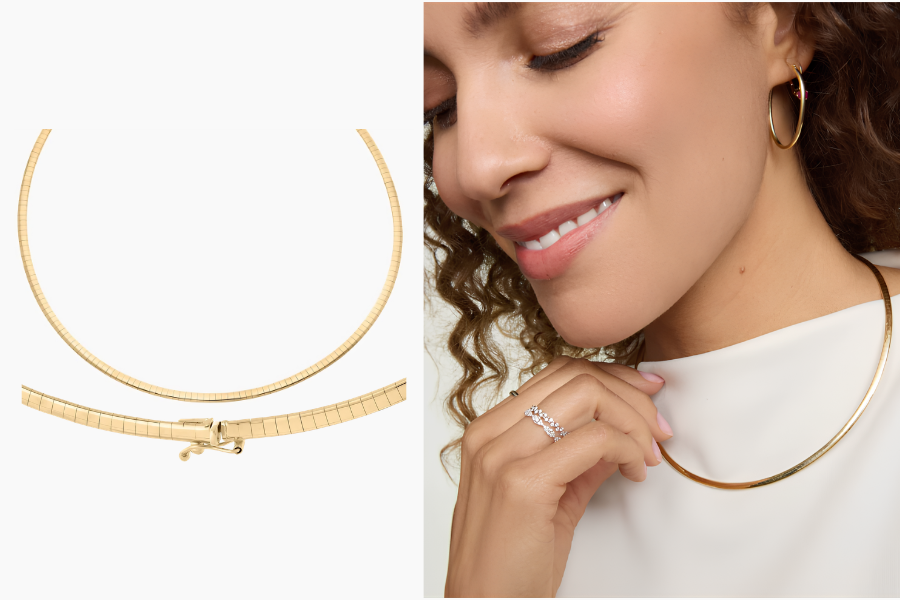
Blue Nile lists this omega necklace in 14K yellow gold with a width of 3.20 mm.
Omega Chain Collar Necklace in 14K Yellow Gold
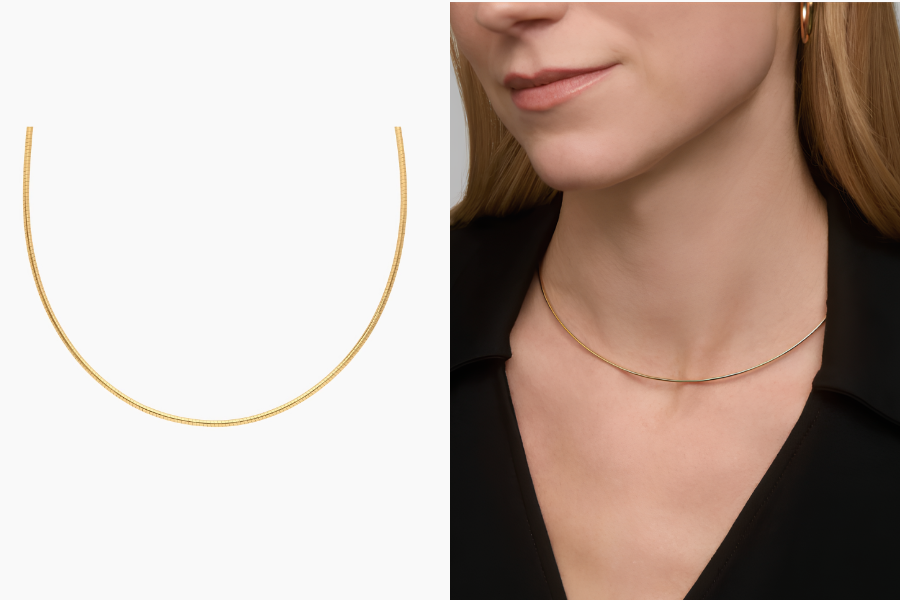
Blue Nile lists this omega chain collar necklace in 14K yellow gold with a width of 1.5 mm.
14K Omega Necklace List
14K Yellow Gold 8mm Lightweight Domed Omega NecklaceBack To 14K Omega Necklace List |

|
14K Gold 10mm Domed Omega NecklaceBack To 14K Omega Necklace List |

|
14K Two-Tone Gold Polished 6.1mm Reversible Omega NecklaceBack To 14K Omega Necklace List |

|
|
|
8) Spotlight: Sterling Silver Omega NecklacesBack To Table Of Contents |
Sterling silver omega necklaces offer a silvery finish and generally cost less than comparable gold pieces. This selection includes a silver-colored design and a gold-over-sterling option. The latter has a gold surface over a sterling silver base, rather than gold alloy throughout.
Compare each necklace’s dimensions, construction and finish before choosing. If you plan to add a pendant, ask whether the necklace can support it and whether the bail will fit. Cleaning requirements also depend on any plating or protective coating.
Sterling Silver Omega Necklaces List
925 Sterling Silver 8mm Cubetto Omega Chain NecklaceBack To Sterling Silver Omega Necklaces List |

|
Italian 8mm 18kt Gold Over Sterling Omega NecklaceBack To Sterling Silver Omega Necklaces List |
|
|
|
|
9) Spotlight: White Gold Omega ChainsBack To Table Of Contents |
White gold omega necklaces offer a silvery alternative to yellow gold. The examples below show different widths and profiles, giving you a starting point for comparing a narrower necklace with a broader domed design.
Check the stated gold purity and ask whether the necklace has rhodium plating. If it does, the coating may need renewing as it wears. Compare fit, weight and construction too, since a white finish alone tells you little about comfort or durability.
White Gold Omega Chain List
3mm White Gold Omega Chain NecklaceBack To White Gold Omega Chain List |

|
14K White Gold Polished 8mm Solid Domed Omega NecklaceBack To White Gold Omega Chain List |

|
|
|
10) Why Choose an Omega Chain NecklaceBack To Table Of Contents |
Choose an omega chain necklace if you enjoy a smooth surface and a structured neckline. Its appeal lies in the combination of shape, finish and styling options. Consider the fit and care requirements too, so the necklace suits how you plan to wear it.
|
|
10.a) Style Flexibility from Casual to FormalBack To Table Of Contents |
An omega necklace can work with both casual and formal outfits. Try a narrower design with an open-neck shirt or a plain tee for a subtle accent. For a stronger focal point, wear a broader or highly polished necklace on its own against a simple neckline.
Let the overall look guide your choice rather than reserving gold for evenings or silver for casual wear. Both can suit either setting. If you prefer layering, try different lengths so each necklace has space to sit comfortably. Check that the pieces do not catch on or press against one another.
|
|
10.b) Flip-Side Design Adds More ValueBack To Table Of Contents |
A reversible omega necklace offers two wearable looks in one piece. Depending on the design, the sides may differ in color, texture or polish. For example, you might choose a yellow gold tone for one outfit and a silvery finish for another. The added value is styling choice, rather than a guarantee of higher resale value.
Check that the seller explicitly describes the necklace as reversible. A two-tone design does not necessarily offer a different wearable finish on each side. Also confirm the underlying metals and any coatings, since appearance alone cannot tell you the composition.
Italian 18kt Gold Over Sterling Omega Bracelet, 8 Inches |

|
| View Gold Over Sterling Omega Bracelet on Amazon |
|
|
10.c) Omega Chains Feel as Good as They LookBack To Table Of Contents |
A well-fitting omega necklace can feel comfortable, but its smooth appearance does not guarantee a comfortable fit. Length, width, weight and profile all affect how it rests against your neck. An 18-inch necklace, for example, will sit differently on different wearers.
Try the necklace on and move your head and shoulders normally. Check for pressure points, pinching or edges that catch on clothing. Omega chains generally have a more structured shape and less flexibility than snake chains, so choose one that fits naturally rather than trying to bend it into place.
|
|
10.d) Lightweight Yet BoldBack To Table Of Contents |
Some omega necklaces offer a broad, eye-catching surface without feeling especially heavy. However, omega chains are not automatically lightweight. Their weight varies with the metal, length, width, thickness and construction. Ask for the weight in grams rather than judging it from a photograph or the word “lightweight.”
If you want a bold look with less weight, compare pieces of similar width and try them on where possible. Lower weight alone does not tell you how well a necklace will resist damage. If you need an extender, ask the jeweler whether one is compatible with the clasp and how it will affect the fit.
|
|
11) Caring for Your Omega Chain NecklaceBack To Table Of Contents |
Care for an omega necklace by protecting its shape and choosing cleaning methods suited to its materials. Avoid sharp bends, twisting and crushing. Before cleaning, check the maker’s instructions for the metal, any surface coating and any gemstones.
|
|
11.a) At-Home Cleaning TipsBack To Table Of Contents |
For routine care, gently wipe the necklace with a clean, soft, lint-free cloth. Support its natural curve while you work, rather than pulling it straight or rubbing it between your fingers. If the maker permits washing, use lukewarm water with a little mild soap, rinse carefully and pat dry. Let it dry fully before storing.
Do not assume that soaking or a jewelry polishing cloth is suitable for every omega chain. Polishing products can wear coatings or alter a matte finish. For tarnished sterling silver, ask which cleaner is appropriate for the necklace’s finish. If it has gemstones, their identity and treatments determine safe cleaning methods. A cabochon describes a cut, not a gemstone material.
Avoid abrasive household cleaners and vigorous scrubbing. Use ultrasonic or steam cleaning only if a jeweler confirms that the entire piece is suitable. If you notice loose plates, a kink or a damaged clasp, stop cleaning and have the necklace inspected.
14K Yellow Gold Polished 14.7mm Omega Chain Bracelet for Women |

|
|
|
11.b) Maintenance and Yearly InspectionsBack To Table Of Contents |
Check your omega necklace regularly for displaced plates, unusual gaps, sharp edges or wear around the clasp and end connections. Apply perfume and hairspray before putting it on, and keep it away from household cleaning chemicals. For reversible designs, check both surfaces for changes in the finish.
A yearly inspection by a jeweler is a useful starting point. Ask whether your wearing habits or the necklace’s condition call for more frequent checks. The jeweler can assess the clasp, connections and any gemstone settings, then recommend suitable cleaning or repairs. An inspection helps identify wear; it cannot guarantee that damage will not occur.
If you notice a kink, stop wearing the necklace and seek professional advice. Do not try to straighten it by pulling, twisting or pressing the plates. Repairs can be difficult, and a jeweler may not be able to restore the original shape completely.
3mm White Gold Omega Chain Necklace |
|
|
|
|
11.c) Smart Storage to Prevent DamageBack To Table Of Contents |
Store your omega necklace flat on a soft, padded surface, allowing it to retain its natural curve. Choose a compartment or case large enough to hold it without folding, tight coiling or pressure from the lid. Keep other jewelry separate to reduce scratching and snagging.
A soft pouch can protect the surface, but it will not prevent crushing if other items press against it. For travel, use a supportive case that holds the necklace without forcing its shape. Avoid draping it over a narrow hook or stand that creates a sharp bend.
Make sure the necklace is fully dry before storing it, and remove it before sleeping or activities that could snag or crush it. Careful storage reduces the risk of damage, but it does not make an omega chain kink-proof.
If you’re comparing kink resistance and structure, check the omega chain vs herringbone comparison.
|
|
12) ConclusionBack To Table Of Contents |
An omega chain offers a smooth surface and a structured shape, making it an appealing choice if you prefer a defined neckline. Different metals, profiles and finishes offer room for both subtle and bold styling. However, its limited flexibility means it needs careful handling.
Choose by comparing fit, weight, construction and maintenance needs, rather than appearance alone. If you want to add a pendant, confirm compatibility with the jeweler. A necklace that suits your style and care routine will be a more practical choice than one selected only for its shine.
