Ball chain necklaces combine a distinctive beaded profile with versatile options for solo wear, pendants, dog tags and layering. This guide examines their styles, materials, sizes, durability and care while explaining what to compare before choosing one.
Table Of Contents

|
1) What Is a Ball Chain Necklace?Go To Table Of Contents |
A ball chain necklace is a flexible necklace formed from small metal spheres connected by short bars. Unlike a conventional link chain, it creates a regular, bead-like profile around the neck. The necklace may be worn alone or used to carry a pendant or dog tag.
Solid 14k Yellow Gold Beads Ball Chain Necklace |

|
| Click Or Tap The Image To View The Product Details. |
The repeated spheres give the chain a clean geometric rhythm. However, its appearance can change considerably with bead diameter, spacing, metal and surface finish. A fine version may look discreet and minimalist, while larger spheres can create a stronger statement.
Ball chain and bead chain often describe the same metal-chain construction. In contrast, a beaded necklace may contain gemstones, pearls, glass or other beads threaded onto cord or wire. Therefore, a necklace can have a beaded appearance without being a true ball chain.
These distinctions matter when comparing necklaces online. They help readers identify the construction being offered and judge whether its proportions suit solo wear, layering or a pendant. The following subsections examine the necklace’s appearance, alternative names and relationship to conventional beaded necklaces.

|
1.a) What Does a Ball Chain Necklace Look Like?Back To Table Of Contents |
A ball chain necklace looks like a uniform row of small metallic spheres linked by narrow bars. The connectors often recede from view, so the necklace resembles a rhythmic line of polished dots rather than open interlocking links.
The rounded surfaces create many compact highlights as the chain moves. Consequently, a polished necklace can appear bright without producing the broad reflective planes associated with flatter chain styles. Fine spheres give it a precise, understated outline, whereas larger spheres make the silhouette more pronounced.
At close range, small gaps may reveal the connecting bars between the spheres. From farther away, however, the repeated balls dominate the design and create a clean, geometric character. The connected structure also allows the necklace to follow the neckline while retaining its orderly pattern.
An unadorned necklace emphasizes the repeated spherical profile. By contrast, a pendant or dog tag becomes the focal point while the ball chain provides a subtly textured frame.
|
|
1.b) What Are Ball Chain Necklaces Also Called?Back To Table Of Contents |
Ball chain necklaces are most commonly also called bead chain necklaces. Some jewelry-making references also use the less common name pelline chain.
In product listings, sellers may use dog tag chain for the same spherical construction when pairing it with identification tags. However, this label identifies a familiar use rather than a separate chain pattern. Manufacturers may market the same construction as a neck chain, jewelry chain or dog tag chain.
Naming is not fully standardized across the jewelry trade. Therefore, shoppers should examine product images and specifications instead of relying only on the title. Beading chain is also a different term; jewelry makers use it for a fine component that carries threaded beads.
Similarly, beaded necklace is a broad category rather than an exact alternate name for ball chain necklace. The next subsection examines that distinction in detail.
|
|
1.c) How Is a Ball Chain Necklace Different From a Beaded Necklace?Back To Table Of Contents |
A ball chain necklace uses metal spheres mechanically joined by short bars. In contrast, a beaded necklace usually threads separate beads onto cord, thread or wire. The main difference lies in the construction, not merely in the necklace’s rounded appearance.
In a ball chain, each sphere forms part of the connecting system. Short bars join the spheres into a flexible metal structure. By contrast, a beaded necklace relies on a stringing material that passes through separate beads.
Ball chains therefore repeat metallic spheres as the chain itself. Beaded necklaces may combine beads in different shapes, sizes and materials. However, a strand of uniform metal beads can resemble a ball chain from a distance, so appearance alone may not reveal the construction.
Retail terminology can blur this distinction because sellers often use bead chain as another name for ball chain. Therefore, shoppers should check whether the description identifies linked metal spheres or separately threaded beads. That detail provides a more reliable distinction than the product title alone.
|
|
2) Popular Ball Chain Necklace StylesGo To Table Of Contents |
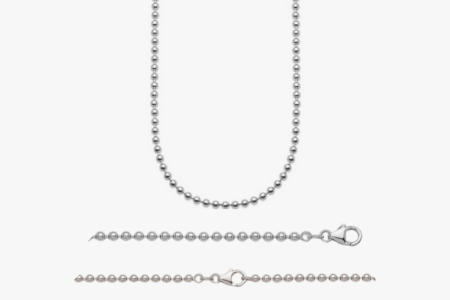
Popular ball chain necklace styles include smooth polished strands, diamond-cut or moon-cut designs, dog-tag chains and larger graduated statement pieces. Each style retains the repeated spherical motif while changing its surface, scale or overall proportions.
14k White Gold 3.2mm Beaded Ball Chain Necklace |
|
| Tap The Image To View The Product Details. |
Classic polished versions emphasize an even line of rounded beads and a clean, minimalist finish. In contrast, cut-surface styles introduce small facets that create livelier highlights as the necklace moves. These approaches show how the same basic pattern can appear restrained or more decorative.
Dog-tag ball chains retain the design’s practical, industrial associations. At the other end of the spectrum, larger beads and graduated arrangements make the repeated spheres the main visual statement. Contemporary fine-jewelry designers have also used changing bead sizes and precious-metal finishes to reinterpret the form.
A single necklace can belong to more than one category. For example, it may combine a polished surface, graduated beads and a pendant. Therefore, the most useful style label identifies the feature that controls the necklace’s overall appearance rather than every detail in its design.
|
|
2.a) Classic Polished Ball Chain NecklacesBack To Table Of Contents |
Classic polished ball chain necklaces feature smooth, rounded metal beads with an even, reflective finish. The uninterrupted surfaces create soft, moving highlights, while the repeated spheres give the strand a clean and orderly appearance.
The style depends on consistency. Beads of similar diameter, regular spacing and a uniform polish create a continuous visual rhythm around the neck. Because the beads remain smoothly rounded, light appears as broad glints across each sphere rather than as a textured effect.
That visual simplicity makes the classic polished style easy to recognize across fine and functional jewelry. However, “polished” describes the surface finish, not the metal itself. A polished ball chain may use sterling silver, gold, stainless steel or plated metal. Therefore, buyers should treat style and material as separate specifications.
|
|
2.b) Diamond-Cut and Moon-Cut Ball Chain NecklacesBack To Table Of Contents |
Diamond-cut and moon-cut ball chain necklaces feature small, machined cuts across the surfaces of their metal beads. Therefore, the beads reflect light from more angles and produce sharper flashes than a smooth polished strand. Despite the name, diamond-cut refers to the metal-finishing method; it does not mean that the necklace contains diamonds.
Jewelry manufacturers commonly treat moon-cut as a specific diamond-cut pattern rather than a separate chain construction. Accordingly, the beads retain the familiar ball-chain format but carry a repeated decorative cutting pattern across their surfaces. Manufacturers also offer other named patterns, so not every diamond-cut ball chain has the same appearance.
Close-up photographs matter when comparing these styles online because product titles may not reveal the number, depth or arrangement of the cuts. Look for an even pattern, crisp reflections and consistent treatment from bead to bead. Ultimately, the best choice depends on whether you prefer a subtle shimmer or a more conspicuous, flashing surface.
|
|
2.c) Dog Tag Ball Chain NecklacesBack To Table Of Contents |
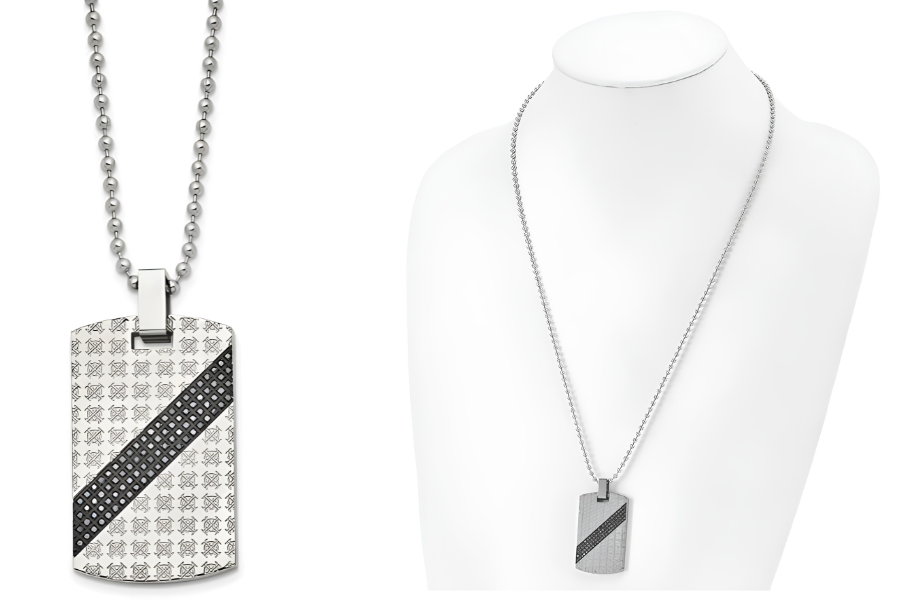
Dog tag ball chain necklaces combine a simple round-bead chain with one or more flat identification-style tags. The spare components and longer hanging profile give the necklace its familiar military-inspired, utilitarian appearance.
Black Diamond Dog Tag on a Ball Chain Necklace |
|
| Click The Image To View The Product Details. |
The style comes from the military practice of wearing identification tags around the neck. However, fashion versions may use blank, engraved or decorative pendants rather than official identity information. Therefore, “dog tag style” describes the necklace’s appearance and does not prove that it meets military specifications.
Many standard commercial dog-tag necklaces use a ball-chain size known as #3, with beads approximately 2.4 millimeters (3/32 inch) in diameter. A 24-inch chain is also common, although manufacturers offer other lengths and finishes. Visually, the regular chain keeps attention on the tag while preserving a clean, industrial outline.
|
|
2.d) Large-Bead, Graduated and Statement Ball Chain NecklacesBack To Table Of Contents |
Large-bead, graduated and statement ball chain necklaces make their metal spheres the main visual feature. Large beads create immediate visual weight, while graduated arrangements use changing diameters to build rhythm, direction or a focal point.
Graduated designs arrange smaller and larger balls in a deliberate sequence. For example, designers may repeat small-to-large progressions or place them asymmetrically. As a result, “graduated” describes a planned change in scale rather than one fixed layout.
“Statement ball chain” is a broader style label. It may use oversized spheres, multiple strands, mixed bead sizes, unusual finishes or gemstone accents to command attention. Therefore, buyers should examine the actual bead pattern and proportions instead of treating “statement” as a technical specification.
|
|
3) Ball Chain Necklace MaterialsGo To Table Of Contents |
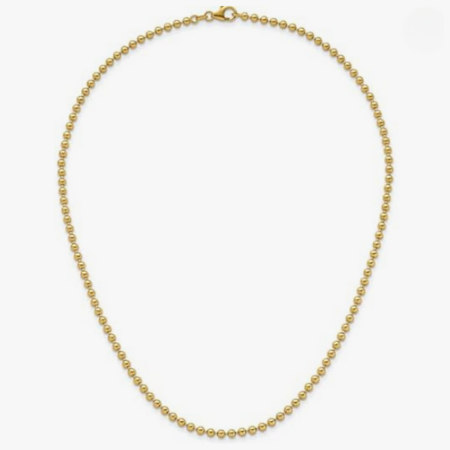
Ball chain necklaces are commonly made from sterling silver, stainless steel, gold, brass or a base metal covered with plating. The material affects color, price, resistance to tarnish or corrosion, care requirements and potential skin compatibility.
14K Solid Yellow Gold 3.2mm Beaded
|
|
| Tap The Image To View The Product Details. |
Material labels are not interchangeable. For example, sterling silver describes a defined silver alloy, while gold plating describes a gold surface applied over another metal. Karat or fineness marks provide additional information about precious-metal content. Therefore, shoppers should confirm the full construction instead of judging a necklace by color alone.
All parts of the necklace matter. Consequently, check the balls, connector, clasp and end fittings instead of considering only the chain’s dominant metal. Someone with a nickel sensitivity should verify the composition of every component that touches the skin.
Each material suits a different priority. Sterling silver and gold provide precious-metal options, while stainless steel offers a practical alternative. Brass and plated metals broaden the available colors and price points. The following subsections examine these choices and their suitability in greater detail.
|
|
3.a) Sterling Silver Ball Chain NecklacesBack To Table Of Contents |
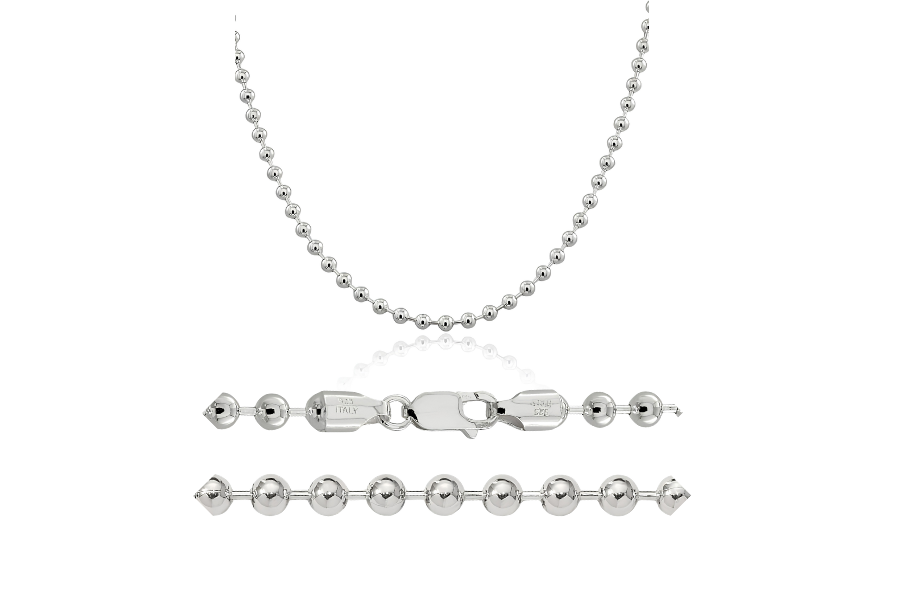
Sterling silver ball chain necklaces contain at least 92.5% pure silver combined with other metals for added strength. Silver provides the cool white luster, while the alloy makes the necklace more practical than pure silver for jewelry use.
925 Sterling Silver 5 mm Ball Chain Necklace |
|
| Click The Image To View The Product Details. |
Manufacturers often stamp qualifying pieces “925,” meaning that 925 parts per thousand are silver. However, sterling silver and silver plate are fundamentally different. Sterling describes the metal alloy, while silver plate is only a silver layer over a base metal. Therefore, shoppers should confirm whether the chain is sterling silver throughout, silver plated or merely silver-tone.
Sterling silver can scratch and tarnish as it reacts with its environment. Nevertheless, tarnish can occur on genuine sterling silver and does not automatically mean that the necklace is fake. Some sterling chains receive rhodium plating to reduce tarnishing and create a brighter surface. However, that applied finish can wear and may eventually need renewal.
|
|
3.b) Stainless Steel Ball Chain NecklacesBack To Table Of Contents |
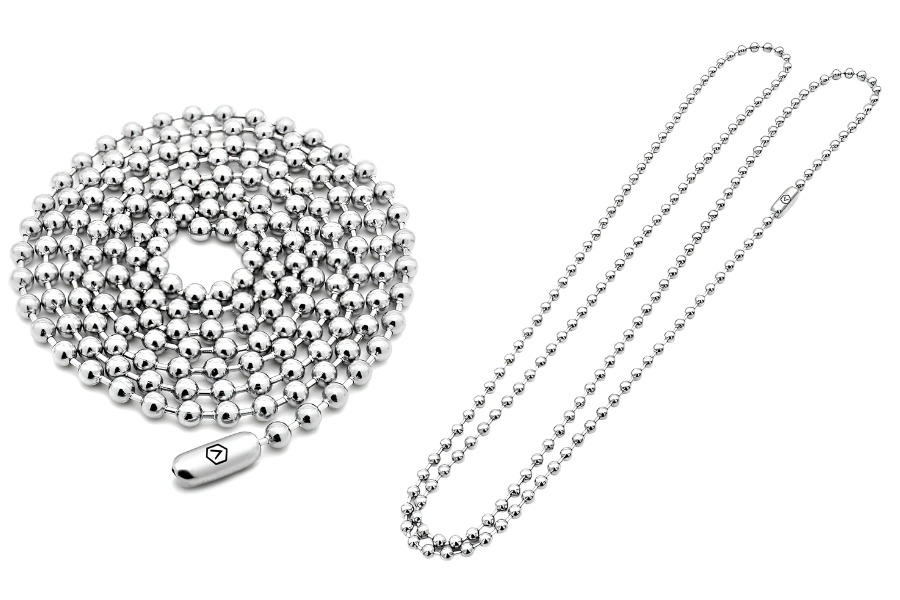
Stainless steel ball chain necklaces offer a hard, tarnish-resistant material with a cool gray-white appearance and an industrial character. Their polished surface can resemble silver, but stainless steel belongs to a family of alloys rather than a precious-metal purity category.
Stainless Steel Ball Chain Medical Grade 316L Surgical Metal |
|
| Click The Image To View The Product Details. |
The metal resists corrosion because chromium forms a thin, protective oxide film on its surface. However, “stainless” does not mean corrosion-proof. Chlorides, contamination and harsh conditions can still cause staining or localized corrosion.
Grade labels provide useful context. Type 316L contains molybdenum and generally resists chloride-related corrosion better than Type 304. Nevertheless, a listing that says only “stainless steel” does not reveal the exact alloy.
Stainless steel also resists scratches better than softer silver, although no polished jewelry remains completely scratch-free. Some grades contain nickel, so buyers with metal sensitivities should confirm the stated alloy rather than rely on “stainless steel” alone.
|
|
3.c) Gold Ball Chain NecklacesBack To Table Of Contents |
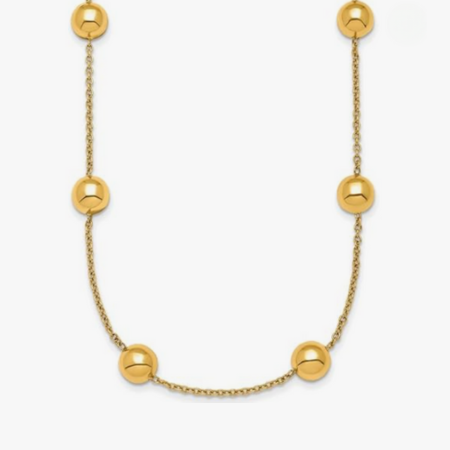
Gold ball chain necklaces combine gold’s rich luster with the clean geometry of repeated metal spheres. They come in yellow, white and rose gold, while karat and alloy composition determine purity, color and hardness.
Karat measures gold purity on a 24-part scale. Thus, 18K gold contains 18 parts gold and six parts other metals. In contrast, 14K contains 14 parts gold and ten parts other metals. Higher karat means more gold, but it does not automatically mean better construction or greater scratch resistance.
14K Yellow Gold 8 mm Bead-Station
|
|
Color and purity are separate characteristics. Yellow, white and rose gold can share the same karat rating because alloying metals influence their color. Moreover, white gold often receives rhodium plating for a brighter white finish, and that coating can wear over time.
Gold content and internal construction are also separate specifications. A 14K or 18K ball chain may use hollow beads, so buyers should check whether the beads are solid or hollow. Likewise, a karat mark identifies gold content but does not reveal bead-wall thickness, necklace weight or workmanship.
|
|
3.d) Brass, Gold-Plated and Other Ball Chain MaterialsBack To Table Of Contents |
Brass, gold-plated and other base-metal ball chains provide alternatives to sterling silver, stainless steel and karat gold. They can offer warm gold tones, silver-colored finishes or decorative colors, but their composition and surface construction vary considerably.
Brass is a copper-and-zinc alloy with a naturally warm yellow tone. However, its surface can darken or develop a patina as the metal reacts with its environment. An unplated brass chain and a brass chain covered with gold are therefore different products, even when they initially look similar.
Gold-plated ball chains have a layer of gold over another metal, and that layer can wear with use. Under U.S. FTC guidance, gold-filled jewelry carries a mechanically applied gold layer representing at least one-twentieth of the item’s metal weight. By contrast, vermeil has a sterling-silver base coated on all significant surfaces with gold or a gold alloy of at least 10-karat fineness and a minimum equivalent thickness of 2.5 microns. Consequently, these terms should not be treated as interchangeable.
Other ball chains may use aluminum, copper, nickel-plated steel or color-coated steel. Each product description should identify both the underlying metal and any applied finish. Therefore, buyers should compare the base metal, coating type and coating thickness instead of relying on color alone.
| Material or Construction | Key Characteristics | Main Care Considerations | Best Suited For |
|---|---|---|---|
| Sterling Silver | Precious-metal alloy containing at least 92.5% silver; usually marked 925 | Can tarnish and scratch; may require appropriate polishing | Buyers who want genuine silver with a traditional bright appearance |
| Stainless Steel | Hard, practical alloy with strong resistance to tarnish and ordinary corrosion | Not corrosion-proof; alloy grade and nickel content can vary | Frequent wear, lower maintenance and an industrial or contemporary look |
| Karat Gold | Gold alloy identified by karat, such as 14K or 18K; available in yellow, white and rose colors | Higher cost; hardness and care vary by alloy; beads may be solid or hollow | Buyers seeking precious-metal content and lasting gold color without surface plating |
| Brass | Copper-and-zinc alloy with a naturally warm yellow tone | Can darken, develop a patina or discolor some wearers’ skin | Affordable warm-toned jewelry and decorative ball chains |
| Gold-Filled | Mechanically applied gold-alloy layer over another metal | The surface can eventually wear; confirm the underlying metal and all component materials | Buyers wanting a more substantial gold layer without the cost of karat gold throughout |
| Vermeil | Sterling-silver base coated with qualifying gold or gold alloy | Gold coating can wear; use cleaning methods suitable for plated sterling silver | Buyers who want a precious-metal base with a gold-colored surface |
| Gold-Plated Base Metal | Gold layer applied over brass, steel or another underlying metal | Plating can wear and expose the base metal; avoid aggressive polishing | Lower-cost gold-colored jewelry and occasional wear |
Note: Material alone does not establish overall quality. Check the ball construction, clasp, connector, surface finish and every component that may contact the skin.
|
|
3.e) Choosing a Ball Chain Necklace for Sensitive SkinBack To Table Of Contents |
For sensitive skin, choose a ball chain with a clearly identified metal composition. Avoid any metal that has caused a previous reaction. Nickel causes many jewelry-related allergies; however, cobalt and other alloy ingredients can also trigger contact dermatitis.
Do not judge a necklace by its surface color alone. Gold plating may conceal a nickel-containing base metal, and wear can eventually expose the underlying alloy. Therefore, check the balls, connecting bars, clasp and connector because every component may touch the neck.
Specific alloy information is more useful than a broad “hypoallergenic” description. The American Academy of Dermatology includes surgical-grade stainless steel, sterling silver, platinum and 18-karat or higher yellow gold among its recommended options. However, no material suits everyone. Consequently, the exact alloy remains more important than price or appearance.
Redness, itching, blistering or a recurring rash around the neck may indicate contact dermatitis rather than ordinary discomfort. Stop wearing the chain and consult a dermatologist if symptoms persist or return. Patch testing can identify nickel, cobalt or another contact allergen and make future material choices more reliable.
|
|
4) Ball Chain Necklace Sizes and LengthsGo To Table Of Contents |
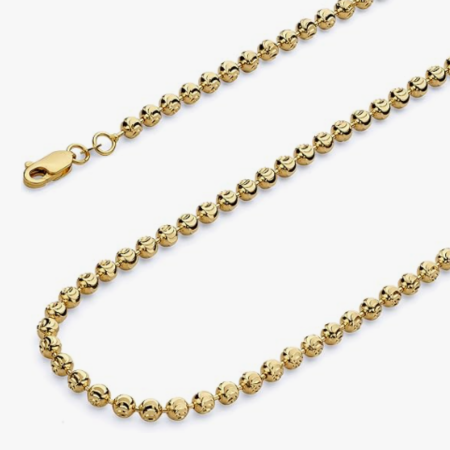
Ball chain necklace sizing combines bead diameter with the chain’s finished length. Diameter controls its visual scale and influences weight. Meanwhile, length determines where the necklace rests and how it works with clothing, pendants or dog tags.
TWJC 14k Yellow Gold 4mm Moon Cut Bead Ball
|
|
| Tap The Image To View The Product Details. |
Manufacturers may express bead size in millimeters, fractions of an inch or numbered trade sizes. Because these systems are easy to confuse, compare the stated diameter instead of relying on the size number alone. In addition, confirm that the connector or clasp matches the selected chain.
A listed necklace length does not produce the same appearance on every wearer. Neck circumference, body proportions and the addition of a pendant can change its resting position. Therefore, use measurements from the wearer or a well-fitting necklace before ordering.
When adding a pendant or dog tag, consider the complete chain assembly. The balls, connector and any end fitting must pass through the bail or opening. Furthermore, the chain’s scale should visually suit the attached piece. Checking these specifications together prevents a chain that fits the neck but cannot carry the intended pendant.
|
|
4.a) Understanding Ball and Bead DiameterBack To Table Of Contents |
Ball or bead diameter is the width of one spherical link measured across its widest point. It determines how fine or substantial a ball chain necklace appears. However, it is separate from the necklace’s overall length.
A designation such as #3 refers to a trade size, not a 3 mm ball. For example, #3 chain has an approximate diameter of 3/32 inch, or 2.4 mm. Meanwhile, #6 chain measures about 1/8 inch, or 3.2 mm. Because manufacturers describe these dimensions as approximate, compare the stated measurement rather than interpreting the trade number literally.
Smaller diameters create a finer visual line, while larger balls give the necklace more presence. As diameter increases, fewer balls fit into each inch of chain, which also changes its visual rhythm. However, diameter alone does not establish quality, durability or suitability for a particular use.
Product listings may use “ball size,” “bead size” and “chain size” somewhat inconsistently. Therefore, confirm that the stated dimension refers to the spherical ball and check the required size of any replacement connector. When measuring an existing chain, use calipers across the widest part of an undamaged ball for the most reliable result.
| Trade Size | Approximate Diameter in Inches | Approximate Diameter in Millimeters | Typical Jewelry Context |
|---|---|---|---|
| #1 | 0.072 inch | 1.8 mm | Fine necklaces and bracelets |
| #2 | 0.082 inch | 2.1 mm | Fine necklaces, neck chains and lighter accessories |
| #3 | 3/32 inch | 2.4 mm | Dog tags, charms, pendants and neck chains |
| #6 | 1/8 inch | 3.2 mm | More substantial necklaces and identification chains |
| #8 | 5/32 inch | 4.0 mm | Bold scale; less commonly used for conventional jewelry |
Note: Trade sizes and diameters are approximate. Measurements can vary slightly by manufacturer, and some jewelry sellers provide only the metric bead diameter rather than a numbered trade size.
|
|
4.b) Standard Ball Chain Necklace LengthsBack To Table Of Contents |
Standard ball chain necklaces commonly use the same 14- to 30-inch length range seen in other necklace styles. However, dog-tag and identification chains often use longer pre-cut lengths, especially 24, 27 and 30 inches.
A 14- to 16-inch necklace generally fits close to the neck, while an 18-inch chain rests near the collarbone. Lengths from 20 to 24 inches usually reach the upper chest. Meanwhile, chains measuring 24 to 30 inches create a longer drop, and those over 30 inches extend farther down the torso.
Manufacturers also offer ball-chain lanyards in lengths such as 24, 27, 30, 36 and 38 inches. These longer options often serve dog tags, identification tags and similar pendants. Importantly, these numbers describe the chain’s length rather than the diameter of its individual balls.
Traditional names such as choker, princess, matinee and opera provide useful shorthand. However, the associated length ranges can overlap among sellers. Therefore, compare the stated measurement in inches or centimeters instead of relying only on the style name. Also confirm whether the seller’s finished measurement includes the connector or clasp.
| Length in Inches | Approximate Length in Centimeters | Typical Resting Area | Common Ball-Chain Use |
|---|---|---|---|
| 14–16 inches | 36–41 cm | Close to the neck or near its base | Short standalone necklace or choker-style fit |
| 18 inches | 46 cm | Near the collarbone | Everyday necklace or lightweight pendant chain |
| 20–22 inches | 51–56 cm | Below the collarbone or at the upper chest | Pendant necklace or layered ball chain |
| 24 inches | 61 cm | Upper chest | Longer pendant or dog-tag necklace |
| 27–30 inches | 69–76 cm | Farther down the chest | Long dog-tag or identification chain |
| 36–38 inches | 91–97 cm | Lower torso, depending on the wearer | Extra-long lanyard or identification chain |
Note: Resting positions are approximate. Neck circumference, body proportions, clothing and pendant weight can change how a particular length appears.
|
|
4.c) How to Measure and Choose the Right Necklace LengthBack To Table Of Contents |
To choose the right necklace length, measure a well-fitting necklace or test the intended position with flexible tape or string. Then select the closest available length after checking where it will rest on the wearer.
Unfasten an existing necklace and lay it straight on a flat surface without stretching or kinking it. Measure from one end to the other, including its connector or clasp. If it offers several fastening positions, measure to the point you normally use. This measurement provides a reliable reference for achieving a similar fit.
If no suitable necklace is available, position flexible tape or string around the neck at the desired resting point. Keep it comfortable rather than pulling it tightly against the skin. Then mark where the ends meet, lay the material flat and measure it. Wear the intended neckline during this test because clothing can alter the necklace’s visible position.
Neck circumference, body proportions, ball diameter and pendant weight can all affect how a given length appears. A pendant also pulls the chain into a lower, more defined drop. Therefore, compare the measurement with the seller’s finished length and confirm whether that figure includes the connector. Choose according to the wearer’s measurements and intended look rather than relying on a gender-based size label.
|
|
4.d) Matching Ball Chain Size to a Pendant or Dog TagBack To Table Of Contents |
Match a ball chain to a pendant or dog tag by comparing the ball diameter, connector width and pendant opening. The complete chain assembly must pass through the opening and look proportionate to the attached piece.
For a removable pendant, measure the internal height and width of its bail or attachment hole. Then compare the smaller dimension with the widest chain component that must pass through it. This component is often the connector rather than the individual ball. Consequently, a small-diameter chain may still be incompatible if its connector cannot clear the opening.
For dog tags, #3 ball chain with an approximate 2.4 mm ball diameter creates the familiar identification-chain profile. Larger diameters provide a more substantial appearance, while finer chains appear less prominent. However, diameter alone does not determine strength or quality. The chain material, ball construction and correctly matched connector also affect its suitability.
A small or lightweight pendant usually looks balanced on a finer ball chain. Meanwhile, a large tag or substantial pendant may suit a more prominent diameter. There is no universal chain-to-pendant ratio, so check the seller’s measurements and load guidance whenever available. For a valuable or unusually heavy pendant, ask a jeweler to confirm that the chain and connector can support it.
|
|
5) Ball Chain Necklace Quality and DurabilityGo To Table Of Contents |
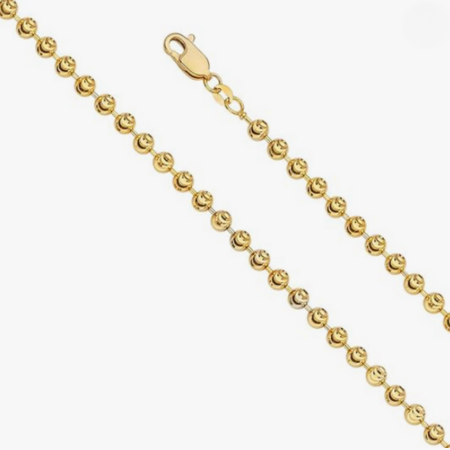
Ball chain necklaces can be durable, but appearance alone does not reveal their quality. Performance depends on bead diameter, material, ball-to-bar construction, connector design and how the wearer uses the chain.
14K Yellow Gold 4 mm Moon-Cut Bead Ball Chain
|
|
| Tap The Image To View The Product Details. |
Manufacturer data show that tensile strength changes with both chain size and base metal. Consequently, two chains with similar appearances may not withstand the same load. A larger diameter may provide greater strength, yet sound construction and a correctly matched connector remain equally important.
Assess the necklace as a complete assembly rather than judging only its visible balls. Useful specifications include the bead diameter, underlying metal, applied finish, connector type and any size-specific strength data. In addition, consistent spacing and a securely fitting connector provide more meaningful quality clues than shine or color alone.
Daily-wear suitability depends on the necklace’s construction, attached weight and exposure to pulling or snagging. Likewise, the type and location of damage determine whether shortening or connector replacement offers a sensible solution. When damage affects several balls or their internal connections, replacing the chain may provide a more dependable result.
|
|
5.a) Are Ball Chain Necklaces Strong?Back To Table Of Contents |
Yes, a well-made ball chain can be strong enough for ordinary necklace wear, dog tags and suitably matched pendants. However, ball chains are not equally strong, and a sudden pull or snag can exceed their capacity.
Manufacturer data show that strength changes with chain size and material. For example, one manufacturer gives its #3 aluminum chain an average tensile strength of 12 pounds. The same size rates at 20 pounds in carbon steel or yellow brass and 25 pounds in stainless steel. However, these figures represent controlled breaking tests, not recommended pendant weights or guarantees under repeated wear.
Normal use can expose a necklace to forces that a static hanging pendant does not create. Snagging, twisting, worn connections and sudden pulling can therefore cause failure below a published tensile figure. In addition, the complete necklace remains only as dependable as its connector and most vulnerable connection.
When strength matters, look for a clearly identified material, bead diameter, matched connector and manufacturer specifications. Do not rely only on thickness, shine or a vague “heavy-duty” description. For a valuable or unusually heavy pendant, ask a jeweler to confirm that the complete assembly suits the intended use.
|
|
5.b) How Bead Size, Material and Construction Affect DurabilityBack To Table Of Contents |
Bead size, material and construction work together to determine a ball chain necklace’s durability. Larger balls may increase tensile capacity, but weak joints or an unsuitable metal can still shorten the chain’s usable life.
Manufacturer charts show that increasing ball-chain size generally raises tensile strength within the same material. Yet the rating can also change substantially when manufacturers use different metals at the same diameter. Therefore, diameter provides useful information, but it should never serve as the sole measure of durability.
The underlying metal determines the chain’s structural behavior, while an applied coating mainly changes its surface. For example, gold plating does not make a base-metal chain perform like solid gold. Moreover, plating eventually wears, so a chain may lose its original color before its underlying structure fails.
Traditional ball-chain construction uses hollow balls joined by short, dumbbell-shaped links or connecting rods. Because every ball introduces another connection, consistent forming and secure internal retention matter throughout the strand. Consequently, dents, irregular spacing, loose balls or stiff sections may indicate damage or inconsistent construction rather than harmless cosmetic variation.
|
|
5.c) Ball Chain Clasps and ConnectorsBack To Table Of Contents |
Ball chain necklaces usually close with either a snap-on ball-chain connector or a conventional jewelry clasp. The closure should suit the chain’s diameter, weight and intended use while holding both ends without distorting the terminal balls.
A traditional ball-chain connector is a slotted metal fitting that captures one terminal ball at each end. Manufacturers supply connectors for particular trade sizes, although some smaller chains can share a fitting. Therefore, follow the stated size compatibility instead of selecting a connector by appearance alone. Larger trade sizes may require a different coupling design.
Fine-jewelry versions may use a lobster clasp and end ring instead of the familiar snap connector. Lobster clasps use a spring-loaded mechanism and are generally easy to operate. Meanwhile, spring-ring and barrel clasps provide more discreet alternatives for lighter or finer necklaces. However, the end fittings that join the clasp to the ball chain also affect security.
The chain and its closure do not always use the same metal. For example, one manufacturer pairs a stainless steel ball chain with a zinc-alloy lobster clasp. Consequently, verify the materials used for the clasp, end rings and connector when metal sensitivity, color matching or durability matters. A loose, cracked or distorted closure should not be trusted with a valued pendant.
|
|
5.d) Are Ball Chain Necklaces Suitable for Daily Wear?Back To Table Of Contents |
Yes. A well-made ball chain necklace can suit daily wear when its bead size, closure and material match the pendant and the wearer’s routine. However, daily wear should not mean leaving it on during every activity.
For regular use, the chain should hang freely and carry its pendant without looking or feeling strained. A fine ball chain suits a light pendant, whereas a heavier pendant needs a more substantial chain and compatible closure. Before each wear, ensure the connector closes fully. Also check that no terminal ball, connecting bar or end fitting appears bent or separated.
Material and finish influence how well the necklace tolerates frequent use. Stainless steel ball chain offers a durable option for exposure to the elements. Sterling silver can be worn regularly, but moisture, cosmetics and sulfur-containing substances can accelerate tarnish. Meanwhile, gold plating eventually wears away according to its thickness and how the item is worn. Therefore, frequent wear may reveal a plated chain’s base metal sooner than occasional use.
Remove the necklace before swimming, bathing, household cleaning, gardening or DIY work. These activities increase chemical exposure or the chance of snagging and bending the chain. A sensible daily-wear habit is to inspect the closure and chain briefly when putting it on. If any part feels loose or deformed, set the necklace aside until a jeweler assesses it.
|
|
5.e) Can a Ball Chain Necklace Be Shortened or Repaired?Back To Table Of Contents |
Yes. Jewelers can shorten many ball chain necklaces and repair or reconnect some damaged examples. However, the safest method depends on the chain’s construction, metal, finish and type of closure.
Shortening a basic ball chain with a removable snap connector is usually straightforward. The technician removes the connector, measures the required length and cuts away the excess chain. The same connector then secures the new terminal balls. Since the alteration removes material, confirm the finished length before authorizing the cut.
Some fine-jewelry ball chains end in fitted components that support a lobster clasp, spring ring or another conventional closure. These necklaces need more care because cutting the chain may also require repositioning or replacing an end fitting. Therefore, a jeweler should alter precious-metal, plated, branded or sentimental pieces.
A correctly sized ball-chain connector can join two separate sections, so it may provide a simple repair for compatible utility-style necklaces. Specialist ball-chain pliers also allow a technician to open and reconnect metal balls without crushing them. However, an added connector or reformed ball may remain visible and change how the necklace bends at that point.
Repair does not always provide the most dependable answer. If damage affects several balls or connecting bars, replacement may make more sense than creating multiple joins. Replacement may also prove preferable when the finish cannot be matched or a heavy pendant will load the repaired area. In every case, the completed chain should close securely and remain aligned before it carries a valuable pendant.
|
|
6) How to Wear and Style a Ball Chain NecklaceGo To Table Of Contents |
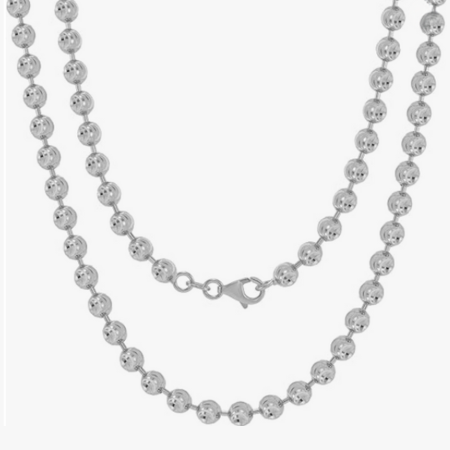
A ball chain necklace looks most effective when its bead diameter, length and finish support the intended style. For a restrained accent, wear a fine chain alone or add a pendant as a focal point. Alternatively, choose larger beads when you want the necklace itself to command attention.
10k Real White Gold Solid Ball 4mm Moon
|
|
| Tap The Image To View The Product Details. |
Start with proportion. A short ball chain draws attention to the neckline or collar. Meanwhile, a longer chain creates a vertical line and gives a pendant more space. The necklace should remain visible against the neckline without crowding the pendant. Its repeated spheres catch light at regular intervals. As a result, even a modest ball chain can add texture to a plain shirt, knitwear or open collar.
Ball chains are not limited to one gender or aesthetic. Metal color, surface finish, bead diameter and pendant choice can make the same construction feel minimal, industrial, polished or expressive. Consequently, a simple version can provide an everyday accent, while a larger scale can serve as the main jewelry statement.
When layering, separate necklaces by length and vary their textures enough to keep each one visible. Vogue has shown ball-chain designs worn at two lengths, with a pendant on the longer strand. However, if the ball chain or pendant provides the focal point, choose quieter companion chains. The following subsections examine men’s, women’s and unisex styling, pendant and layering options, and the style’s current fashion relevance.
|
|
6.a) Ball Chain Necklaces for MenBack To Table Of Contents |
Men can wear a ball chain necklace as a discreet metal accent, a pendant carrier or a bolder standalone piece. Bead diameter, length and finish determine whether it looks refined, utilitarian or expressive.
Men trying the style for the first time may prefer a slim or medium chain at a moderate length. It can show neatly at the neck of a T-shirt, sit inside an open shirt or add detail beneath a jacket. Meanwhile, a larger bead diameter creates stronger contrast when worn over plain fabric. The chain should complement the outfit instead of appearing accidental or disproportionately large.
Metal color also changes the impression. Stainless steel, sterling silver and white gold provide a cooler appearance, while yellow gold creates warmer contrast. A polished finish catches more light, whereas matte or blackened surfaces look quieter. Consequently, coordinating the finish with a watch, rings or clothing hardware can make the overall combination feel intentional. However, an exact metal match is not essential.
Ball chains for men are not limited to military dog tags. Contemporary menswear retailers offer slim 14-karat gold ball chains for fine-jewelry pendants, alongside decorative moon-cut versions. Therefore, consider the pendant’s scale, color and character as well as the chain. If the pendant provides the main visual interest, a simpler ball chain usually creates a cleaner balance.
|
|
6.b) Women’s and Unisex Ball Chain StylesBack To Table Of Contents |
Women’s and unisex ball chain styles range from delicate, jewelry-like strands to bold, hardware-inspired necklaces. The chain’s dimensions, metal, finish and adornment shape its character more than a gender label.
For a refined appearance, choose small, closely spaced balls in polished gold, silver or another bright metal. A short chain can frame the neckline, while a longer version creates a softer vertical line. Adding a small charm can make the design feel more personal. Conversely, larger balls, graduated sizing or a substantial silver-toned finish produce a stronger sculptural effect.
Unisex styling often works well with a simple chain, moderate bead diameter and restrained finish. This combination can complement casual clothing, clean tailoring or minimalist outfits without relying on traditionally masculine or feminine details. Meanwhile, a symbolic pendant, colored finish or oversized scale can give the same basic construction a more individual identity. Modern jewelry styling increasingly favors personal expression over strict gender categories.
Because category names do not reveal the exact fit, compare the measurements rather than relying on “women’s” or “unisex” alone. Check the necklace length, ball diameter, weight and clasp design. The same listed length can also rest differently according to neck size and body proportions. Therefore, on-body photographs and stated measurements provide more useful guidance than the collection label.
Metal color can shift the presentation further. High-polish yellow gold looks warmer, while silver and steel create a cooler, more graphic effect. Matte and blackened finishes appear quieter because they reflect less light. However, these are design effects rather than gender rules. The most suitable version is the one that matches the wearer’s proportions, wardrobe and preferred level of visibility.
|
|
6.c) Wearing and Layering Ball Chains With Pendants and Other NecklacesBack To Table Of Contents |
A ball chain can carry a pendant or form part of a layered arrangement when its dimensions, length and visual weight suit the other pieces. First, confirm that the pendant fits the chain securely. Then create enough separation for every necklace to remain visible.
The pendant’s bail must clear more than the balls themselves. Unless the bail opens or the chain has a removable connector, the end fitting must also pass through it. Therefore, compare the bail’s internal opening with the widest and deepest part of the chain end. Once fitted, the pendant should move freely without catching between adjacent balls.
Match the pendant’s scale and weight to the chain. A small charm often looks balanced on a fine ball chain. Meanwhile, a large dog tag usually benefits from a more substantial chain and secure closure. However, the pendant should not overpower the chain or prevent it from hanging smoothly during movement.
For layering, place the necklaces at visibly different levels and vary their textures. A practical starting point is about 2–4 inches of length difference, although the pendant and neckline can alter the spacing needed. For example, a short ball chain can add texture near the collar while a longer pendant necklace provides the focal point. Two ball-chain lengths can also work together, with the pendant on the longer strand.
Different lengths can reduce crowding and tangling, but they cannot prevent every twist. Consequently, begin with two necklaces and observe how they move during normal wear. An extender can provide more separation when needed. If one pendant or chain looks highly decorative, keep the remaining pieces quieter so the arrangement retains a clear focal point.
|
|
6.d) Are Ball Chain Necklaces Back in Style?Back To Table Of Contents |
Yes, ball chain necklaces are back in style, although their return forms part of several wider jewelry trends rather than one dominant craze. Their distinctive spherical construction now appears in minimalist, pendant and oversized statement designs.
Recent fashion coverage supports this qualified answer. Vogue included short silver ball chains in a contemporary jewelry-layering guide in 2025. Its updated 2026 chain guide also featured bead-chain and fish ball-chain designs among its current selections. Meanwhile, ELLE compared a warped silver collar from Bottega Veneta’s Fall 2026 collection to a ball-chain necklace. These examples place the construction in both wearable jewelry and runway-led design.
Their renewed relevance also fits broader trends toward sculptural silver, prominent chains and personalized pendants. Fine, evenly spaced spheres complement understated jewelry, while larger beads create stronger visual volume. Consequently, designers can reinterpret the same basic construction without removing its recognizable geometric character.
However, being fashionable does not make every ball chain look the same or suit every aesthetic. A plain utility-style version can appear deliberately industrial, while polished precious-metal and oversized designs read more clearly as jewelry. Therefore, it is more accurate to regard the ball chain as a familiar design with renewed versatility—not a short-lived trend that must be worn in one prescribed way.
|
|
7) How to Care for a Ball Chain NecklaceGo To Table Of Contents |
Care for a ball chain necklace by keeping it clean and dry, limiting contact with harsh chemicals, and storing it separately from other jewelry. Before using any cleaner, identify the chain’s metal, plating and finish. Also check whether an attached pendant has separate care requirements.
Ball chains need attention along their entire articulated surface. Skin oils, cosmetics and residue can settle between the closely spaced spheres and around the connector. Therefore, wipe the necklace gently after wear and deal with visible buildup before storing it. After an approved wet cleaning, rinse the chain carefully. Then dry the recesses around its balls and connector.
The chain’s composition determines its main care risks. Sterling silver can tarnish, plating can wear, and softer metals can scratch. Consequently, avoid toothpaste, bleach and unverified chemical dips. Remove the necklace before swimming or using household cleaners. In addition, limit direct contact with perfume, lotion and other cosmetics.
Finally, inspect the connector, clasp and pendant attachment for looseness or distortion. Stop wearing the necklace if it no longer closes securely or has a damaged section. A jeweler or appropriate repair specialist can then assess it. The following subsections examine cleaning, surface protection, storage and removal in more detail.
|
|
7.a) How to Clean a Ball Chain NecklaceBack To Table Of Contents |
To clean a plain metal ball chain necklace, mix a few drops of mild dish soap with lukewarm water. Gently clean between the spheres and around the connector with a soft cloth or very soft-bristled brush. Then rinse the chain thoroughly and blot it dry with a lint-free cloth.
Before wet cleaning, identify the chain’s metal and finish. Also check whether it carries a pendant, gemstone or glued component. If the materials differ, let the most delicate component determine the method. Alternatively, remove a detachable pendant and clean it separately according to its own care instructions.
Residue can collect in the narrow spaces between the balls and connecting wires. Therefore, work along the necklace in short sections and use light pressure. Avoid pulling the chain taut or bending its connector while brushing. After rinsing, allow moisture trapped around the connector and between the spheres to evaporate completely.
Polished sterling silver may benefit from an appropriate silver-cleaning product or treated polishing cloth. However, silver dips and polishing compounds can alter deliberately oxidized finishes. Abrasive materials may also scratch metal or gradually remove plating. Consequently, use only products approved for the chain’s exact metal and surface treatment.
Avoid bleach, chlorine-based cleaners, abrasive pads and household remedies such as toothpaste. In addition, do not use an ultrasonic or steam cleaner when the necklace contains pearls, delicate gemstones, treatments or unknown materials. If gentle cleaning does not remove the residue, ask a jeweler to assess the necklace instead of using a stronger chemical.
|
|
7.b) Preventing Tarnish, Scratches and DiscolorationBack To Table Of Contents |
Prevent tarnish, scratches and discoloration by keeping a ball chain necklace clean and dry. Limit chemical exposure and friction, and use only care products intended for its metal and finish. These precautions matter especially for sterling silver, brass, plated surfaces and deliberate oxidation.
Tarnish is a surface reaction, not simply dirt or proof of poor-quality metal. For example, sterling silver can tarnish faster after exposure to sulfur, humidity, salt air, perspiration, chlorine, bleach and cosmetics. Therefore, allow perfume, lotion, sunscreen and hair products to dry before putting on the necklace. Wiping away moisture and residue after wear also limits prolonged surface contact.
Scratches result from physical abrasion rather than chemical change. The rounded balls can rub against pendant bails, other necklaces and harder pieces of jewelry. Consequently, avoid abrasive cloths, scouring powders and improvised polishes. Also examine the area where a pendant moves along the chain, since repeated contact can mark polished or plated surfaces.
A patchy color change on a plated chain may indicate that the outer layer has worn thin and exposed the underlying metal. More polishing can worsen this type of discoloration instead of removing it. Likewise, dark recesses on oxidized silver may form part of the intended design. Silver dips and aggressive polishing can remove that controlled finish.
If discoloration remains after appropriate gentle cleaning, identify its cause before applying a stronger product. Tarnish may respond to a cleaner approved for the metal. However, worn plating or a damaged finish may require professional replating or refinishing rather than further polishing.
|
|
7.c) How to Store and When to Remove a Ball Chain NecklaceBack To Table Of Contents |
Store a ball chain necklace completely dry, fastened and separated from other jewelry in a soft-lined compartment or individual pouch. Remove it before sleeping, showering, swimming, exercising, playing contact sports, performing household chores or handling strong chemicals.
Before storage, fasten the connector and arrange the chain in a relaxed loop rather than a tight coil. This keeps the ends together and reduces tangling or accidental bending. If the necklace has a large or hard-edged pendant, place it beside the chain instead of directly on top of it. Otherwise, the pendant may rub against the balls or place unnecessary pressure on the connector.
Choose a cool, dry storage location away from bathrooms, direct sunlight and household chemicals. Sterling silver can benefit from a tarnish-resistant pouch or lined compartment. In a humid climate, a suitable desiccant packet within the storage area can help control moisture. However, never put the necklace away while water remains between its spheres or around the clasp.
Remove the chain whenever an activity could expose it to chlorine, salt water, perspiration, cosmetics, cleaning products or repeated impact. Even if the main chain uses a water-resistant metal, its plating, connector or pendant may require greater care. Therefore, judge the necklace as a complete piece rather than relying only on the chain’s metal description.
It is also prudent to remove a ball chain before bed. Movement during sleep can twist the necklace, pull a pendant or strain its closure. Finally, take it off whenever clothing, tools or sports equipment could catch the chain. Place it in its usual storage location immediately so protection does not create a new risk of loss.
|
|
8) How to Choose and Buy a Ball Chain Necklace OnlineGo To Table Of Contents |
Choose and buy a ball chain necklace online by starting with its intended use. Then verify the metal, finish, bead diameter, length, connector and seller’s terms before paying. Compare written measurements and specifications instead of judging suitability from price or photographs alone.
A reliable listing should describe what the necklace contains rather than relying on vague color terms. It should also provide enough dimensional information to judge scale and fit. For example, lifestyle photographs may make the balls appear larger or smaller than they are. Therefore, treat images as visual references and measurements as the basis for comparison.
Price becomes meaningful only when two necklaces have comparable specifications. Consider the stated metal composition, surface treatment, dimensions, construction, closure and included services. However, a higher price does not establish better quality by itself. Likewise, a low price may reflect plating, lighter construction, a basic connector or limited after-sales support rather than a genuine bargain.
Before ordering, check the seller’s identity, contact information and reputation beyond testimonials displayed on the product page. Also read the return window, refund conditions, return-shipping costs, restocking fees and warranty exclusions. Marketplace protection may differ from the individual seller’s policy. Consequently, confirm which party will resolve a problem if the necklace arrives damaged, differs from its description or does not fit as expected.
A sound online purchase connects three forms of evidence: the necklace’s intended purpose, its documented specifications and the seller’s written protections. This approach reduces uncertainty while keeping the final decision focused on suitability and value.
|
|
8.a) Choose a Ball Chain Necklace for Its Intended UseBack To Table Of Contents |
Choose a ball chain necklace according to its primary purpose before comparing individual products. Decide whether you want to wear it alone, carry a pendant or dog tag, add it to a layered arrangement, or reserve it for occasional statement wear. This decision determines which product features deserve priority.
For a pendant or dog tag, function comes before appearance. The chain must accommodate the attachment and carry the item without interfering with how it hangs. If the pendant cannot be removed, consider how its combined weight and movement will affect comfort. Also confirm that the seller intends the chain for this type of use rather than assuming that every ball chain performs identically.
A standalone necklace depends more heavily on its visual presence and how it follows the neckline. Meanwhile, an everyday chain should feel comfortable, close reliably and suit the wearer’s normal routine. A piece intended for layering must work with the position and movement of the other necklaces. An occasional statement design can prioritize visual impact over discreetness or all-day practicality.
Ball chains also appear in key chains, identification products and other non-jewelry applications. However, similar construction does not make decorative jewelry suitable for every utility task. If the chain will secure something valuable or perform a non-jewelry function, rely on the manufacturer’s stated application and performance information. Do not treat an unrated necklace as safety or load-bearing equipment.
When several uses matter, identify one as the priority and treat the others as secondary. Therefore, the best choice is not the chain with the longest feature list. It is the one whose design and documented purpose most closely match how the buyer expects to wear it.
|
|
8.b) Check the Metal and FinishBack To Table Of Contents |
Check both the underlying metal and the surface finish before buying a ball chain necklace online. A complete listing should identify whether the chain consists of one stated alloy throughout or carries plating or another coating. Color alone does not establish metal composition.
A gold necklace should state its karat quality. Under U.S. terminology, vermeil has a sterling-silver base coated on all significant surfaces with gold or a gold alloy of at least 10-karat fineness and a minimum equivalent thickness of 2.5 microns. Gold-filled, gold overlay and rolled gold plate describe mechanically applied layers of karat gold over another metal. Therefore, these terms do not mean the same thing as solid gold or ordinary electroplating.
Terms such as gold-plated, rhodium-plated and PVD-coated describe a surface treatment. They do not identify the material underneath. Consequently, the listing should name both the base metal and the coating. Descriptions such as gold-tone or silver-tone should be treated as color information unless the seller separately identifies the metal content.
Likewise, polished, satin, matte, diamond-cut and oxidized describe appearance rather than purity. A polished surface reflects light evenly, while texturing or cutting changes how the chain catches light. An oxidized finish may intentionally create dark areas. However, none of these treatments turns a base-metal chain into precious-metal jewelry.
Finally, check that the product title, specifications, photographs and any visible quality marks agree. A hallmark can support a metal claim, but it should not replace a clear written description. If the listing combines phrases such as gold, gold-plated and gold-tone without explaining their relationship, request clarification before purchasing.
|
|
8.c) Verify the Bead Size, Length and ClaspBack To Table Of Contents |
Before buying, confirm the bead diameter in millimeters, the finished necklace length and the exact clasp or connector type. These specifications determine how substantial the chain looks, where it sits and whether it closes correctly.
First, look for an actual diameter rather than relying on photographs or a size number alone. For example, one manufacturer defines its #3 chain as approximately 2.4 mm and its #6 chain as approximately 3.2 mm. Therefore, use the seller’s corresponding millimeter measurement when comparing products from different listings.
Next, check how the seller measures the necklace and whether the stated length includes the closure or an extension chain. Compare that measurement with a necklace you already own or test the length with a piece of string. If the description provides only a general label such as short or long, request an exact measurement.
Finally, identify the closure and inspect a clear photograph of its end fittings. A traditional snap-on ball-chain connector must match the chain size; connectors designed for one diameter may not fit another correctly. If the necklace uses a lobster clasp, spring ring or other jewelry closure, verify its dimensions, material and method of attachment.
|
|
8.d) Compare Product Specifications, Quality and ValueBack To Table Of Contents |
Compare ball chain necklaces only after matching their specifications, construction and total cost. A lower price offers poor value if the necklace uses a different metal, smaller beads, a shorter length or less substantial construction.
Start with the declared metal, fineness or grade, construction, finish, bead diameter, length, item weight and clasp material. Weight becomes meaningful only when the material, dimensions and construction are otherwise comparable. If a listing omits an important specification, contact the seller instead of assuming that two visually similar chains are equivalent.
Next, examine close-up photographs for uniform beads, regular spacing, a consistent finish and neatly attached end fittings. Images may reveal scratches, uneven coatings or poorly formed components, although they cannot prove strength or long-term durability. Therefore, give greater weight to precise measurements and clear material disclosures than to vague terms such as premium or heavy-duty.
Finally, compare the complete delivered price and any included components rather than focusing on the advertised discount. A higher price may reflect more precious metal, heavier construction or more refined finishing, but the listing should substantiate those differences. The best value is the necklace whose verifiable specifications justify its price and suit its intended use.
|
|
8.e) Check Seller Reputation, Returns and WarrantyBack To Table Of Contents |
Before purchasing, confirm that the seller has a verifiable reputation, a practical return policy and a clearly written warranty. These safeguards matter because a necklace may differ in fit, finish or construction once you examine it in person.
First, verify the business identity and look for working contact information. Then read reviews across several independent sources rather than relying on the seller’s star rating alone. Search the business name with terms such as complaint or scam, and watch for recurring problems involving misdescribed metals, undelivered orders or refused refunds.
Next, read the complete return policy before placing the order. Confirm the return window, when that period begins and whether sale, engraved or personalized items qualify. Also check the required condition, packaging and tags, as well as return-shipping costs, restocking fees and whether you receive a refund or store credit.
Finally, distinguish the warranty from the return policy. A return policy governs whether you can send the necklace back, while a warranty addresses specified problems after the return period. Check who provides the warranty, how long it lasts, what components it covers and whether repair, replacement or refund is offered. In addition, review exclusions and claim costs, then save the product listing, receipt, return terms and warranty.
|
|
9) Frequently Asked Questions About Ball Chain NecklacesGo To Table Of Contents |
These frequently asked questions address how to close and wear a ball chain necklace, whether it can pull hair and how moisture or overnight wear may affect it. They also examine tarnishing and whether the chain works as a standalone necklace without a pendant.
However, the correct guidance can vary with the metal, surface coating, bead diameter, connector, fit and condition of the necklace. Wear habits and exposure to moisture or chemicals also matter. Therefore, the answers below distinguish broadly applicable advice from situations that require the manufacturer’s product-specific care instructions.
|
|
9.a) How Do You Close a Ball Chain Necklace?Back To Table Of Contents |
To close a traditional ball chain necklace, place the final ball into the connector’s central opening. Next, guide the short connecting bar through the narrow slot and pull the ball into the rounded side until it sits securely.
Most pre-cut necklaces arrive with the connector already attached to one end, so only the free end needs to be inserted. If the connector is separate, secure one chain end within each side. After closing it, gently tug the chain near the connector to confirm that both end balls remain captured.
To open the necklace, reverse the movement by sliding the end ball towards the central opening and lifting it out. However, some jewelry-grade ball chains use a lobster clasp, spring ring or another conventional closure. Operate that clasp as designed rather than trying to push a ball into it. If a snap connector slips or requires excessive force, check that its size matches the bead diameter and replace it if damaged.
|
|
9.b) Do Ball Chain Necklaces Pull Hair?Back To Table Of Contents |
Ball chain necklaces can occasionally catch or pull hair, but the problem does not affect every wearer. Individual strands may become trapped around the connector or beside the short bars joining the metal balls.
The likelihood of snagging depends on the chain’s fit, bead spacing, surface condition and closure design. A rough, bent or damaged connector can create an additional catching point. Moreover, a necklace that repeatedly shifts against hair at the nape may cause more noticeable pulling.
To reduce snagging, inspect the chain for damaged components and keep loose hair clear while fastening it. Choose a comfortable length that does not rub tightly against the hairline. If hair becomes caught, open the necklace and gently unwind the strand instead of pulling it free. Repeated snagging may indicate that the connector or chain needs repair or replacement.
|
|
9.c) Can You Shower With a Ball Chain Necklace?Back To Table Of Contents |
It is best to remove a ball chain necklace before showering. Plain water may not immediately damage every solid-metal chain. However, repeated contact with soap, shampoo and moisture can leave residue and make the necklace harder to keep clean.
Metal and finish also matter. Humidity and chemicals can accelerate sterling silver tarnish, while chlorine and bleach can damage or discolor precious-metal alloys. Moreover, a connector, coating or attached pendant may require more cautious care than the underlying chain. Therefore, follow the maker’s instructions for the complete necklace.
If the necklace gets wet, remove any remaining product as its care instructions permit. Then dry the beads, spaces and connector thoroughly with a soft cloth. Removing the chain before each shower remains especially sensible when its metal is unknown or it has a plated, coated or oxidized finish.
|
|
9.d) Can You Sleep in a Ball Chain Necklace?Back To Table Of Contents |
An adult can sleep in a ball chain necklace, but removing it before bed is the safer care choice. Overnight movement can make the chain catch on bedding, press against the skin or place repeated strain on its connector.
Fit and attachments also matter. A tight chain, heavy pendant, damaged connector or rough edge increases the chance of discomfort or snagging. Moreover, prolonged contact may aggravate sensitive skin. If an itchy or painful rash develops beneath the necklace, stop wearing it.
Therefore, make removal part of your bedtime routine and inspect the necklace if it catches on anything. This guidance becomes a firm safety rule for infants and young children. They should never sleep in necklaces because neck loops present entanglement and strangulation hazards.
|
|
9.e) Do Ball Chain Necklaces Tarnish?Back To Table Of Contents |
Yes, some ball chain necklaces tarnish, but the rate and appearance depend on their metal and finish. Sterling silver can darken after exposure to sulfur compounds, humidity, perspiration, chlorine or cosmetics. Gold may also tarnish or discolor over time, particularly after contact with harsh cleaning products.
Stainless steel generally resists corrosion more effectively because chromium forms a thin protective oxide film on its surface. However, no stainless steel grade is immune in every environment, and chlorides can cause localized corrosion. Therefore, a stainless steel label does not make salt water or pool chemicals harmless.
Also, not every color change is tarnish. On a gold-plated chain, the gold layer gradually wears away and may reveal a differently colored base metal. Polishing cannot replace missing plating, so a worn finish may require professional replating rather than ordinary tarnish removal.
|
|
9.f) Can a Ball Chain Necklace Be Worn Without a Pendant?Back To Table Of Contents |
Yes, a ball chain necklace can be worn without a pendant. Its repeated spherical links create a complete visual pattern, so the chain can function as a minimalist necklace rather than merely supporting a tag or charm.
When worn alone, bead diameter, finish, length and connector design become the main visual features. Fine, closely spaced beads produce a subtle line, while larger or graduated beads create a stronger statement. Moreover, a reflective finish gives the necklace more visual movement as the individual balls catch the light.
For the cleanest result, choose a well-finished connector that suits the chain’s scale. A snap connector gives the necklace a utilitarian or dog-tag character, whereas a conventional jewelry clasp can appear more refined. Therefore, the best standalone ball chain looks complete by design, even without a pendant providing the focal point.
View More Ball Chain Jewelry as Follows:
 |
Gold Ball Chain |  |
|
Ball Chain Style |  |
See Also:
|
Anchor Chain Style |  |
|
Box Chain Style |  |
|
Byzantine Chain Style |  |
|
Curb Chain Style |  |
|
Figaro Chain Style |  |
|
Herringbone Chain Style |  |
|
Omega Chain Style |  |
|
Snake Chain Style |  |
|
Rope Chain Style |  |
|
Wheat Chain Style |  |