Herringbone Chain jewelry is known for its sleek, reflective surface and distinctive V-shaped pattern. This guide covers its construction, styles, materials, durability, styling, buying considerations, care and repair.
Table Of Contents

|
1) What Is a Herringbone Chain?Go To Table Of Contents |
A herringbone chain is a flat jewelry chain made from short, closely connected metal links arranged in angled rows. Together, these links create a smooth, continuous surface that rests close to the neck or wrist. Its broad, polished profile also reflects light effectively, giving the chain a distinctive and elegant presence.
Unlike chains with open, individually visible links, a herringbone chain resembles a flexible ribbon of metal. It is available in different widths, finishes and materials and can form necklaces, bracelets or anklets. However, its closely fitted construction requires careful handling because sharp bends can disrupt the alignment of the links.

|
1.a) What Does a Herringbone Chain Look Like?Back To Table Of Contents |
A herringbone chain has a broad, flat profile formed by tightly arranged links that slant in alternating directions. These angled rows create a repeating V-shaped or chevron pattern along the chain. As a result, its surface appears smooth and almost continuous rather than open or visibly segmented.
The chain usually rests close to the skin and follows the curve of the neck or wrist. Its closely spaced links reflect light across a wide surface, often producing a bright, mirror-like sheen. Thin versions look sleek and understated, while wider herringbone chains create a bolder, more noticeable appearance.
Close-Up of an 11 mm Gold-Plated Herringbone Chain

aligned links that create its smooth, reflective surface.
|
|
1.b) Why Is It Called a Herringbone Chain?Back To Table Of Contents |
The name “herringbone” comes from the chain’s resemblance to the bone structure of a herring fish. Its alternating, slanted links branch in opposite directions, much like the small bones extending from a fish’s central spine. Together, they form the broken zigzag or V-shaped arrangement known as a herringbone pattern.
The term also describes similar patterns in textiles, flooring and brickwork. In jewelry, therefore, “herringbone” identifies the arrangement of the links rather than the metal used to make the chain.
|
|
1.c) What Is the History of the Herringbone Chain?Back To Table Of Contents |
The herringbone pattern has a much longer history than the modern herringbone chain. Ancient craftspeople used related angled designs in textiles and decorative metalwork. Meanwhile, Roman builders arranged bricks and tiles in a similar pattern called opus spicatum, meaning “spiked work.” Jewelers eventually translated this repeated V-shaped arrangement into rows of closely fitted metal links. However, historical records do not identify one inventor or a precise date for the modern chain style.
During the 20th century, the flat and highly polished design reached a wider fashion market. Herringbone necklaces became especially popular during the 1970s and 1980s, when bold gold chains served as prominent style statements. Although tastes later shifted, renewed interest in vintage jewelry, minimalist necklaces and layered chains brought the design back into fashion.
|
|
2) How Are Herringbone Chains Made?Go To Table Of Contents |
Manufacturers make herringbone chains by forming metal into small links and joining them in closely aligned rows. Depending on the production method, they may stamp individual links from sheet metal or begin with a double cable or curb-style chain. Machines or skilled chain makers then secure the link joints and arrange the connected sections into the required configuration.
Next, rolling, pressing or swaging compacts the assembled links into the chain’s characteristic low profile. The manufacturer then cuts the chain to length, attaches end fittings and adds a suitable clasp. Finally, polishing removes roughness and creates the smooth, reflective finish associated with this chain style. Careful inspection remains important because uneven links can affect the chain’s alignment and movement.
|
|
2.a) How Do the Flat Links Form the Herringbone Pattern?Back To Table Of Contents |
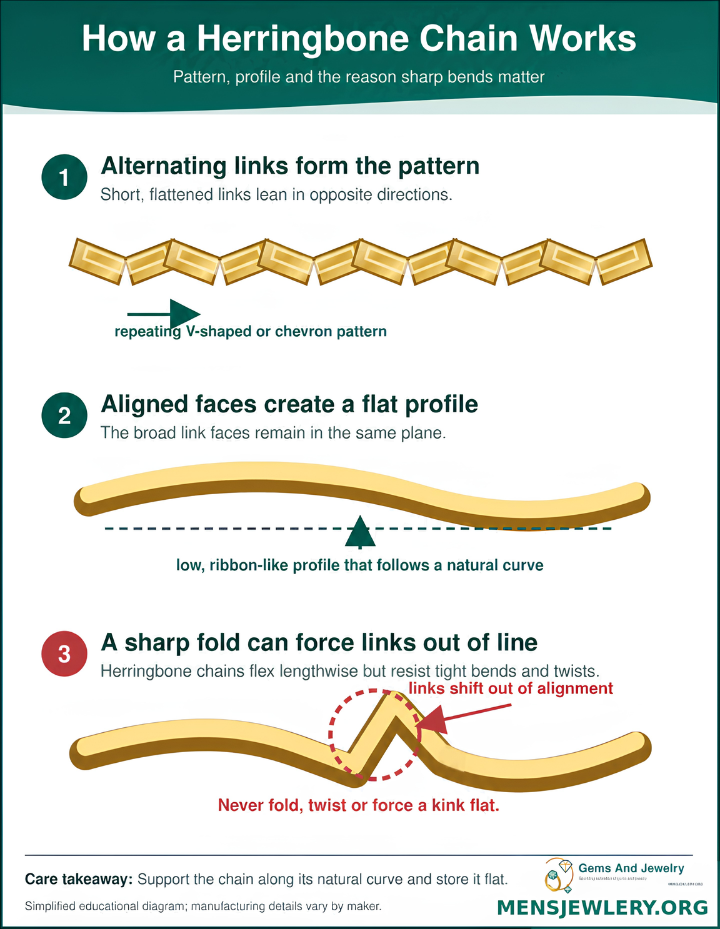
To form the herringbone pattern, chain makers position short, flattened links side by side at an angle. One row leans in one direction, while the neighboring row leans in the opposite direction. Where the two directions meet, the link edges create a repeating broken V or chevron.
Each link also overlaps or interlocks closely with the links beside it, concealing most of the open space. As a result, the separate links appear to form one continuous geometric design. Although wider chains may contain more rows or larger links, the alternating diagonal arrangement remains the pattern’s defining feature.
|
|
2.b) Why Does a Herringbone Chain Lie Flat?Back To Table Of Contents |
A herringbone chain lies flat because its short, compressed links sit closely together in the same plane. Unlike rounded links that can rotate freely, its broad link faces remain aligned side by side and face outward. This arrangement spreads the chain’s width across the skin instead of allowing individual links to stand upright.
The joints provide movement mainly along the chain’s length. Therefore, the necklace can curve around the neck while maintaining its low profile. Flattening and polishing during manufacturing also create a more even surface. Consequently, the finished chain drapes like a narrow metal ribbon, although it cannot tolerate sharp twisting as easily as many open-link chains.
|
|
3) Types and Styles of Herringbone ChainsGo To Table Of Contents |
Herringbone chains share the same angled link pattern, but their width, thickness, finish and overall format can vary considerably. Classic designs feature a slim, flat profile with a smooth surface. However, delicate proportions create a subtle appearance, while wide or chunky versions make a stronger statement.
Surface treatments also change how the chain reflects light. A polished finish produces a mirror-like shine, while diamond-cut details add brighter flashes. In contrast, textured finishes create a softer or more decorative effect. Jewelers use these variations in necklaces, chokers, bracelets and other pieces, allowing the herringbone design to suit different styles and occasions.
|
|
3.a) Classic Flat Herringbone ChainsBack To Table Of Contents |
Classic flat herringbone chains feature rows of short, angled links fitted closely together. Their shallow depth and broad outward-facing surface make the chain resemble a smooth metal ribbon. Unlike round or heavily textured chains, this style emphasizes a clean silhouette and an almost uninterrupted reflective surface.
The classic design usually displays an even V-shaped pattern throughout its length. Although these chains come in different widths, their flat profile and consistent link alignment define the style rather than any particular measurement. As the wearer moves, the connected sections shift gently and reflect light across the chain’s surface.
|
|
3.b) Thin, Wide and Chunky Herringbone ChainsBack To Table Of Contents |
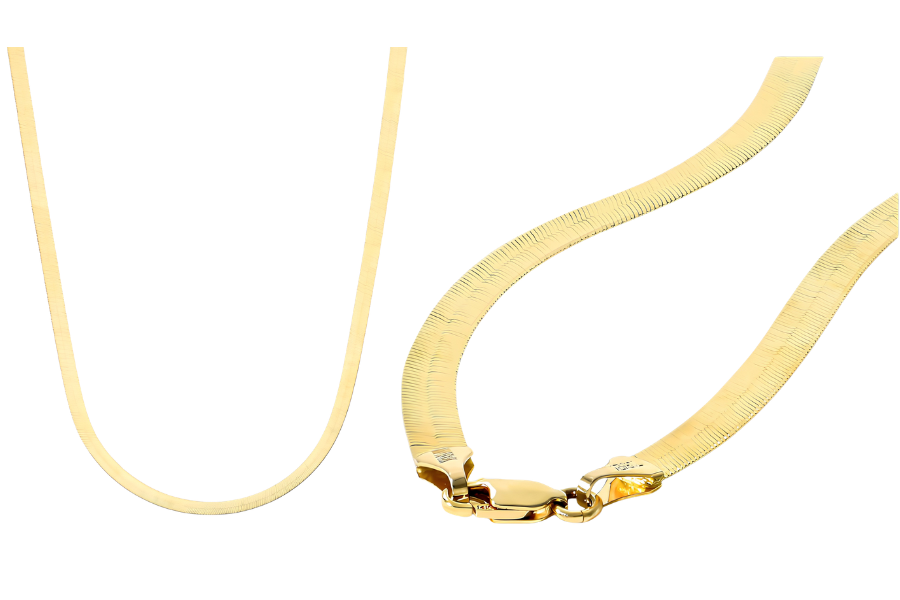
Thin herringbone chains have a narrow profile that gives the pattern a subtle and refined appearance. Since they expose less metal across the neck or wrist, they usually create a lighter visual effect. Therefore, they can complement understated outfits without dominating the overall look.
Wide herringbone chains display more of the angled link pattern and reflective surface. As a result, they attract more attention and create a stronger style statement. Chunky versions add greater thickness and visual weight, producing an even bolder appearance. However, the terms “thin,” “wide” and “chunky” do not follow universal measurements. Jewelers and retailers may use them differently depending on the chain’s width, thickness and proportions.
14K Yellow Gold 5.1mm Herringbone Chain Necklace |
|
|
Click On The Image To Reveal Full Specs And Shine Of This 14K Yellow Gold 5.1mm Herringbone Chain Necklace! |
|
|
3.c) Polished, Diamond-Cut and Textured Herringbone ChainsBack To Table Of Contents |
Polished herringbone chains have a smooth surface that reflects light in broad, continuous bands. This finish emphasizes the clean V-shaped pattern and creates the mirror-like shine associated with the classic style.
In contrast, diamond-cut herringbone chains feature small facets cut or engraved into the metal. These facets reflect light from several angles and produce sharper flashes of sparkle. Despite the name, a diamond-cut chain does not necessarily contain diamonds; the term describes the finishing technique.
Textured herringbone chains use fine grooves, brushing, engraving or similar treatments to break up the smooth reflection. As a result, they can appear softer, more detailed or less formal than highly polished versions. Some designs also combine polished and textured areas for greater contrast.
|
|
3.d) Herringbone Necklaces, Chokers and BraceletsBack To Table Of Contents |
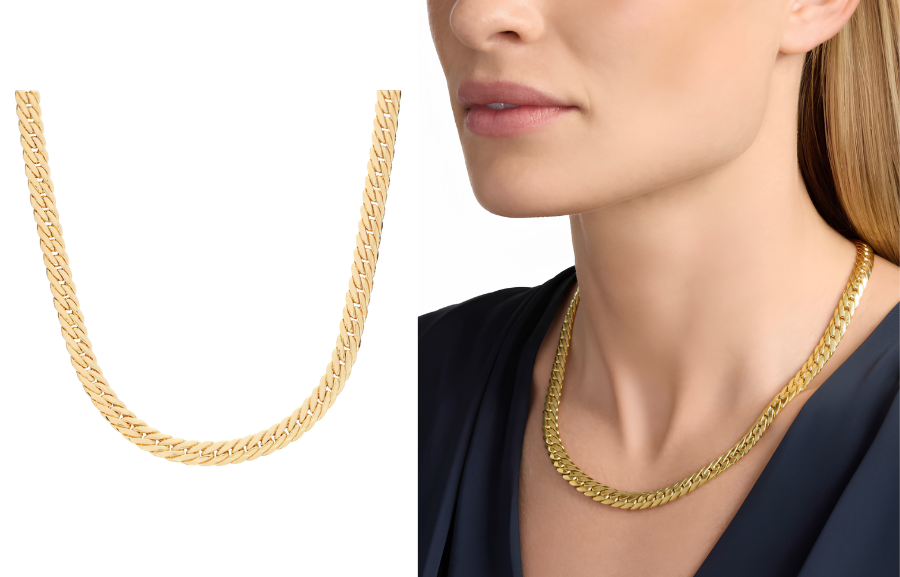
The herringbone pattern appears in necklaces, chokers and bracelets. A standard necklace follows the neckline and gives the flat links room to form a smooth, uninterrupted band. Because its broad surface reflects light prominently, the chain can provide strong visual impact without additional ornamentation.
18 Inches Herringbone Necklace
|
|
|
Turn Heads With This 18 Inches Herringbone Necklace In 14K Italian Yellow Gold 7 mm. Tap The Image To Explore! |
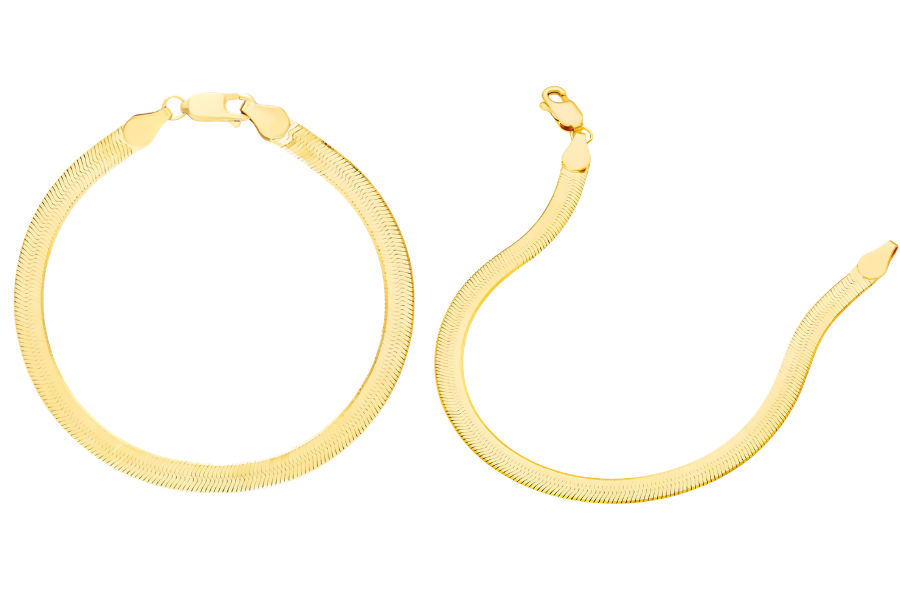
A herringbone choker places the same pattern higher and closer to the neck, creating a sleek, collar-like effect. In contrast, a herringbone bracelet wraps the reflective design around the wrist. Its fit should allow comfortable movement while helping the links remain properly aligned. Across all three formats, different widths and finishes can make the design appear either subtle or bold.
Herringbone Chain Bracelet In 14K Yellow Gold |
|
|
Curious About This Herringbone Chain Bracelet In 14K Yellow Gold? Tap The Image And Learn More Instantly! |
|
|
4) Herringbone Chain MaterialsGo To Table Of Contents |
Herringbone chains come in solid gold, sterling silver, stainless steel and various coated base metals. Although each material can form the same distinctive link pattern, it affects the chain’s color, weight, price, durability and maintenance requirements.
Solid precious-metal chains contain the stated alloy throughout their links. In contrast, gold-plated chains receive their gold color from a surface coating over another metal. Vermeil uses sterling silver as its base, while stainless steel and other alloys provide additional price and performance options. Therefore, buyers should read the metal description, fineness mark and coating information instead of judging a herringbone chain by color alone.
| Material | Key Characteristics | Best Suited For |
|---|---|---|
| Solid Gold | Gold alloy throughout the non-hollow links; available in different karats and colors; generally the highest-cost option | Buyers who prioritize precious-metal content, lasting value and a traditional fine-jewelry appearance. |
| Gold-Plated | Gold coating over a base metal; affordable, but the surface can gradually wear, fade or expose the underlying metal | Buyers who want a gold-colored appearance at a lower price and can protect the coating from wear. |
| Gold Vermeil | Gold coating over sterling silver; provides a precious-metal base, although the gold surface still requires gentle care | Buyers who prefer a sterling silver base with a gold appearance but do not want the cost of solid gold. |
| Sterling Silver | Contains at least 92.5% silver; offers a bright silver-white appearance but can tarnish and require polishing | Buyers who want an affordable precious metal and are comfortable managing tarnish. |
| Stainless Steel | Durable, corrosion-resistant and relatively easy to maintain; generally the lowest-cost option but not a precious metal | Buyers who prioritize durability, easy maintenance and affordability. |
|
|
4.a) Solid Gold Herringbone ChainsBack To Table Of Contents |
A solid gold herringbone chain uses a gold alloy throughout and does not have a hollow interior. However, “solid gold” does not mean pure 24K gold. The karat mark identifies the proportion of gold in the alloy. For example, 18K gold contains 18 parts gold out of 24, while 14K gold contains 14 parts gold.
Manufacturers combine gold with other metals to improve hardness and create yellow, white or rose colors. Unlike gold-plated jewelry, solid gold does not have a thin gold layer that can wear away and expose a base metal. Nevertheless, the chain can still develop scratches or kinks. White gold versions may also have rhodium plating, which can gradually wear and require renewal.
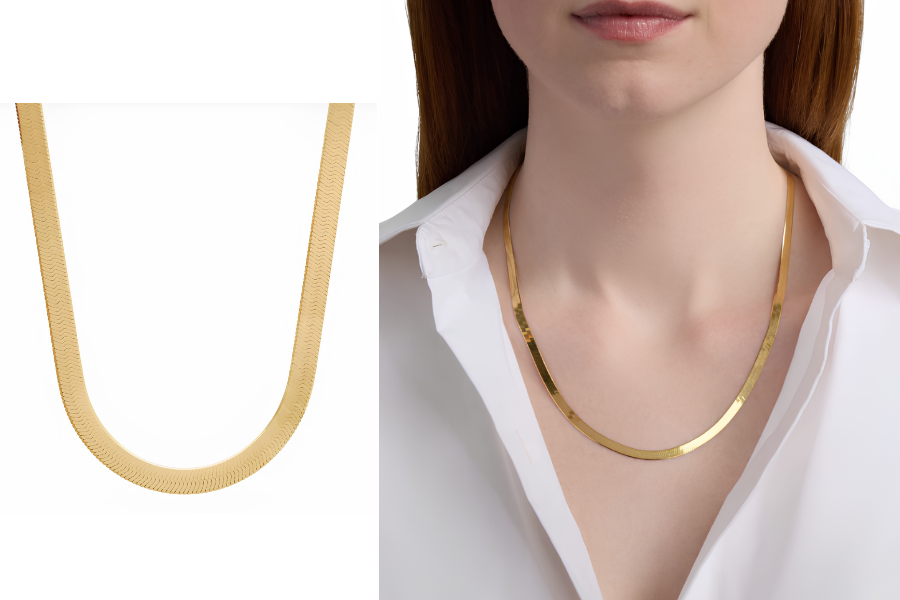
18 Inches Herringbone Chain In 14K Yellow Gold 4mm |
|
|
Tap The Image To Reveal Full Details Of This Elegant 18 Inches Herringbone Chain In 14K Yellow Gold 4mm! |
|
|
4.b) Gold-Plated and Vermeil Herringbone ChainsBack To Table Of Contents |
Gold-plated herringbone chains have a layer of gold applied over another metal, such as brass or stainless steel. Because gold covers only the surface, these chains provide a gold-colored appearance at a lower price than solid gold. However, regular wear, friction and chemical exposure can gradually thin the coating and reveal the underlying metal.
Gold vermeil is a specific type of gold-plated jewelry. Under FTC Jewelry Guides, 16 CFR § 23.4, vermeil must use a sterling silver base covered on all significant surfaces with gold or gold alloy of at least 10K fineness. The gold layer must also have a minimum thickness equivalent to 2.5 microns of fine gold. Consequently, buyers should check the base metal, gold karat and coating thickness instead of relying on color or the product name alone.
|
|
4.c) Sterling Silver Herringbone ChainsBack To Table Of Contents |
Sterling silver herringbone chains combine the pattern’s smooth, reflective appearance with the cool white color of silver. Sterling silver contains at least 92.5% pure silver and is commonly stamped “925.” The remaining metal in the alloy increases strength because pure silver is generally too soft for practical jewelry.
These chains usually cost less than solid gold versions, making them an accessible precious-metal option. However, sterling silver can tarnish when it reacts with substances in the air or comes into contact with perspiration, cosmetics and household chemicals. Gentle cleaning and flat, separate storage help preserve the finish while reducing the risk of scratches, bends and kinks.
|
|
4.d) Stainless Steel and Other Herringbone Chain MaterialsBack To Table Of Contents |
Stainless steel herringbone chains provide a durable, affordable alternative to precious-metal versions. Stainless steel resists corrosion and usually requires less maintenance than sterling silver. It also retains its silvery appearance without regular polishing. However, the metal’s durability does not make the herringbone structure kink-proof, so the chain still requires careful handling and flat storage.
Other herringbone chains may use brass, copper, titanium or mixed base-metal alloys. Brass and copper offer warm colors but can tarnish or discolor with exposure to moisture and chemicals. Manufacturers may also plate these metals to create a gold- or silver-colored finish. Titanium is lightweight and corrosion-resistant, although titanium herringbone chains are less common. Because compositions and coatings vary, buyers should check the complete material description before choosing a chain.
|
|
5) Are Herringbone Chains Strong and Durable?Go To Table Of Contents |
Herringbone chains can remain durable with careful handling, but their strength should not be confused with resistance to kinking. The closely arranged flat links create a smooth, flexible surface. However, this construction is less tolerant of sharp bends and twisting than many open-link chain styles. A chain may withstand ordinary tension yet still develop damage when folded beyond its natural curve.
Durability also depends on the metal, link thickness, width, construction quality and frequency of wear. Thicker, well-made chains generally tolerate handling better than extremely thin versions, although no herringbone chain is immune to deformation. Therefore, careful use and proper storage are essential for preserving its shape and reflective finish.
|
|
5.a) Why Do Herringbone Chains Kink or Bend?Back To Table Of Contents |
Herringbone chains kink because their flat links are tightly arranged and designed to move together along a gentle curve. When the chain is sharply folded, twisted sideways or compressed, individual links can shift out of alignment. As a result, the smooth surface develops a visible angle, ridge or dent that may not return to its original shape.
Kinks often occur when the chain becomes caught in clothing, gets crushed during storage or is worn while sleeping. Thin herringbone chains can be especially vulnerable because their links contain less metal and deform more easily. Furthermore, repeatedly bending an already damaged area can weaken it, so a kink should never be pulled or forced flat.
|
|
5.b) Do Herringbone Chains Break Easily?Back To Table Of Contents |
Herringbone chains do not necessarily break easily, and a well-made chain can last for years with careful handling. However, their tightly connected flat links are less tolerant of snagging, crushing and repeated bending than many sturdier link patterns. Thin chains may be especially vulnerable because their links can deform or separate under concentrated stress.
Breakage often begins at a kink, dent or other damaged area. Once the links move out of alignment, repeated flexing can concentrate stress at that point and gradually weaken the chain. Therefore, owners should check for raised links, sharp bends, cracks and loose clasp connections. A chain showing visible damage should not be worn until a jeweler has examined it.
|
|
5.c) Can You Wear a Herringbone Chain Every Day?Back To Table Of Contents |
You can wear a herringbone chain every day, provided you handle it carefully and remove it before activities that may bend, twist or crush the links. Daily wear does not mean continuous wear. Sleeping, exercising or playing contact sports while wearing the chain can place pressure on its flat structure and increase the risk of kinking.
Put the chain on after dressing and remove it before taking off tight clothing to prevent snagging. In addition, avoid wearing it while showering or swimming because moisture, chlorine and personal-care products may affect certain metals or finishes. After each use, check that the chain remains smooth and lies flat before storing it safely.
|
|
5.d) Can You Wear a Pendant on a Herringbone Chain?Back To Table Of Contents |
A herringbone chain is generally better worn without a pendant. Its broad, reflective surface already creates a complete look, while the chain’s flat links are not designed to support concentrated weight. A pendant can pull on the center of the chain, and its bail may rub against the links as it moves. Over time, this pressure and friction can cause scratches, bending or a permanent kink.
A very lightweight pendant may be suitable for some thicker herringbone chains, but only if the chain’s manufacturer or a qualified jeweler confirms compatibility. The bail must also be wide and smooth enough to move without scraping or pinching the links. For most pendants, a cable, box, rope or another pendant-friendly chain provides a safer choice.
|
|
6) Herringbone Chain vs Snake Chain: What Is the Difference?Go To Table Of Contents |
Herringbone and snake chains may both have smooth, closely connected surfaces, but their construction and appearance are different. A herringbone chain uses short, flat links arranged in slanting rows. These links form a broad, ribbon-like surface with a visible V-shaped pattern. In contrast, a snake chain uses tightly connected rings or curved plates to create a more continuous, rounded profile resembling a snake’s body.
A herringbone chain generally offers a bolder, more reflective appearance and lies flat against the skin. A snake chain usually looks narrower and more streamlined, with a fluid drape. Although both styles require protection from sharp bends, their different structures affect flexibility, durability and suitability for pendants. Therefore, the better choice depends on the desired look and how the chain will be worn.
| Feature | Herringbone Chain | Snake Chain |
|---|---|---|
| Construction | Short, flattened links arranged in alternating angled rows | Closely connected rings or curved plates forming a smooth tube |
| Appearance | Broad, flat and reflective with a visible V-shaped pattern | Rounded or slightly flattened with a smooth, uniform surface |
| Flexibility | Curves smoothly lengthwise but has limited sideways flexibility | Generally more fluid and flexible in multiple directions |
| Kink Risk | More vulnerable to sharp folds, twisting and crushing | Can still kink or crease if sharply bent or crushed |
| Daily Wear | Suitable for regular wear with careful handling and proper storage | Generally better suited to frequent wear |
| Pendant Suitability | Usually best worn alone because pendant movement can damage the flat links | May support a lightweight pendant when the chain and bail are suitably sized |
| Overall Style | Bold, reflective and visually prominent | Smooth, streamlined and understated |
| Best Suited For | Wearers who want a broad, reflective chain that serves as the focal point and can be handled carefully. | Wearers who prefer fluid movement, a rounded profile or a suitable chain for a lightweight pendant. |
|
|
6.a) Link Construction and AppearanceBack To Table Of Contents |
A herringbone chain consists of flattened links placed closely together in angled rows. The links change direction along the center, forming the recognizable V-shaped or zigzag pattern. Because they create a broad, flat surface, herringbone chains reflect light in noticeable flashes and resemble a flexible metal ribbon.
A snake chain is made from tightly connected rings or curved metal plates, depending on its construction. The individual components fit so closely that they create an almost continuous surface with few visible gaps. Unlike the wide, patterned face of a herringbone chain, a snake chain usually has a rounded or slightly flattened profile. Consequently, it produces a smoother, more uniform appearance resembling the body of a snake.
|
|
6.b) Flexibility, Durability and KinkingBack To Table Of Contents |
A snake chain is generally more flexible than a herringbone chain because its curved components form a rounded tube that can move in multiple directions. A herringbone chain bends smoothly along its broad surface but has less sideways flexibility. Therefore, a sharp fold or twist can force its flat links out of alignment and create a noticeable kink.
However, a snake chain is not kink-proof. Its closely connected rings or plates can also crease when the chain is sharply bent, twisted or crushed. For both styles, durability depends on the metal, thickness, workmanship and handling. Overall, a snake chain usually provides a more fluid drape, while a herringbone chain requires greater care to preserve its flat, uniform shape.
|
|
6.c) Which Chain Is Better for Daily Wear and Pendants?Back To Table Of Contents |
Between the two styles, a snake chain is generally better suited to daily wear because its rounded, flexible construction follows natural movement more easily. Its smooth surface is also less likely to catch on clothing. However, a snake chain can still kink if sharply bent or crushed. A herringbone chain may be worn regularly, but it requires more careful handling and is usually best worn alone.
A snake chain is also the better option for a lightweight pendant, provided the chain is thick enough to support it and the bail moves freely. Nevertheless, a heavy pendant can place excessive stress on a snake chain and cause it to crease. Herringbone chains are less suitable because pendant weight and movement can distort or scratch their broad, flat links.
|
|
7) Are Herringbone Chains Still in Style?Go To Table Of Contents |
Yes, herringbone chains are still in style. Their smooth surface and clean silhouette complement both minimalist jewelry and the continuing preference for noticeable chain designs. Current jewelry collections and trend guides feature herringbone patterns in delicate necklaces, bold statement chains, bracelets and layered combinations.
A thin herringbone chain creates a subtle, polished accent, while a wider version makes a stronger visual statement. Furthermore, its simple geometric pattern can look vintage-inspired or distinctly modern, depending on the metal, width and styling. This versatility allows the herringbone chain to remain fashionable without depending entirely on a short-lived trend.
|
|
7.a) How to Wear a Herringbone ChainBack To Table Of Contents |
Wear a herringbone chain by itself when you want its smooth pattern and reflective surface to remain the focal point. A collarbone-length chain works well with an open neckline, while a longer version can stand out against a plain crew-neck or high-neck top. After fastening it, check that the links lie flat and follow a natural curve without twisting.
Choose the width according to the effect you want to create. A slim herringbone chain provides a subtle accent for casual or professional clothing, whereas a wider chain creates a stronger statement. Yellow gold adds warmth, while sterling silver and white gold produce a cooler, streamlined appearance. Simple clothing and uncluttered necklines allow either finish to remain clearly visible.
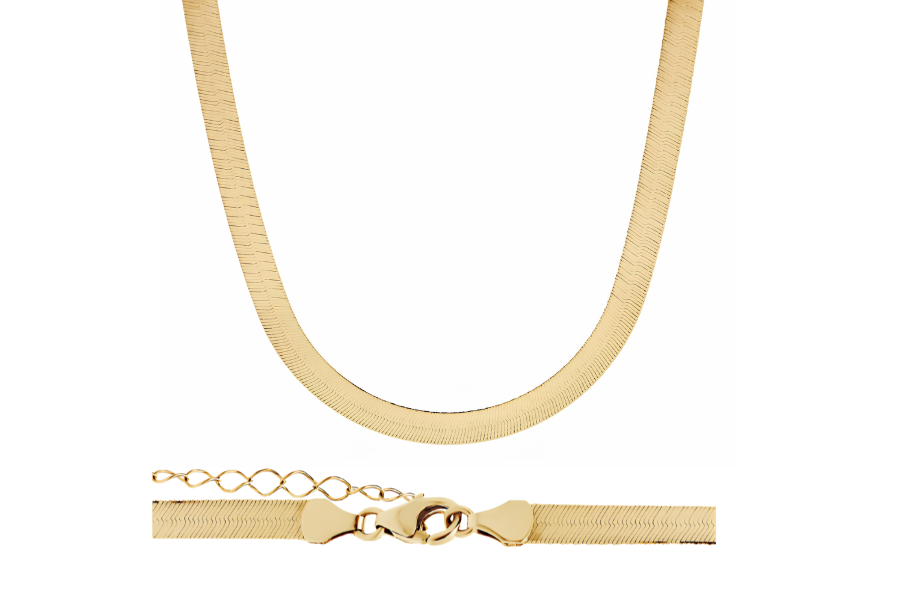
16 Inches Herringbone Chain Necklace
|
|
|
Click On The Image To View Details And Own This Gorgeous 16 Inches Herringbone Chain Necklace In 14K Italian Yellow Gold 5 mm! |
|
|
7.b) Can You Layer a Herringbone Chain?Back To Table Of Contents |
Yes, you can layer a herringbone chain with other necklaces. Choose clearly different lengths so each chain occupies its own space instead of repeatedly crossing or resting on the herringbone links. Its broad, smooth surface contrasts well with a thinner cable, rope or paperclip chain. You can also combine different metal colors for a more varied look.
Because herringbone links can scratch, bend or kink, pair the chain with lighter necklaces rather than heavy or sharply textured styles. Check occasionally that the chains have not twisted together, especially around the sides and back of the neck. After wearing them, separate and store each necklace individually instead of leaving the layered arrangement tangled.
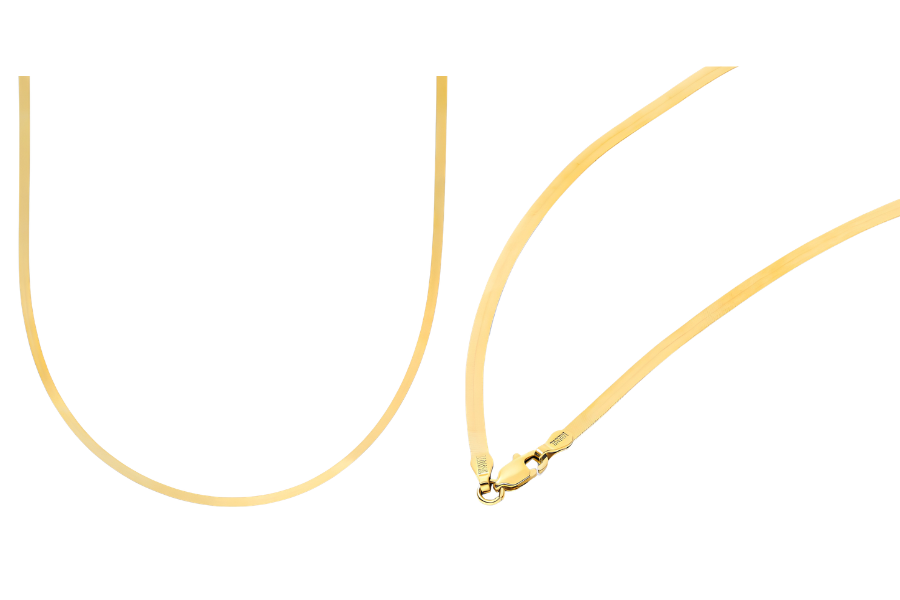
14K Yellow Gold 2.7mm Herringbone Chain Necklace |
|
|
Fall For The Details. Click On The Image To Learn More About This 14K Yellow Gold 2.7mm Herringbone Chain Necklace! |
|
|
7.c) Are Herringbone Chains for Men or Women?Back To Table Of Contents |
Herringbone chains are suitable for both men and women. Their clean geometric pattern is unisex, while the width, length, metal and finish determine whether a particular chain appears subtle or bold. Although retailers may place certain designs in men’s or women’s categories, these labels are shopping conventions rather than rules about who can wear them.
A slim, shorter herringbone chain creates a restrained and refined look. In contrast, a wider or longer chain has greater visual weight and produces a stronger statement. Yellow gold offers warmth, while white gold, sterling silver and stainless steel create a cooler appearance. Ultimately, the best choice depends on personal style, comfort and how the chain complements the wearer’s wardrobe.
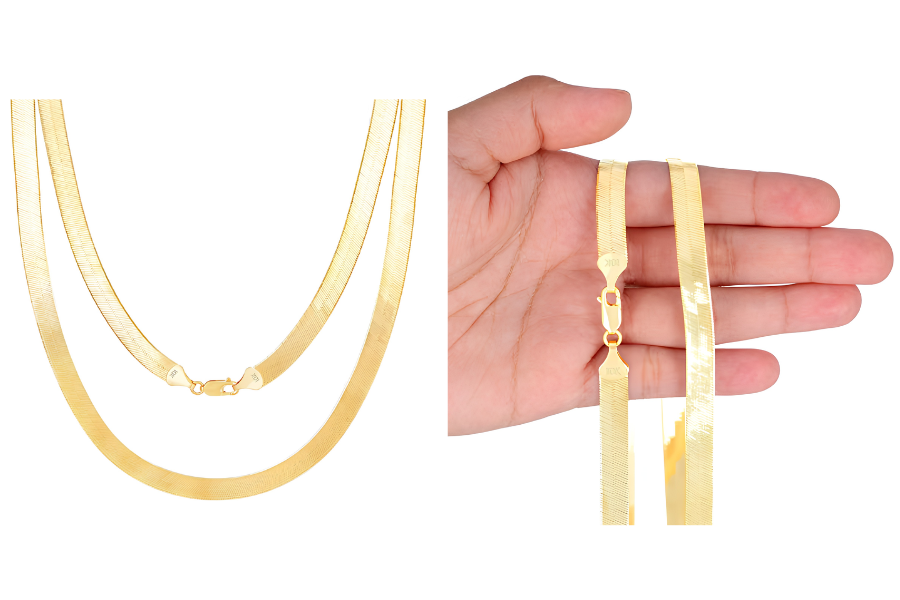
10K Real Yellow Gold Herringbone 8mm Chain Necklace |
|
|
Tap On The Image To Dive Deeper Into The Style Of This 10K Real Yellow Gold Herringbone 8mm Chain Necklace! |
|
|
8) How to Choose a Herringbone ChainGo To Table Of Contents |
Choose a herringbone chain by considering how often you will wear it, the appearance you prefer and the amount of care you can provide. Begin with a material and finish that fit your budget and maintenance expectations. Next, select a width and length that suit your proportions, neckline and preferred level of visual impact.
Construction and workmanship are equally important because the flat links must remain properly aligned for the chain to look smooth. Compare the stated dimensions, weight and metal description instead of judging size or quality from photographs alone. Before buying, also consider whether the chain is solid or hollow, how securely the clasp operates and what protection the seller provides if a problem develops.
|
|
8.a) What Width Herringbone Chain Should You Choose?Back To Table Of Contents |
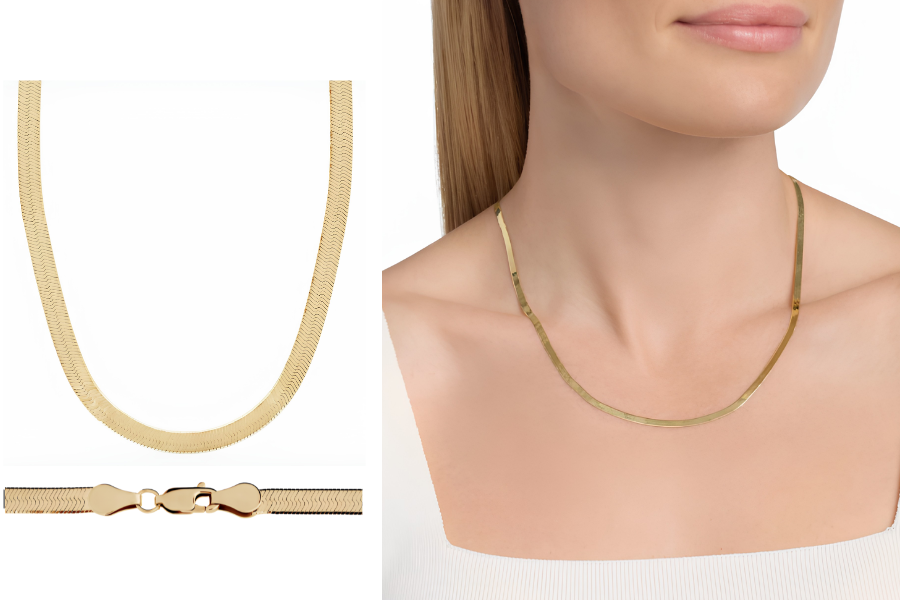
The best herringbone chain width depends on how noticeable you want the necklace to appear. As a practical guide, widths around 2–3 mm create a slim, understated look. A 4–5 mm chain offers a more visible but versatile presence, while widths of 6 mm or more produce a bold statement. These categories are approximate because the finish and link proportions can change how wide a chain appears.
Consider how the width relates to your neck, clothing and other jewelry. A wider chain has greater visual weight and may also feel heavier during extended wear. However, width alone does not determine strength, durability or value; metal thickness and solid or hollow construction also matter. Therefore, check the stated millimeter measurement and weight instead of relying only on enlarged product photographs.
18 Inches Herringbone Chain In
|
|
|
Discover Every Angle Of This 18 Inches Herringbone Chain In 14K Italian Yellow Gold 3 mm. Click On The Image To View! |
|
|
8.b) What Length Herringbone Chain Should You Choose?Back To Table Of Contents |
Choose a herringbone chain length according to where you want the necklace to rest. On many wearers, a 16-inch chain sits near the base of the neck, while an 18-inch chain reaches the collarbone and provides a versatile fit. A 20-inch chain falls slightly lower, whereas lengths of 22–24 inches create a more relaxed look across the upper chest.
However, the same length will not sit identically on everyone. Neck size, body proportions and chain width can change the final position, and a wide chain may feel closer-fitting than a narrow one. Before ordering, place a soft measuring tape or piece of string around your neck at the desired level. Also consider the necklines you commonly wear and make sure the chain can follow a smooth curve without feeling tight.
| Category | Typical Size | General Effect or Position |
|---|---|---|
| Slim Width | 2–3 mm | Creates a subtle, lightweight and understated appearance |
| Medium Width | 4–5 mm | Provides a visible but versatile presence |
| Wide Width | 6 mm or more | Produces a bold and visually prominent statement |
| Short Length | 16 inches | Usually rests near the base of the neck |
| Collarbone Length | 18 inches | Typically reaches the collarbone and offers a versatile fit |
| Medium Length | 20 inches | Generally falls slightly below the collarbone |
| Long Length | 22–24 inches | Creates a more relaxed look across the upper chest |
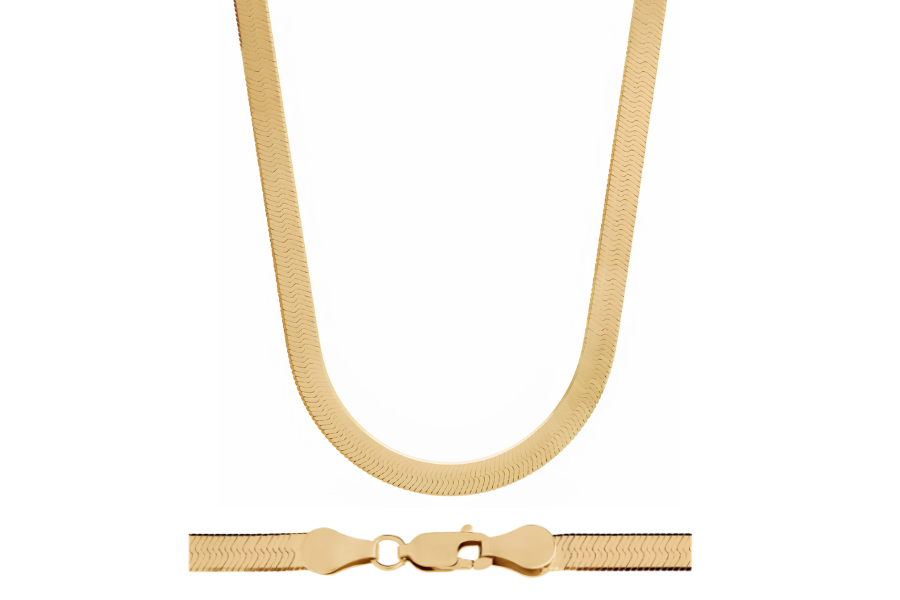
20 Inches Herringbone Chain In 14K Yellow Gold 4mm |
|
|
Click The Image To See Why This 20 Inches Herringbone Chain In 14K Yellow Gold 4mm Stands Out! |
|
|
8.c) Solid vs Hollow Herringbone ChainsBack To Table Of Contents |
A solid herringbone chain contains metal throughout its links, while a hollow chain has empty space inside them. Solid construction should not be confused with metal purity. For example, a solid 14K gold chain is not pure gold; “solid” means it is not hollow, while “14K” identifies the proportion of gold in the alloy.
At comparable dimensions and karat quality, a solid chain contains more metal, weighs more and usually costs more. However, it generally resists crushing and denting better than a hollow version. A hollow chain offers a wider appearance with less weight and a lower price, but its thin walls can deform more easily. Therefore, solid construction is usually the better choice for longevity, while hollow construction suits buyers who prioritize size, lightness and affordability and can handle the chain carefully.
|
|
8.d) What Should You Check Before Buying a Herringbone Chain?Back To Table Of Contents |
Before buying a herringbone chain, confirm the metal, purity and construction. A gold chain should carry a karat mark, such as 10K, 14K or 18K, while sterling silver may be marked “925” or “Sterling.” For plated jewelry, check the base metal and type of coating. Also determine whether the chain is solid or hollow, and compare its stated length, width and weight.
Next, examine the workmanship. The chain should lie smoothly without visible kinks, dents or raised links. Its pattern should appear even, while the clasp and end connections should feel secure and operate easily. When shopping online, inspect clear close-up photographs and read the specifications instead of relying only on the main product image.
Finally, research the seller and obtain the return, refund and warranty terms in writing. Check whether the seller offers inspections or repairs and how accidental damage is handled. These details matter because a herringbone chain can be difficult to restore after severe bending or link damage.
|
|
9) How to Clean and Care for a Herringbone ChainGo To Table Of Contents |
Clean and care for a herringbone chain gently because its appearance depends on keeping the flat links aligned. After wearing it, wipe the surface with a soft, lint-free cloth to remove skin oils and residue. Keep the chain away from perfume, lotion, chlorine and harsh household chemicals. However, the safest cleaning method will also depend on whether the chain is solid gold, sterling silver, stainless steel or plated.
Handle the chain along its natural curve and never fold, twist or scrub it aggressively. When it is not being worn, keep it flat, dry and separate from other jewelry. In addition, inspect the links and clasp periodically for bends, raised sections or loose connections. If the chain tangles, kinks or breaks, avoid pulling or forcing it back into shape because this may worsen the damage.
|
|
9.a) How to Clean a Herringbone ChainBack To Table Of Contents |
Before cleaning a herringbone chain, lay it flat and check for kinks, raised links or loose connections. If you notice damage, stop and take the chain to a jeweler. For an intact solid-metal chain, mix a few drops of mild dish soap with lukewarm water in a small bowl. Gently wipe the links with a soft, lint-free cloth while keeping the chain supported and flat.
If dirt remains between the links, use an extremely soft brush with light strokes in the direction of the pattern. Do not scrub across the links or bend the chain while cleaning. Rinse it carefully with clean water, blot away moisture and allow it to dry completely on a flat towel.
Use extra caution with gold-plated, vermeil or coated chains because excessive rubbing and prolonged soaking may wear the surface. Avoid toothpaste, baking soda, bleach and other abrasive or harsh cleaners. Furthermore, do not use an ultrasonic or steam cleaner unless the manufacturer or a qualified jeweler confirms that the chain’s material and construction can tolerate it.
|
|
9.b) How to Store a Herringbone ChainBack To Table Of Contents |
Store a herringbone chain flat in a straight line or broad, natural curve. Fasten the clasp, then place the chain in a long, soft-lined jewelry box or tray that supports its entire length. Do not fold it sharply, wind it into a tight coil or drop it loosely into a small pouch because these actions can force the links out of alignment.
Keep the chain separate from other jewelry so clasps, gemstones and textured links cannot scratch or press against its surface. Nothing should rest on top of it. In addition, choose a cool, dry storage area away from direct sunlight, humidity and household chemicals. A sterling silver chain may benefit from an anti-tarnish bag or strip, provided the chain still has enough room to remain flat.
|
|
9.c) What Should You Do If a Herringbone Chain Tangles or Kinks?Back To Table Of Contents |
If a herringbone chain becomes tangled or twisted, unclasp it and place it on a clean, soft surface under good lighting. First, determine whether one section has simply crossed over another or whether the links have developed a sharp bend. A loose overlap may release with slow fingertip movements, but stop immediately if the chain resists or the links begin to lift.
A true kink appears as a fixed angle, ridge or dent that remains after the chain is laid flat. Do not tug, twist, massage or press the damaged section under a heavy object. Also avoid using needles, pliers or other hard tools that may scratch or stretch the links. Stop wearing the chain, keep it flat and take it to a qualified jeweler for assessment. If any part has detached, save it and bring it with the chain.
|
|
9.d) Can a Kinked or Broken Herringbone Chain Be Repaired?Back To Table Of Contents |
A kinked or broken herringbone chain can sometimes be repaired, but the result depends on the severity and location of the damage. A jeweler may carefully straighten a minor bend or reconnect a clean break through soldering or laser welding. If several links are crushed or misaligned, the damaged section may need to be removed and replaced with matching links.
Herringbone repairs are challenging because the flat links must remain aligned and flexible. Even after professional work, the repaired area may show a slight mark, feel stiffer or remain weaker than the surrounding chain. Thin, hollow or plated chains can be especially difficult to restore. Therefore, ask a qualified jeweler to compare the likely appearance, strength and repair cost with the cost of replacing the chain.
| Care Area | Do | Don’t |
|---|---|---|
| Handling | Support the chain along its natural curve and handle it gently | Fold, twist, pull or force the flat links |
| Cleaning | Use a soft, lint-free cloth and a material-appropriate cleaning method | Use toothpaste, baking soda, bleach or abrasive cleaners |
| Chemicals and Water | Remove the chain before swimming, showering or applying personal-care products | Expose it unnecessarily to chlorine, perfume, lotion or household chemicals |
| Storage | Fasten the clasp and store the chain flat, dry and separate from other jewelry | Fold it sharply, coil it tightly or place heavy objects on it |
| Kinks or Damage | Stop wearing the chain and ask a qualified jeweler to examine it | Straighten it forcefully or use needles, pliers or other hard tools |
|
|
10) Frequently Asked Questions About Herringbone ChainsGo To Table Of Contents |
Questions about herringbone chains often concern value, pricing and authenticity. The answers below explain how material, weight, construction, workmanship, condition and seller information affect whether a chain is worthwhile, why prices vary, what a gold chain may be worth and how buyers can verify its description.
|
|
10.a) Are Herringbone Chains Worth It?Back To Table Of Contents |
A herringbone chain can be worth buying if you value its sleek, reflective appearance and are willing to handle it carefully. Its broad surface creates a noticeable look without requiring a pendant. A well-made chain in solid gold, sterling silver or stainless steel may provide years of use when its links are protected from sharp bends, crushing and twisting.
However, a herringbone chain may not suit someone who wants a rugged, low-maintenance necklace for continuous wear. Thin, hollow and plated versions can cost less, but they may be more vulnerable to deformation or surface wear. Therefore, judge the chain by its material, weight, construction, workmanship and seller protection rather than appearance alone.
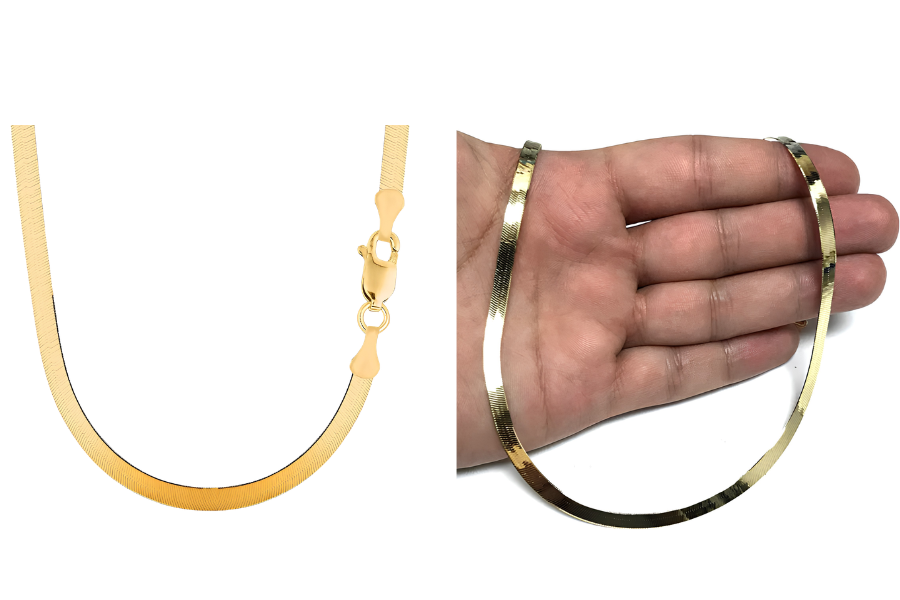
14K Yellow Solid Gold Herringbone Chain Necklace 4.7mm |
|
|
Click On The Image To Zoom In On The Details Of This Irresistible 14K Yellow Solid Gold Herringbone Chain Necklace 4.7mm! |
|
|
10.b) Why Are Herringbone Chains Expensive?Back To Table Of Contents |
Herringbone chains can be expensive because their broad surfaces may require a substantial amount of precious metal. A longer, wider or solid chain generally contains more metal and costs more than a shorter, narrower or hollow version. Gold karat also affects the price because a higher karat indicates a greater proportion of pure gold in the alloy.
Manufacturing quality adds to the cost. The flat links must be shaped, joined and aligned precisely so the chain forms a smooth pattern and moves along its natural curve. Polishing, decorative finishes, a secure clasp and careful quality control can increase the price further. Brand positioning, seller margins, warranties and repair services also contribute. However, stainless steel and plated herringbone chains are usually more affordable because they contain little or no precious metal.
|
|
10.c) How Much Is a Gold Herringbone Chain Worth?Back To Table Of Contents |
There is no single fixed value for a gold herringbone chain. Its basic metal value depends mainly on its verified karat, weight in grams and the current price of pure gold. A simple estimate is: chain weight × (karat ÷ 24) × current gold price per gram. For example, 14K gold contains approximately 58.3% pure gold, while 18K gold contains 75%.
This calculation estimates only the contained-gold value. A retail or replacement price may be higher because it includes manufacturing, finishing, clasp quality, brand and seller costs. A resale or scrap offer may be lower after testing, refining and dealer expenses. Condition, construction and market demand can also influence the price. Gold-plated and vermeil chains should not be valued as though their entire weight were solid gold. For a reliable estimate, have a jeweler verify the karat and weight before comparing the results with the current gold price.
|
|
10.d) How Can You Tell if a Herringbone Chain Is Real?Back To Table Of Contents |
First, determine what “real” means in the product description. A chain can have an authentic herringbone pattern while being made from solid gold, gold-filled metal, vermeil or gold-plated base metal. Genuine herringbone construction consists of closely connected, slanted flat links that form a smooth, repeating V-shaped pattern.
For a gold herringbone chain, examine the clasp or end tag for a purity mark. Common marks include 10K, 14K and 18K, as well as their approximate numerical equivalents: 417, 585 and 750. Also look for a maker’s name, initials or registered trademark. However, a stamp alone does not prove authenticity because markings can be missing, altered or counterfeit.
Next, inspect the edges and high-contact areas for peeling, fading or a different-colored metal beneath the surface. These signs may indicate plating. Magnet tests and other home methods are not conclusive, while acid testing can damage the chain. Therefore, the safest approach is to have a reputable jeweler verify the metal with professional testing equipment and provide a written assessment when the chain has significant value.
Explore More Chain Styles
 |
Anchor Chain Style |  |
|
Ball Chain Style |  |
|
Box Chain Style |  |
|
Byzantine Chain Style |  |
|
Curb Chain Style |  |
|
Figaro Chain Style |  |
|
Omega Chain Style |  |
|
Snake Chain Style |  |
|
Rope Chain Style |  |
|
Wheat Chain Style |  |
