The Eureka Diamond is generally recognized as the first authenticated diamond discovered in South Africa. Found near Hopetown in 1866, the historic brownish-yellow stone helped reveal the country’s diamond potential. This guide explores its discovery, size, cut, value, ownership, historical importance, and present location.
Eureka Diamond
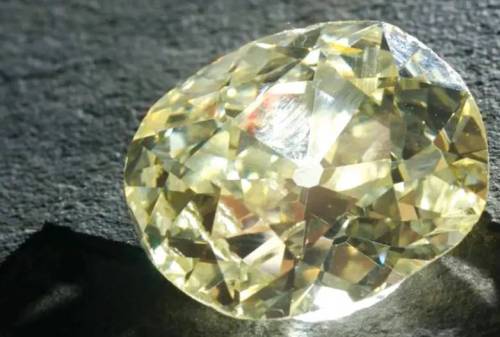
Table Of Contents

|
1) What Is the Eureka Diamond?Go To Table Of Contents |
The Eureka Diamond is a historic brownish-yellow natural diamond generally recognized as the first authenticated diamond found in South Africa. Fifteen-year-old Erasmus Stephanus Jacobs found the rough stone near Hopetown on the Orange River in 1866. Mineralogist William Guybon Atherstone identified it as a diamond in 1867, bringing wider attention to the discovery.
The rough stone weighed approximately 21.25 carats. It was later fashioned into a 10.73-carat cushion-shaped brilliant. Today, the diamond is displayed at the Kimberley Mine Museum in South Africa.
Although modest in size compared with many other famous diamonds, the Eureka Diamond represents a turning point in South African history. Its authentication drew attention to the region’s diamond potential. Later discoveries helped trigger the South African diamond rush and transformed the international diamond industry.

|
1.a) Eureka Diamond Key FactsBack To Table Of Contents |
| Fact | Detail |
|---|---|
| Discovery Date | Found in 1866 and authenticated as a diamond in 1867 |
| Finder | Fifteen-year-old Erasmus Stephanus Jacobs |
| Discovery Location | Near Hopetown on the Orange River in South Africa’s Northern Cape region |
| Authentication | Identified as a diamond by mineralogist William Guybon Atherstone in 1867 |
| Original Rough Weight | Approximately 21.25 carats |
| Polished Weight | 10.73 carats |
| Color | Brownish yellow |
| Cut and Shape | Cushion-shaped brilliant |
| Historical Importance | Generally recognized as the first authenticated diamond discovered in South Africa |
| Return to South Africa | De Beers acquired the diamond in 1967 and presented it to the people of South Africa |
| Present Location | Kimberley Mine Museum in Kimberley, South Africa |
|
|
2) Who Found the Eureka Diamond?Go To Table Of Contents |
Erasmus Stephanus Jacobs is credited with finding the Eureka Diamond. He was fifteen years old when he encountered the unusual rough stone near Hopetown in South Africa in 1866. Neither Erasmus nor his family initially recognized the pebble as a diamond.
Finding the stone and establishing its identity were separate stages of the story. The rough diamond attracted the attention of the Jacobs family’s neighbor, Schalk van Niekerk. It was subsequently carried for examination by John O’Reilly before mineralogist William Guybon Atherstone authenticated it as a diamond in 1867.
Although several people contributed to the stone’s identification, Erasmus Jacobs remains recognized as its finder. His chance discovery became historically significant only after examination confirmed the pebble’s true nature.
|
|
2.a) Erasmus Jacobs and the 1866 DiscoveryBack To Table Of Contents |
In 1866, fifteen-year-old Erasmus Stephanus Jacobs encountered an unusually bright pebble near his family’s home outside Hopetown. At first, neither Erasmus nor his family knew that the stone was valuable. They treated it as an interesting natural object rather than a potentially important gemstone.
However, the pebble later attracted the attention of their neighbor, Schalk van Niekerk. He took an interest in unusual rocks and minerals. The Jacobs family allowed him to have the stone examined because they considered it an ordinary pebble.
Therefore, the Eureka Diamond discovery did not begin with organized mining or deliberate prospecting. Instead, a teenager’s chance find revealed the first evidence of South Africa’s extraordinary diamond resources. Historical accounts consequently credit Erasmus Jacobs with discovering the stone that became the Eureka Diamond.
|
|
2.b) Where Was the Eureka Diamond Found?Back To Table Of Contents |
The Eureka Diamond was found near Hopetown on the banks of the Orange River in 1866. At the time, the area formed part of the Cape Colony. Today, Hopetown lies in South Africa’s Northern Cape province.
Importantly, Erasmus Jacobs encountered the stone as a loose pebble rather than inside an established diamond mine. The discovery site was also far from Kimberley, despite the diamond’s later association with that city.
Kimberley became important after subsequent discoveries encouraged intensive diamond mining in the region. Moreover, the Eureka Diamond eventually returned to South Africa for public display at the Kimberley Mine Museum. Therefore, its discovery location near Hopetown and its present location in Kimberley represent two separate parts of its history.
|
|
2.c) How Was It Identified as a Diamond?Back To Table Of Contents |
After the pebble attracted Schalk van Niekerk’s attention, he entrusted it to travelling trader John O’Reilly. O’Reilly then took the stone to Colesberg to investigate its identity and possible value.
There, acting civil commissioner Lorenzo Boyes examined the pebble. The stone scratched glass, so Boyes suspected that it might be a diamond. However, that simple test alone could not provide conclusive identification.
Therefore, O’Reilly sent the stone to mineralogist William Guybon Atherstone in Grahamstown. After examining it, Atherstone confirmed in 1867 that the pebble was a genuine diamond. He also recorded its rough weight at approximately 21.25 carats.
This professional authentication transformed an overlooked pebble into the Eureka Diamond. Moreover, it provided the first widely recognized evidence that South Africa contained significant diamond resources.
|
|
3) Eureka Diamond Size, Color, and CutGo To Table Of Contents |
The Eureka Diamond originally weighed approximately 21.25 carats in its rough form. After cutting and polishing, it became a 10.73-carat cushion-shaped brilliant. Although the cutting process reduced its weight substantially, it gave the stone a more balanced shape and faceted appearance.
The diamond displays a noticeable brownish-yellow body color. Unlike many famous colorless diamonds, the Eureka retains a warm and distinctly historical appearance. However, widely available descriptions do not provide a modern laboratory color or clarity grade.
Together, its size, color, and cut make the Eureka Diamond easy to distinguish from larger and more colorless historic stones. Nevertheless, its importance comes primarily from its discovery and historical influence rather than exceptional carat weight or gemological quality.
|
|
3.a) Original Rough WeightBack To Table Of Contents |
Most modern accounts record the Eureka Diamond’s original rough weight as approximately 21.25 carats, equivalent to about 4.25 grams. This measurement describes the uncut stone before a lapidary shaped and polished it.
However, some historical accounts report a rough weight of 24 carats. This difference appears to reflect inconsistencies among early records rather than a second weighing of another stone. Therefore, 21.25 carats remains the most widely accepted figure.
Carat weight measures mass rather than physical dimensions. Consequently, the rough weight does not reveal the stone’s exact length or width. Nevertheless, it provides the clearest basis for comparing the original discovery with the polished 10.73-carat diamond seen today.
|
|
3.b) Polished Weight and Cushion CutBack To Table Of Contents |
After cutting and polishing, the Eureka Diamond weighs 10.73 carats. The finished stone retains slightly more than half of its widely accepted 21.25-carat rough weight. Thus, the cutting process removed approximately 10.52 carats of material.
Such weight loss is normal when a lapidary transforms an irregular rough diamond into a finished gemstone. The cutter must remove unsuitable material while creating a balanced outline and an effective facet arrangement. However, surviving public accounts do not consistently identify the cutter or provide a detailed cutting plan.
The finished Eureka Diamond has a cushion-shaped brilliant cut. This design combines a softly squared or rectangular outline with rounded corners. Meanwhile, its brilliant-style facets create stronger reflections than the unpolished rough surface. The resulting shape highlights the diamond’s warm brownish-yellow appearance while giving the historic stone a recognizable polished form.
|
|
3.c) Why Is the Eureka Diamond Brownish Yellow?Back To Table Of Contents |
A diamond’s color depends on how its crystal structure absorbs and transmits visible light. In many natural yellow diamonds, nitrogen-related defects absorb part of the blue region of the spectrum. Consequently, the transmitted light gives the stone a yellow appearance.
Gemologists describe the Eureka Diamond as brownish yellow rather than purely yellow. Brown components in natural diamonds can arise from structural deformation or from combinations of atomic-level defects. However, different mechanisms can produce similar visible colors.
No widely available modern laboratory report identifies the exact defects responsible for the Eureka Diamond’s color. Therefore, assigning it a precise diamond type or color mechanism would involve speculation. Lighting and facet arrangement may also influence its visible appearance, although they do not create its underlying body color.
|
|
4) How Much Is the Eureka Diamond Worth?Go To Table Of Contents |
No reliable public figure establishes the Eureka Diamond’s present monetary value. The stone belongs to South Africa’s historical heritage and remains on public display rather than on the commercial diamond market. Consequently, online estimates should not be treated as verified appraisals.
Historical records provide several earlier transaction amounts. The stone reportedly changed hands for £500 during the nineteenth century. Later, a Christie’s auction sold the diamond as part of a bangle for £5,700 in 1946. However, those amounts reflect their respective historical markets and cannot establish its value today.
A modern valuation would require an expert to examine the diamond’s present condition, color, clarity, cut, and provenance. Moreover, its importance as South Africa’s first authenticated diamond could add substantial historical value beyond its gemological characteristics. Therefore, its current monetary worth remains undetermined.
|
|
4.a) Historical Valuations and SalesBack To Table Of Contents |
The Eureka Diamond’s earliest documented purchase occurred after its identification and public exhibition. Sir Philip Wodehouse, then governor of the Cape Colony, bought the rough diamond for £500. He subsequently took it to Britain, where it was later cut and passed through several private owners.
The diamond returned to the auction market on April 16, 1946. Christie’s sold it in London as the central stone in a diamond bangle. The complete jewel reportedly achieved £5,700 at the public auction.
These amounts record two stages in the Eureka Diamond’s ownership history. However, they should not be treated as direct estimates of its present value. Changes in currency, the diamond market, provenance, and the historical importance of the stone make a simple conversion into modern money misleading.
|
|
4.b) Does the Eureka Diamond Have a Present Market Value?Back To Table Of Contents |
The Eureka Diamond does not have a publicly verified present market value. It has not appeared in a recent public sale that could establish a current price. Instead, it remains a historic museum object associated with the people of South Africa.
A qualified appraiser could estimate the value of its 10.73-carat brownish-yellow stone. However, that calculation would require reliable information about its clarity, condition, color grade, cut quality, and laboratory classification. These details are not fully available in published records.
Moreover, the Eureka Diamond carries considerable historical value as South Africa’s first authenticated diamond discovery. Its provenance may therefore make it more significant than another diamond with similar physical characteristics. Any precise price quoted without a recent appraisal or public sale would be speculative.
|
|
5) Why Is the Eureka Diamond Important?Go To Table Of Contents |
The Eureka Diamond is important because it provided the first authenticated evidence of a natural diamond discovery in South Africa. Although modest beside many famous diamonds, the stone changed how people viewed the region’s geology and mineral potential.
Its discovery also marked the beginning of a much larger historical transformation. Prospectors, merchants, and mining interests began paying closer attention to South Africa. However, the Eureka Diamond alone did not immediately cause a major diamond rush.
Instead, later discoveries confirmed that the Eureka was not an isolated stone. These finds encouraged intensive prospecting and eventually helped establish South Africa as a leading source of diamonds. Therefore, the Eureka Diamond represents the starting point of a discovery sequence that reshaped the country and the international diamond industry.
|
|
5.a) Was It South Africa’s First Diamond?Back To Table Of Contents |
The Eureka Diamond is generally recognized as the first authenticated diamond discovered in South Africa. Erasmus Jacobs found the rough stone near Hopetown in 1866. However, experts did not confirm its identity until mineralogist William Guybon Atherstone examined it in 1867.
Calling it South Africa’s “first diamond” requires some qualification. Diamonds may have existed or even been encountered in the region before the Eureka discovery. Nevertheless, no earlier South African find has the same widely accepted record of identification and authentication.
Therefore, “the first authenticated diamond discovered in South Africa” is the most precise description. This wording recognizes the Eureka Diamond’s historical position without claiming that no person had ever encountered a South African diamond before it.
|
|
5.b) Its Connection to the South African Diamond RushBack To Table Of Contents |
The Eureka Diamond alerted people to South Africa’s potential as a source of diamonds. However, its authentication in 1867 generated curiosity rather than an immediate large-scale rush. Many observers initially regarded the stone as an isolated discovery.
Interest increased after the much larger Star of South Africa diamond was found near Hopetown in 1869. This discovery offered stronger evidence that the region contained valuable diamond deposits. Consequently, more prospectors began searching along the Orange and Vaal river systems.
The major rush intensified after further discoveries around present-day Kimberley in the early 1870s. Thousands of diggers arrived, mining settlements expanded, and increasingly organized operations replaced small-scale searching. Therefore, the Eureka Diamond did not cause the rush by itself. Instead, it provided the first authenticated sign of the diamond wealth that later discoveries confirmed.
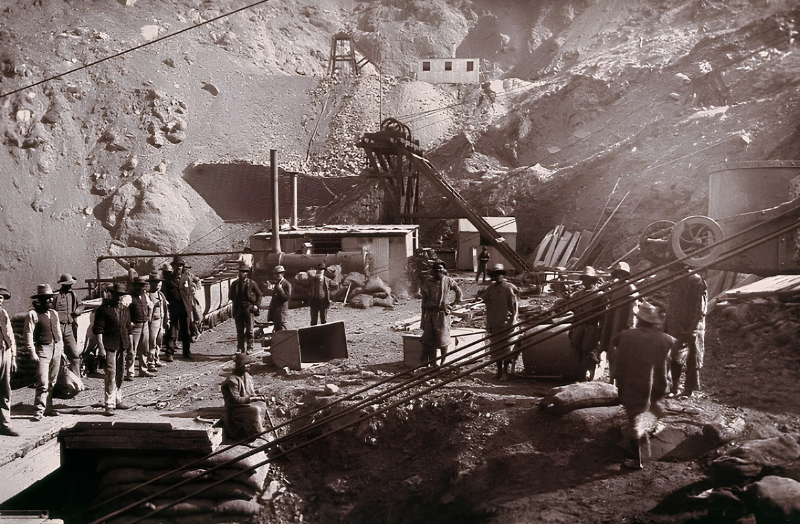
Image: Wellcome Collection. Licensed under the Public Domain Mark 1.0.
|
|
6) Ownership and Journey of the Eureka DiamondGo To Table Of Contents |
The Eureka Diamond followed a remarkable journey after experts authenticated it in 1867. Its discovery attracted public attention, and the stone soon became associated with exhibitions and prominent colonial figures. Sir Philip Wodehouse later purchased it for £500 and took it to Britain.
While in Britain, cutters transformed the 21.25-carat rough stone into a 10.73-carat cushion-shaped brilliant. The diamond subsequently passed through private hands and became part of a diamond bangle. Christie’s sold the jewel at a London auction in 1946.
A century after the Eureka Diamond’s identification, De Beers acquired it in 1967. The company then presented the historic stone to the people of South Africa. As a result, the diamond returned to the country where its extraordinary story had begun.
|
|
6.a) Exhibition, Cutting, and Later OwnersBack To Table Of Contents |
The Eureka Diamond became a public attraction soon after its authentication. Historical accounts connect it with the Cape Colony’s display at the 1867 Paris Exhibition. However, some sources state that the exhibition showed a glass replica while the original stone went to Windsor for Queen Victoria’s inspection. Therefore, the identity of the stone displayed in Paris remains uncertain.
Sir Philip Wodehouse, governor of the Cape Colony, later purchased the rough diamond for £500. When he returned to Britain in 1870, he took the Eureka Diamond with him. Cutters subsequently transformed the approximately 21.25-carat rough into a 10.73-carat cushion-shaped brilliant.
The diamond then passed through British private ownership. Published accounts associate it with the family of the Marquess of Bute, although publicly accessible records do not provide a complete chain of ownership. Eventually, it became the central stone in a diamond bangle.
On April 16, 1946, Christie’s offered the bangle at a public auction in London. It sold for £5,700 to an unidentified buyer. The Eureka Diamond remained outside South Africa until De Beers acquired it in 1967 and returned it to the country.
|
|
6.b) Where Is the Eureka Diamond Now?Back To Table Of Contents |
The Eureka Diamond is displayed at the Kimberley Mine Museum in Kimberley, South Africa. The museum forms part of the historic Big Hole complex in the Northern Cape, a region closely associated with the country’s early diamond-mining industry.
De Beers acquired the diamond in 1967, approximately a century after its authentication. The company then presented it to the people of South Africa. Consequently, the stone returned after spending much of the previous century in Britain.
Its museum setting reflects the Eureka Diamond’s importance as a national historical object. Visitors can view the 10.73-carat cushion-shaped brilliant while learning about the discoveries that transformed Kimberley and South Africa’s diamond industry.
|
|
7) Eureka Diamond TimelineGo To Table Of Contents |
The Eureka Diamond’s timeline begins with a chance discovery and continues through authentication, international attention, private ownership, and its eventual return to South Africa.
| Date or Period | Event | Historical Significance |
|---|---|---|
| 1866 | Fifteen-year-old Erasmus Stephanus Jacobs finds an unusual rough stone near his family’s home outside Hopetown. | The chance discovery begins the recorded history of the Eureka Diamond. |
| 1867 | Mineralogist William Guybon Atherstone confirms that the approximately 21.25-carat stone is a diamond. | The Eureka becomes the first authenticated diamond discovered in South Africa. |
| 1867 | Historical accounts connect the Eureka with the Paris Exhibition. However, sources disagree over whether the original diamond or a glass replica appeared there. | The exhibition story reflects the international attention surrounding the discovery. |
| Late 1860s | Sir Philip Wodehouse, governor of the Cape Colony, purchases the Eureka Diamond for £500. | This becomes the diamond’s first widely documented purchase. |
| 1870 and after | Wodehouse takes the Eureka Diamond to Britain, where cutters fashion it into a 10.73-carat cushion-shaped brilliant. | Cutting transforms the original rough stone into the polished diamond known today. |
| April 16, 1946 | Christie’s auctions the Eureka Diamond in London as the central stone of a diamond bangle. | The jewel sells for £5,700 to an unidentified buyer. |
| 1967 | De Beers acquires the Eureka Diamond and presents it to the people of South Africa. | The historic diamond returns to South Africa approximately a century after its authentication. |
| Present | The Eureka Diamond is displayed at the Kimberley Mine Museum in the Northern Cape. | Its museum display preserves the stone as an important part of South Africa’s diamond history. |
|
|
8) Frequently Asked QuestionsGo To Table Of Contents |
The following answers address common questions about the Eureka Diamond, including its discovery, physical characteristics, historical importance, value, and present location.
|
|
8.a) Was the Eureka Diamond South Africa’s First Diamond?Back To Table Of Contents |
Yes. The Eureka Diamond is generally recognized as the first authenticated diamond discovered in South Africa. Erasmus Jacobs found it in 1866, and mineralogist William Guybon Atherstone confirmed its identity in 1867. However, this distinction does not prove that nobody had encountered an unrecognized South African diamond earlier.
|
|
8.b) How Large Was the Original Eureka Diamond?Back To Table Of Contents |
The original rough Eureka Diamond weighed approximately 21.25 carats, or about 4.25 grams. Although some historical accounts report a weight of 24 carats, 21.25 carats is the most widely accepted figure. Cutting later reduced the diamond to its present polished weight of 10.73 carats.
|
|
8.c) How Much Does the Polished Eureka Diamond Weigh?Back To Table Of Contents |
The polished Eureka Diamond weighs 10.73 carats, or approximately 2.15 grams. Cutters fashioned the original rough stone into a cushion-shaped brilliant, removing about 10.52 carats of material in the process. Such weight loss is normal because cutting removes material to improve a diamond’s shape, proportions, and appearance.
|
|
8.d) What Color Is the Eureka Diamond?Back To Table Of Contents |
The Eureka Diamond is generally described as brownish yellow. However, publicly available records do not provide a modern laboratory color report or an official fancy-color grade. Therefore, “brownish yellow” is the most accurate description without assigning the diamond an unsupported gemological classification.
|
|
8.e) How Much Is the Eureka Diamond Worth Today?Back To Table Of Contents |
The Eureka Diamond has no publicly verified present market value because it has not entered a recent public sale. Moreover, a reliable appraisal would require current information about its condition and gemological grades. Its unique place in South African history would also add substantial provenance value beyond the price of a comparable 10.73-carat diamond.
|
|
8.f) Where Is the Eureka Diamond Now?Back To Table Of Contents |
The Eureka Diamond is displayed at the Kimberley Mine Museum, part of the Big Hole complex in Kimberley, South Africa. De Beers acquired the historic stone in 1967 and presented it to the people of South Africa approximately a century after its authentication.
|
|
8.g) Did the Eureka Diamond Start the South African Diamond Rush?Back To Table Of Contents |
Not by itself. The Eureka Diamond provided the first authenticated evidence of South Africa’s diamond potential, but it caused only limited initial interest. The larger Star of South Africa discovery in 1869 and further finds near Kimberley subsequently attracted thousands of prospectors and triggered the major diamond rush.
See More Famous Diamonds As Follows
| The Orloff Diamond | The Cullinan Diamond |
| The Centenary Diamond | The Esperanza Diamond |