Stainless steel Byzantine chains combine an intricate, interwoven link pattern with the strength and low-maintenance qualities of stainless steel. This guide explains their construction, durability, styles, sizing, care, and how they compare with sterling silver and gold.
Table Of Contents

|
1) What Is a Stainless Steel Byzantine Chain?Go To Table Of Contents |
A stainless steel Byzantine chain is a necklace or bracelet made from stainless steel links arranged in the intricate, interlocking pattern associated with the Byzantine chain style. Rather than forming a simple sequence of links, multiple rings weave over, under, and through one another to create the chain’s characteristic textured appearance.
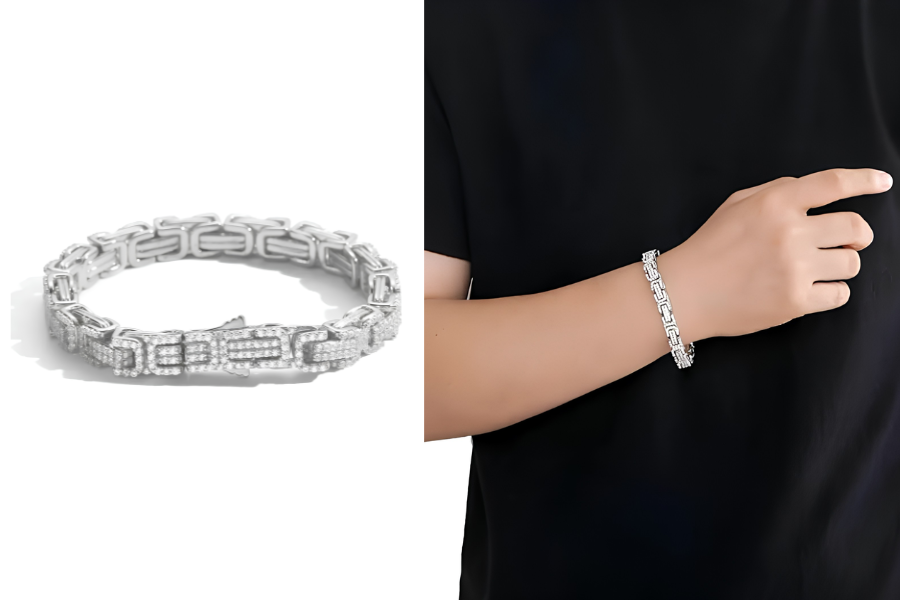
Mens Micro-Inlaid Zircon Stainless Steel Byzantine Chain Bracelet |
|
|
Tap The Image To Reveal Full Details Of This Elegant Mens Micro-Inlaid Zircon Stainless Steel Byzantine Chain Bracelet! |
Stainless steel gives this traditional chain design a distinctly practical character. The metal is strong, resistant to corrosion, and relatively easy to maintain, making it well suited to an elaborate link structure that may be worn regularly. Its silvery-grey appearance can also range from highly polished and reflective to brushed or matte, while some chains use coatings or contrasting finishes to create gold-tone or two-tone designs.
The combination of an elaborate Byzantine weave and durable stainless steel produces a chain that can look substantial without relying on precious metal. Width, link size, finish, and length can further change its appearance, from a relatively restrained everyday chain to a bold statement piece.
Understanding how the links are constructed and how the finished weave looks helps explain what distinguishes a stainless steel Byzantine chain from simpler chain styles.

|
1.a) How Is a Stainless Steel Byzantine Chain Constructed?Back To Table Of Contents |
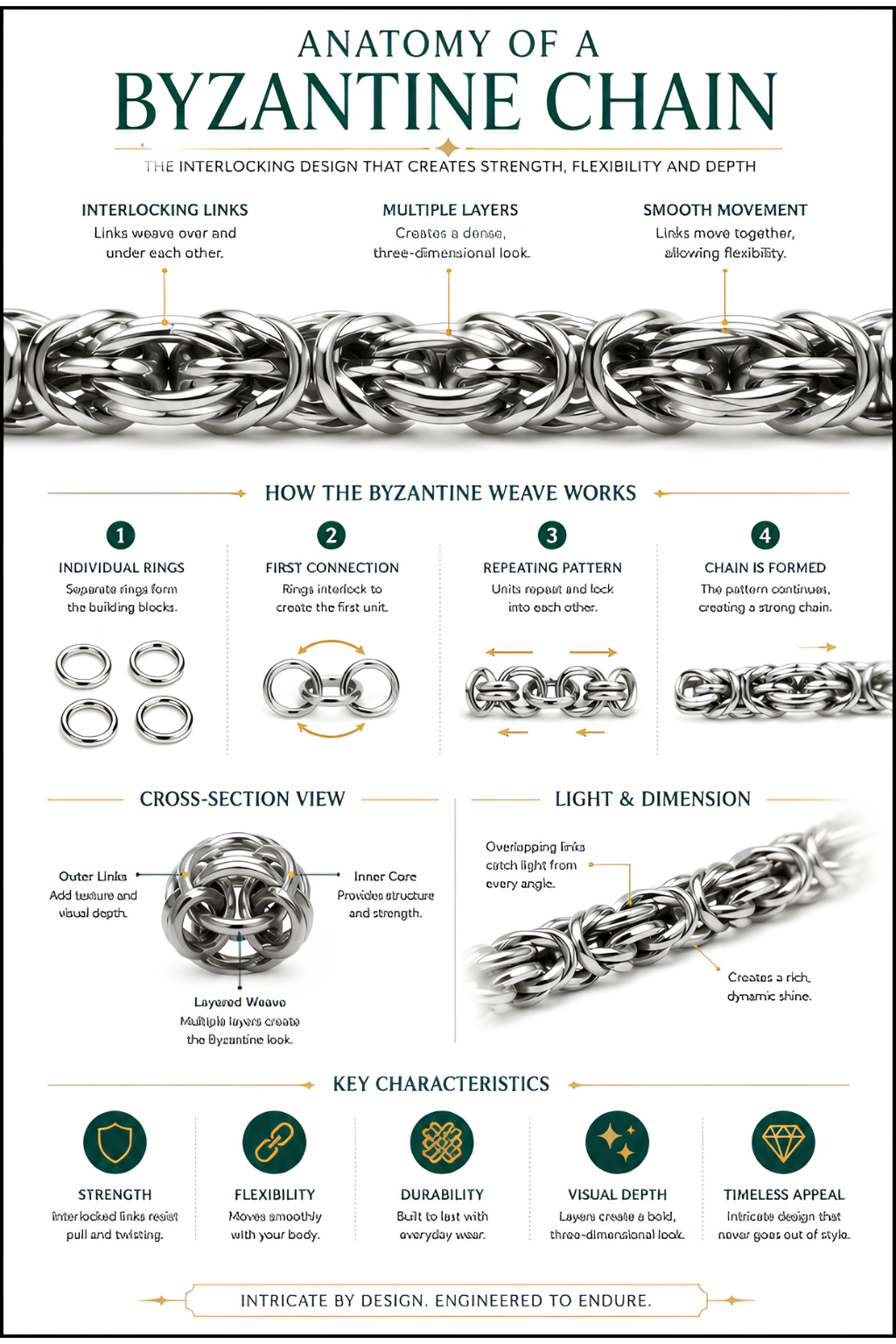
A stainless steel Byzantine chain is constructed from individual metal links that are interwoven into repeating groups rather than simply connected end to end. The links pass through and around neighboring links, producing the dense, layered structure that distinguishes the Byzantine weave from simpler chain patterns.
As each group of links is added, the pattern repeats along the length of the chain. This arrangement creates multiple visible layers and gives the chain its characteristic three-dimensional texture. Although the finished weave can appear complex and substantial, the individual links can move in relation to one another, allowing the chain to bend and drape around the neck or wrist.
The proportions of the links are important to the finished structure. Link diameter, wire thickness, and the relationship between them influence how tightly the links fit together. A tighter weave can create a dense, compact appearance, while different link proportions can produce a more open and visibly articulated pattern.
In stainless steel versions, the same Byzantine construction can be produced in different widths and finishes without changing the fundamental interwoven link pattern. This distinctive construction is responsible for much of the chain’s visual depth, which becomes particularly noticeable when light falls across its overlapping links.
|
|
1.b) What Does a Stainless Steel Byzantine Chain Look Like?Back To Table Of Contents |
A stainless-steel Byzantine chain has a dense, intricate appearance created by groups of interlocking links. Instead of forming a simple flat row, the links overlap and turn in different directions. This gives the chain a layered, three-dimensional look that resembles a carefully woven metal pattern.
The stainless steel surface can make this structure especially noticeable. Polished chains reflect light across the individual links, emphasizing the depth and complexity of the weave. Brushed or matte finishes produce a more subdued appearance while preserving the distinctive Byzantine pattern.
The overall look also changes with the chain’s width. Narrow Byzantine chains tend to appear refined and understated, while wider versions make the interwoven construction more prominent and create a bolder visual presence. Regardless of width or finish, the repeating layered link pattern is the defining visual characteristic of a Byzantine chain.
|
|
2) Why Choose a Stainless Steel Byzantine Chain?Go To Table Of Contents |
A stainless steel Byzantine chain combines the intricate appearance of the Byzantine weave with the practical qualities of stainless steel. This makes it an appealing option for someone who wants a substantial, detailed chain that can also cope well with regular wear.
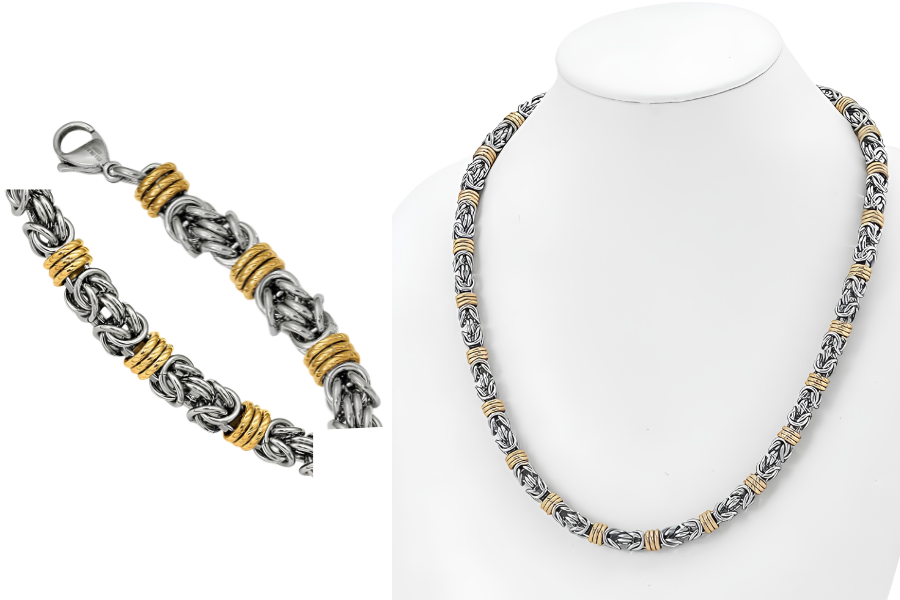
8.5mm Stainless Steel Gold Tone Plated Byzantine Chain Necklace |
|
|
Discover The Two-Tone Character Of Stainless Steel And Gold-Tone Plating. Tap The Image To Explore This 8.5mm Stainless Steel Gold Tone Plated Byzantine Chain Necklace! |
Durability is one of its main advantages. Stainless steel resists corrosion and generally requires less maintenance than some traditional jewelry metals. Its ability to retain its appearance with routine care can be particularly useful in a Byzantine chain, where numerous interlocking links create many surfaces and contact points.
Stainless steel also gives buyers considerable choice in appearance. It can be highly polished for a bright metallic look, given a brushed or matte finish, or treated with gold-tone and other coatings. This allows the same basic Byzantine weave to range from understated to bold.
Practical considerations such as weight, flexibility, skin sensitivity, and the particular grade of stainless steel are still important when choosing a chain. Understanding these characteristics makes it easier to decide whether stainless steel is the right material for the way you intend to wear your Byzantine chain.
|
|
2.a) Durability and Corrosion ResistanceBack To Table Of Contents |
Durability is one of the strongest reasons to choose a stainless steel Byzantine chain. Stainless steel is a hard, resilient material that stands up well to the knocks, friction, and repeated movement that jewelry can experience during regular wear.
This durability is particularly useful for a Byzantine chain because its design depends on numerous interlocking links. As the chain moves, individual links continually come into contact with neighboring links. A durable metal helps the weave maintain its structure and appearance over time, although any chain can still be scratched or damaged by sufficiently rough treatment.
Stainless steel also offers good resistance to corrosion. Chromium in the alloy forms a thin protective oxide layer on the surface, helping protect the underlying metal from corrosion when exposed to normal environmental conditions. If this passive layer is disturbed, it can reform when sufficient oxygen is present.
Corrosion resistance can vary according to the stainless steel grade and the conditions in which the jewelry is worn. Salt, chlorine, harsh chemicals, and prolonged exposure to demanding environments can still affect stainless steel. For everyday jewelry use, however, its combination of strength and corrosion resistance makes stainless steel particularly practical for a complex, link-intensive design such as the Byzantine chain.
|
|
2.b) Tarnish Resistance and Everyday WearBack To Table Of Contents |
Stainless steel Byzantine chains are valued for their resistance to tarnishing. Unlike metals that readily develop surface discoloration through reactions with air and moisture, stainless steel generally retains its metallic appearance with relatively little maintenance.
This quality is particularly useful in a Byzantine chain. Its intricate weave contains numerous overlapping links, recesses, and contact points that would make frequent polishing more time-consuming than with a simpler chain. A tarnish-resistant metal therefore makes the elaborate Byzantine pattern easier to maintain for regular wear.
Stainless steel is also well suited to everyday use because normal handling, perspiration, and exposure to the environment are less likely to cause rapid surface deterioration. However, tarnish resistance does not mean that the chain is maintenance-free. Skin oils, sweat, soap, cosmetics, and dirt can still collect between the tightly arranged links and gradually dull the finish.
Occasional cleaning and sensible care can help preserve the chain’s appearance. It is also wise to limit unnecessary contact with harsh chemicals, chlorine, and salt water. With routine care, a stainless steel Byzantine chain can provide the combination of an intricate decorative weave and practical everyday wearability.
|
|
2.c) Weight, Comfort, and FlexibilityBack To Table Of Contents |
The weight of a stainless steel Byzantine chain depends largely on its width, length, link thickness, and construction. Because the Byzantine weave uses numerous interlocking links, a wide or densely constructed chain can feel substantial around the neck. Narrower versions generally provide a lighter and less prominent option for everyday wear.
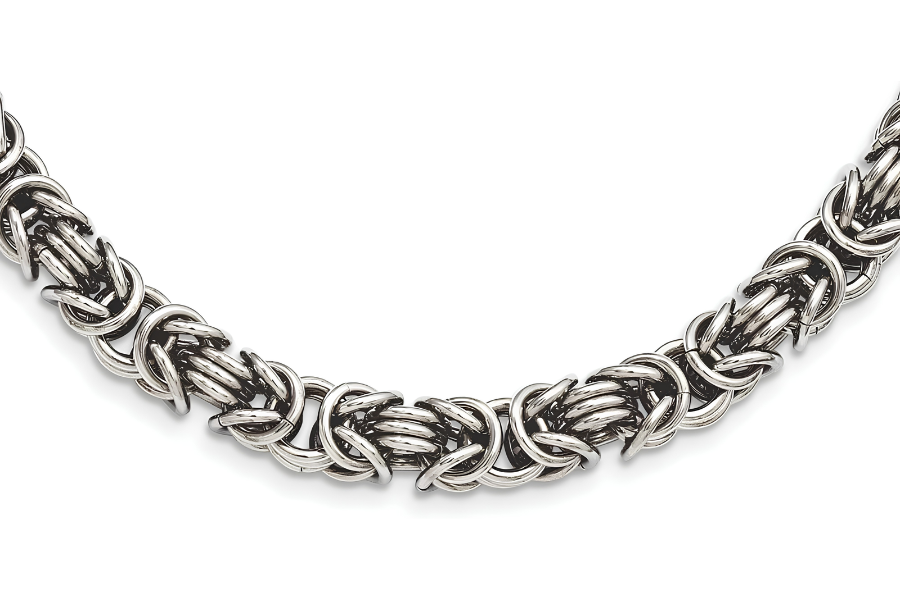
Men’s Stainless Steel 7mm Byzantine Link Chain Necklace |
|
|
Discover The Intricate Character And Strength Of Stainless Steel. Tap The Image To Explore This Men’s Stainless Steel 7mm Byzantine Link Chain Necklace! |
Weight alone does not determine comfort. A well-constructed Byzantine chain has many articulated links that allow the weave to bend and follow the contours of the neck. This flexibility helps distribute the chain’s weight rather than concentrating it at a few rigid points.
The intricate construction also means that link quality matters. Links should move smoothly without sharp edges, rough surfaces, or poorly finished joints that could catch on skin or clothing. The clasp should also be proportionate to the chain and comfortable against the neck.
Personal preference is important when choosing between a lighter and heavier Byzantine chain. Some wearers prefer the substantial feel of a wide chain, while others find a narrower, lighter version more comfortable for extended wear. Considering weight, width, flexibility, and finishing together provides a better indication of comfort than judging the chain by appearance alone.
|
|
2.d) Is Stainless Steel Suitable for Sensitive Skin?Back To Table Of Contents |
Stainless steel can be suitable for many people with sensitive skin, but it should not automatically be described as hypoallergenic for everyone. Stainless steel is an alloy, and its composition varies according to the grade used. Some grades contain nickel, which can be a concern for people with a known nickel sensitivity.
Jewelry made from suitable grades of stainless steel may release relatively small amounts of nickel because the metal’s passive surface layer helps limit direct exposure. However, individual reactions vary, so a stainless steel Byzantine chain that causes no problems for one wearer may not be appropriate for another.
The finish and condition of the chain can also matter. Damaged coatings, rough surfaces, accumulated perspiration, soap, or other residues may contribute to skin irritation. Keeping the chain clean and dry can therefore improve comfort during regular wear.
If you have a known metal allergy or experience redness, itching, or irritation from jewelry, check the stated alloy or material specifications before buying and seek appropriate medical advice if reactions persist. Terms such as “nickel-free” or “hypoallergenic” should be verified for the particular chain rather than assumed simply because it is made from stainless steel.
|
|
3) What Is 316L Stainless Steel in Byzantine Chains?Go To Table Of Contents |
316L stainless steel is a low-carbon version of 316 stainless steel and is one of the stainless steel grades commonly used for jewelry. It contains chromium and nickel as well as molybdenum, an alloying element that helps improve resistance to certain forms of corrosion.
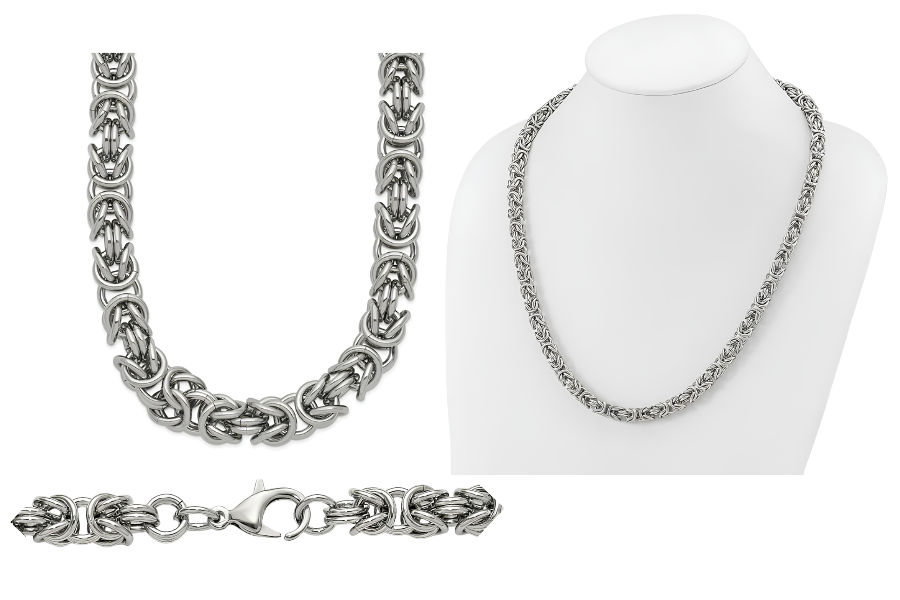
Stainless Steel Polished 8mm Byzantine Link Necklace |
|
|
Discover The Intricate Detail And Polished Finish Of Stainless Steel. Tap The Image To Explore This Stainless Steel Polished 8mm Byzantine Link Necklace! |
For a Byzantine chain, these properties are particularly useful. The design contains many interlocking links, creating numerous surfaces and contact points that can be exposed to perspiration, moisture, skin oils, and everyday environmental conditions. Good corrosion resistance therefore complements the complex construction of the chain.
The “L” in 316L stands for “low carbon.” It distinguishes the grade from standard 316 stainless steel by specifying a lower maximum carbon content. This distinction is particularly important in applications involving welding because lower carbon content helps reduce the risk of corrosion problems associated with sensitization around welded areas.
However, the label “316L” should not be treated as a guarantee that a piece of jewelry is nickel-free or suitable for every person with metal sensitivities. 316L normally contains nickel as part of its alloy composition. When buying a 316L stainless steel Byzantine chain, it is therefore useful to distinguish the actual steel grade from broader marketing descriptions such as “hypoallergenic” or “surgical steel.”
|
|
3.a) 316L Stainless Steel vs Other Stainless Steel GradesBack To Table Of Contents |
Not all stainless steel is the same. Stainless steels are available in numerous grades with different alloy compositions and properties. For jewelry buyers, 316L is particularly relevant, but other grades such as 304 stainless steel may also be encountered.
Both 304 and 316L contain chromium and nickel, which contribute to their corrosion resistance and useful mechanical properties. One important difference is that 316L also contains molybdenum. This improves resistance to certain forms of corrosion, particularly in environments containing chlorides. The lower carbon content designated by the “L” also distinguishes 316L from standard 316 stainless steel.
For a Byzantine chain, either grade can provide strength and good corrosion resistance under ordinary conditions. However, 316L offers greater corrosion resistance in some demanding environments, which helps explain its frequent use in jewelry and other applications where the metal may encounter moisture and salts.
The grade alone does not determine the overall quality of a stainless steel Byzantine chain. Link construction, finishing, weld quality, coatings, clasp quality, and overall workmanship also matter. A well-made chain using an appropriate stainless steel grade is more important than relying solely on a “316L” label as a measure of quality.
|
|
3.b) Why Is 316L Used in Jewelry?Back To Table Of Contents |
316L stainless steel is used in jewelry because it combines durability, corrosion resistance, and an attractive metallic finish with relatively straightforward maintenance. These characteristics make it practical for pieces intended for frequent wear, including chains, bracelets, rings, and other accessories.
Its corrosion resistance is especially useful for jewelry that regularly encounters perspiration, moisture, skin oils, and environmental contaminants. The chromium-rich passive layer on the surface helps protect the underlying metal, while the molybdenum in 316L improves resistance to certain forms of corrosion.
316L can also be polished to a bright, reflective finish or given brushed, matte, and coated finishes. This versatility allows manufacturers to create different appearances while retaining the underlying strength of stainless steel.
For Byzantine chains, 316L offers another practical advantage: it can provide the strength needed for a design made from numerous interlocking links while still allowing the finished chain to remain flexible. However, 316L contains nickel and should not automatically be considered suitable for everyone with a nickel allergy. Material grade, construction quality, surface finish, and individual sensitivity should all be considered when choosing stainless steel jewelry.
|
|
4) Stainless Steel Byzantine Chain Styles and FinishesGo To Table Of Contents |
Stainless steel Byzantine chains are available in a wide range of styles and finishes, even though they share the same distinctive interwoven link structure. Surface treatment can dramatically change how the individual links reflect light and how bold or understated the finished chain appears.
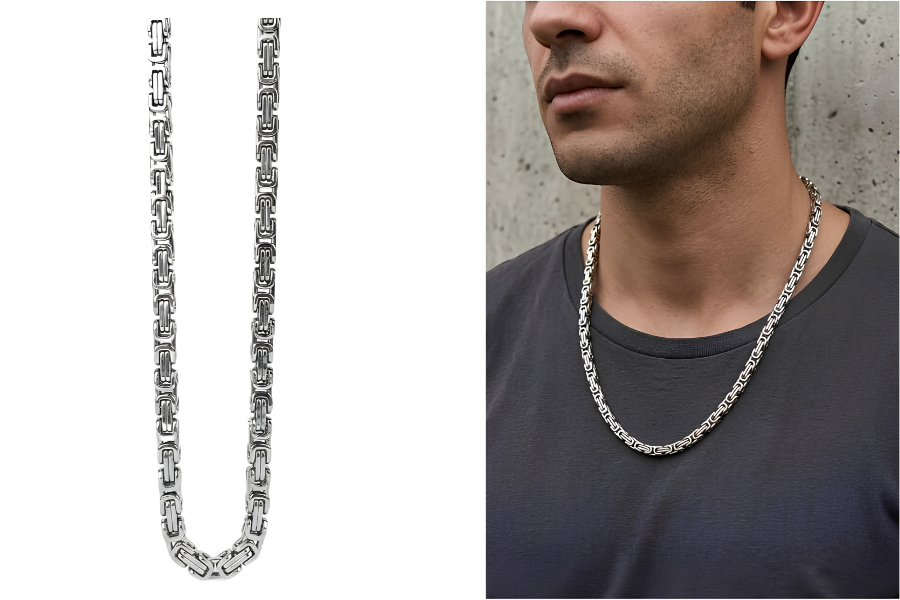
Men’s Stainless Steel Byzantine Chain Necklace Antique Silver Finish |
|
|
Discover The Distinctive Character Of An Antique Silver Finish. Tap The Image To Explore This Men’s Stainless Steel Byzantine Chain Necklace! |
A polished stainless steel Byzantine chain emphasizes shine and contrast. Light reflects from the many overlapping surfaces of the weave, making its intricate construction particularly noticeable. Brushed and matte finishes reduce this reflectivity and create a softer, more subdued appearance.
Color treatments provide further variation. Gold-tone and PVD-coated Byzantine chains can give stainless steel a warmer appearance, while two-tone designs combine contrasting colors or finishes to emphasize different parts of the weave.
The choice of finish is therefore more than a cosmetic detail. It influences the chain’s overall character, how prominently its Byzantine pattern stands out, and the type of clothing or other jewelry with which it can be paired. The following styles illustrate some of the most common ways stainless steel Byzantine chains can be finished.
|
|
4.a) Polished Stainless Steel Byzantine ChainsBack To Table Of Contents |
Polished stainless steel Byzantine chains have a smooth, reflective surface that emphasizes the complexity of the interwoven links. Because the links face in different directions, they catch light at changing angles and create alternating areas of brightness and shadow.
The polishing process smooths the metal’s surface and increases its reflectivity. On a Byzantine chain, this effect can be especially noticeable because the weave contains numerous small surfaces rather than one broad, flat area. As the chain moves, different links reflect the surrounding light, giving the pattern a lively and dimensional appearance.
A polished finish also brings out the naturally cool, silvery-grey color of stainless steel. It can give the chain a cleaner and more refined look, although the overall effect still depends heavily on width and link proportions. A narrow polished chain may appear relatively restrained, while a wide version can become a prominent statement piece.
Polished surfaces can show fingerprints, skin oils, fine scratches, and residue more readily than less reflective finishes. Regular wiping with a soft cloth and occasional appropriate cleaning can help maintain the shine and keep the intricate Byzantine weave looking well defined.
|
|
4.b) Brushed and Matte FinishesBack To Table Of Contents |
Brushed and matte finishes give a stainless steel Byzantine chain a more subdued appearance than a highly polished surface. Instead of reflecting light sharply, these finishes diffuse it across the metal, creating a softer look while allowing the intricate Byzantine weave to remain visible.
A brushed finish is typically created by producing very fine directional marks on the surface of the stainless steel. These subtle lines reduce mirror-like reflections and add visual texture. A matte finish has even lower reflectivity, producing a flatter, more muted surface.
These finishes can work particularly well on wider Byzantine chains. The reduced shine allows the shape and arrangement of the interlocking links to provide much of the visual interest rather than relying primarily on reflected light. Some designs also combine brushed and polished surfaces, creating contrast within the weave and making individual link groups more noticeable.
Brushed and matte surfaces may also make fingerprints and minor surface marks less conspicuous than a highly polished finish. They are not scratch-proof, however, and aggressive polishing can alter their texture. Cleaning should therefore preserve the intended finish rather than attempting to make the surface glossy.
|
|
4.c) Gold-Tone and PVD-Coated Byzantine ChainsBack To Table Of Contents |
Gold-tone stainless steel Byzantine chains combine the warm appearance associated with yellow gold with a stainless steel base. The color comes from a surface treatment or coating rather than from the chain being made from solid gold, so “gold-tone” should not be confused with yellow gold jewelry.
PVD, or physical vapor deposition, is one method used to apply a thin decorative coating to stainless steel. During the process, coating material is deposited onto the metal’s surface under controlled conditions. PVD coatings can produce a gold-colored finish while maintaining the strength and structural characteristics of the stainless steel underneath.
The Byzantine weave can make a gold-tone finish particularly striking. Its numerous overlapping links reflect light from different angles, while the warm color emphasizes the depth and complexity of the pattern. Depending on the width and finish, the result can range from relatively understated to highly prominent.
A coating also introduces an additional care consideration. Although a well-applied PVD coating can be durable, it is still a surface layer and may gradually show wear depending on its quality, thickness, frequency of use, friction, and exposure to chemicals. Buyers should therefore distinguish between solid gold, gold plating, gold-tone finishes, and PVD-coated stainless steel when comparing Byzantine chains.
|
|
4.d) Two-Tone Stainless Steel Byzantine ChainsBack To Table Of Contents |
Two-tone stainless steel Byzantine chains use contrasting colors or surface finishes within the same chain. A common approach combines the natural silvery-grey appearance of stainless steel with gold-tone links, although other combinations of polished, brushed, matte, or coated surfaces are also possible.
The Byzantine weave is particularly well suited to a two-tone treatment because its links overlap in several directions. Alternating colors can emphasize individual link groups and make the construction of the weave easier to see. As the chain moves, the contrast between neighboring links can create additional visual depth.
Two-tone designs can also make a Byzantine chain easier to coordinate with other jewelry. A chain combining silver and gold tones, for example, can visually bridge accessories in both color families without requiring the Byzantine chain itself to be made from two precious metals.
The durability of a two-tone chain depends partly on how its contrasting surfaces are produced. Natural stainless steel areas generally retain their inherent color, while coated sections can gradually show wear from friction, chemicals, and frequent use. For this reason, the type and quality of any coating should be considered alongside the overall construction and appearance of the chain.
|
|
5) How to Choose a Stainless Steel Byzantine ChainGo To Table Of Contents |
Choosing a stainless steel Byzantine chain involves more than selecting a design that looks attractive. Width, length, clasp type, link proportions, and overall scale can all affect how the chain looks, feels, and sits around the neck.
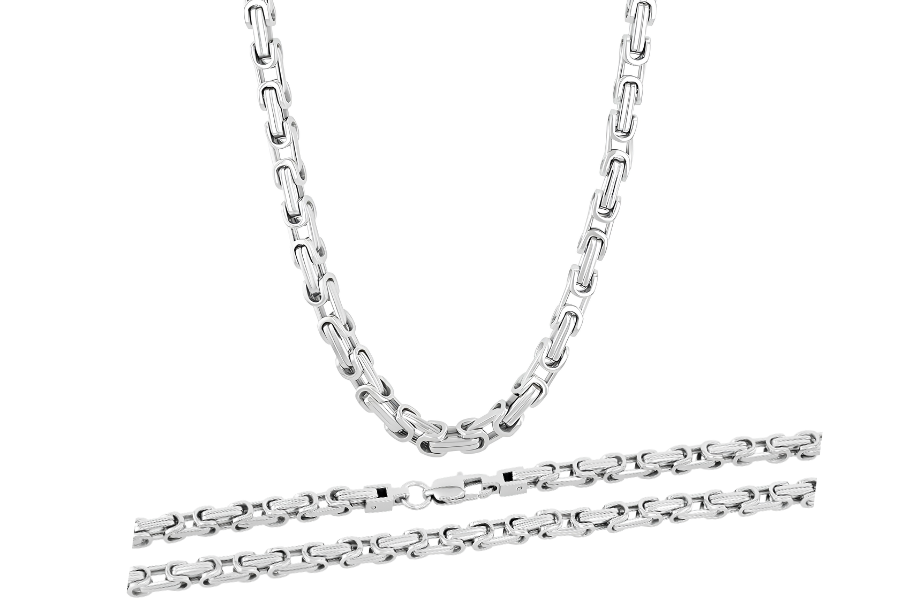
Stainless Steel Byzantine Chain Necklace 24 Inches |
|
|
Discover The Intricate Character Of A Stainless Steel Byzantine Weave. Tap The Image To Explore This 24-Inch Stainless Steel Byzantine Chain Necklace! |
Width is particularly important with the Byzantine weave. Because the pattern is dense and three-dimensional, even a modest increase in width can make the chain appear considerably more substantial. Length also changes the visual effect by determining where the chain rests on the chest and how prominently it is displayed.
The clasp deserves attention as well. It should be secure, easy enough to operate, and appropriately sized for the weight and width of the chain. On heavier Byzantine chains, a clasp that feels too small or lightweight may be less practical than one proportioned to the chain.
Finally, consider how you intend to wear the piece. A narrower, simpler Byzantine chain may integrate easily into everyday outfits, while a wider or more elaborate version can function as a statement piece. Evaluating these factors together will help you choose a stainless steel Byzantine chain that suits both your preferred appearance and the way you plan to wear it.
|
|
5.a) Choosing the Right Chain WidthBack To Table Of Contents |
Chain width has a strong influence on the appearance of a stainless steel Byzantine chain. Because the Byzantine weave is dense and three-dimensional, increasing the width makes the interlocking link structure more prominent and can substantially increase the chain’s visual weight.
Narrower Byzantine chains generally create a more restrained look. They retain the characteristic woven texture but can be easier to incorporate into everyday outfits. Medium-width chains make the Byzantine pattern more noticeable without necessarily dominating the overall look, while wider chains tend to function as bold statement pieces.
Width can also affect physical weight and comfort. A wider chain normally contains more metal and may feel heavier around the neck, although actual weight also depends on the link dimensions, construction, and length. Someone planning to wear the chain for extended periods should consider how substantial a piece feels rather than choosing by appearance alone.
When comparing widths, measurements in millimeters provide a more reliable guide than photographs. Product images can make a chain appear larger or smaller depending on magnification and styling. If possible, compare the stated width with a chain you already own or measure the approximate width against your neck or clothing before choosing.
|
|
5.b) Choosing the Right Chain LengthBack To Table Of Contents |
The right length for a stainless steel Byzantine chain depends on your neck size, body proportions, chain width, clothing, and where you want the chain to sit. Two chains with the same length can also appear different on different wearers, so the stated measurement should be treated as a guide rather than a guarantee of exact placement.
Shorter chains sit closer to the base of the neck and make the Byzantine weave more immediately noticeable. Longer chains fall farther down the chest and can create a more relaxed appearance. Wider Byzantine chains may also feel and sit differently from narrow chains because their greater bulk can affect how closely they follow the neck.
Common necklace lengths such as 20, 22, and 24 inches can produce noticeably different looks. However, choosing a length simply because it is described as “standard” may not give the result you expect. Neck circumference and personal proportions should also be considered.
A practical approach is to measure an existing necklace that sits where you want the Byzantine chain to fall. Alternatively, use a flexible measuring tape or cord to preview different lengths around your neck. Considering length together with width provides a much better indication of how the finished stainless steel Byzantine chain will look and feel.
|
|
5.c) Choosing a ClaspBack To Table Of Contents |
The clasp is an important part of a stainless steel Byzantine chain because it must secure a piece made from numerous interlocking links while remaining convenient to open and close. The clasp should feel sturdy, operate smoothly, and be proportionate to the chain’s width and weight.
Lobster clasps are commonly used on stainless steel chains. Their spring-loaded mechanism provides a secure closure, while different sizes allow the clasp to be matched to lighter or heavier chains. Larger clasps can also be easier to handle, although they may be more visually noticeable.
Some substantial Byzantine chains use box-style or concealed clasps that integrate more closely with the surrounding links. Certain designs may also include an additional safety mechanism. These options can create a more continuous appearance, but the quality and security of the mechanism remain more important than how well the clasp is hidden.
Before choosing a chain, examine how the clasp connects to the end links as well as the clasp itself. Connections should appear secure and appropriately sized for the chain. For a wide or heavy stainless steel Byzantine chain, a robust clasp and strong attachment points are especially important for dependable everyday wear.
|
|
5.d) Choosing Between Subtle and Statement StylesBack To Table Of Contents |
A stainless steel Byzantine chain can range from relatively subtle to distinctly statement-making, even though the underlying weave remains the same. The difference comes largely from the chain’s width, length, link proportions, finish, and overall visual scale.
For a more understated look, consider a narrower chain with relatively compact links. Polished stainless steel can add brightness without necessarily making a narrow chain overpowering, while brushed or matte finishes can further soften its appearance. These styles tend to integrate easily with casual and everyday clothing.
For a bolder effect, wider Byzantine chains make the interwoven structure much more prominent. Larger links, greater width, highly reflective surfaces, gold-tone coatings, or contrasting two-tone finishes can further emphasize the chain and allow it to function as the focal point of an outfit.
Consider your other jewelry as well. A substantial Byzantine chain may work best with fewer competing pieces, while a narrower version can be easier to combine with a watch, bracelet, ring, or other necklace. The best choice is ultimately the one that balances the distinctive Byzantine pattern with the level of visual prominence you prefer.
|
|
6) Stainless Steel vs Sterling Silver Byzantine ChainsGo To Table Of Contents |
Stainless steel and sterling silver can both showcase the intricate Byzantine weave, but the two metals differ in appearance, durability, maintenance, and material value. Choosing between them therefore involves more than deciding which silvery metal looks better.
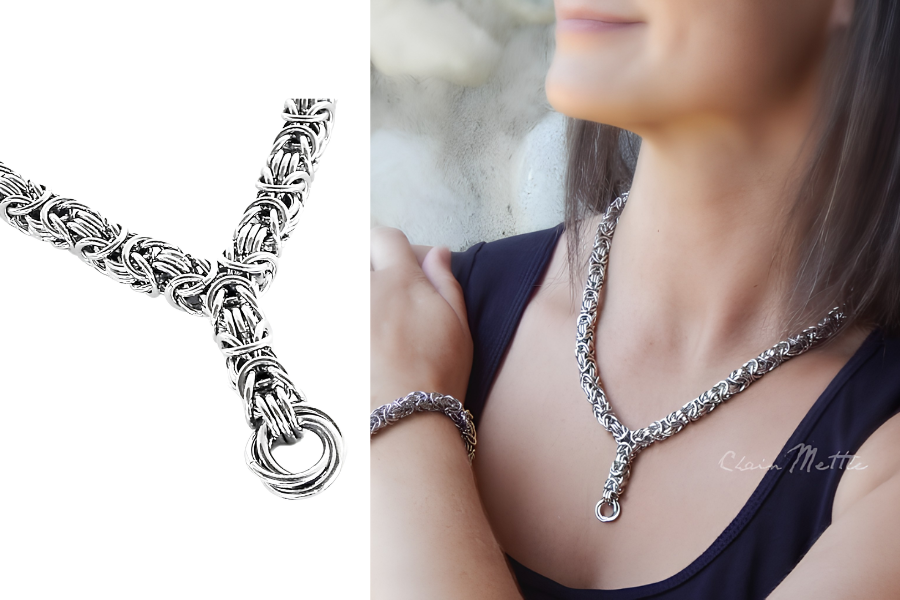
Love Knot Byzantine Stainless Steel Necklace |
|
|
Discover The Intricate Beauty Of A Byzantine Weave And Love Knot Design. Tap The Image To Explore This Love Knot Byzantine Stainless Steel Necklace! |
Sterling silver is a precious-metal alloy containing at least 92.5% silver. It has the bright, characteristic appearance associated with silver jewelry, but it can tarnish as compounds form on its surface over time. Stainless steel is not a precious metal, but it offers greater resistance to tarnishing and corrosion under typical everyday conditions.
The metals also behave differently in use. Stainless steel is generally harder and more resistant to scratches and deformation than sterling silver. This can be advantageous in a Byzantine chain, where numerous interlocking links repeatedly move against one another. Sterling silver is softer, but some buyers prefer its precious-metal status, traditional jewelry appeal, and distinctive silver appearance.
Neither material is automatically the better choice. Stainless steel tends to suit buyers who prioritize durability and relatively low maintenance, while sterling silver may appeal more to those who value precious-metal content and the character of genuine silver jewelry. Comparing their appearance, durability, tarnishing, and care requirements makes the differences clearer.
|
|
6.a) AppearanceBack To Table Of Contents |
At first glance, polished stainless steel and sterling silver Byzantine chains can look quite similar because both have a cool, silvery appearance. However, differences in color, reflectivity, finish, and how the metals change with wear can give each chain a distinct character.
Sterling silver typically has a bright white-silver appearance and the traditional visual appeal associated with precious-metal jewelry. Its reflective surface can emphasize the many curves and overlapping links of the Byzantine weave, creating strong highlights across the chain.
Stainless steel generally has a slightly cooler, greyer metallic tone. A highly polished stainless steel Byzantine chain can still be very reflective, while brushed and matte versions produce a more subdued appearance. Stainless steel also lends itself readily to treatments such as gold-tone and two-tone finishes.
Appearance can change over time as well. Sterling silver may develop tarnish that darkens parts of the surface. Cleaning can restore the original contrast within the weave. Stainless steel generally retains its original metallic color more consistently under normal conditions. The better choice therefore depends on your priorities. Sterling silver offers traditional brightness and precious-metal character, while stainless steel provides a more consistent, contemporary appearance.
|
|
6.b) Durability and TarnishingBack To Table Of Contents |
Stainless steel generally has an advantage over sterling silver when durability and tarnish resistance are the main priorities. It is harder than sterling silver and better resists scratches, dents, and deformation during normal wear. However, no jewelry metal is completely resistant to damage.
This difference can be particularly relevant to a Byzantine chain. Its many interlocking links repeatedly move and rub against neighboring links. A harder metal can help the chain withstand this regular contact. Softer sterling silver links may show wear more readily over time.
The two metals also behave differently when exposed to the environment. Sterling silver can tarnish when the silver reacts with sulfur-containing compounds in the air and surroundings. The resulting surface discoloration can range from yellowish or brown tones to dark grey or black. Tarnish does not necessarily mean the underlying silver is permanently damaged. Appropriate cleaning can usually restore its appearance.
Stainless steel is considerably more resistant to this type of surface discoloration. It generally retains its original appearance with less frequent polishing. For a Byzantine chain with numerous recesses between its links, that lower tendency to tarnish can be a practical advantage. Sterling silver remains attractive to buyers who prefer genuine silver. However, they should be comfortable with the additional care it may require.
|
|
6.c) MaintenanceBack To Table Of Contents |
Stainless steel generally requires less routine maintenance than sterling silver. Both metals can collect perspiration, skin oils, dust, and cosmetic residue between the tightly interwoven links. Therefore, occasional cleaning is useful regardless of the material.
An uncoated stainless steel Byzantine chain is relatively easy to clean. Mild soap, warm water, and a soft cloth are usually sufficient for ordinary dirt and residue. The chain should be rinsed carefully and dried thoroughly, particularly between the overlapping links where moisture can remain trapped.
Sterling silver requires similar attention to dirt but may also need periodic tarnish removal. A suitable silver-polishing cloth can restore accessible surfaces. However, the intricate recesses of a Byzantine weave may require more careful cleaning. Aggressive rubbing or unsuitable cleaners should be avoided because they can scratch the metal or alter intentional finishes.
For buyers who want relatively low-maintenance jewelry, stainless steel has a practical advantage. Sterling silver demands somewhat more attention, but regular care can preserve its distinctive precious-metal appearance. With either material, gentle cleaning and proper storage are preferable to waiting until heavy residue or discoloration has accumulated.
|
|
6.d) Which Should You Choose?Back To Table Of Contents |
Choose a stainless steel Byzantine chain if durability, corrosion resistance, and relatively low maintenance are your main priorities. Stainless steel is well suited to regular wear. Its strength and resistance to deformation also make it practical for wider or heavier Byzantine chains.
Choose sterling silver if you place greater value on precious-metal content. It also offers the traditional character of genuine silver jewelry. Sterling silver offers a bright, distinctive appearance. However, it is softer than stainless steel and requires more attention to tarnish and surface care.
Budget can also influence the decision. Stainless steel usually allows buyers to choose a substantial Byzantine chain without paying the premium associated with a precious metal. Sterling silver generally costs more because of its silver content. However, it may appeal more to someone who specifically wants precious-metal jewelry.
Neither material is universally better. Stainless steel is a practical choice for buyers seeking durability and easy care. Sterling silver suits those who prefer the look, feel, and status of a precious metal. The best choice depends on which qualities matter most to you and how frequently you intend to wear the chain.
| Feature | Stainless Steel Byzantine Chain | Sterling Silver Byzantine Chain |
|---|---|---|
| Appearance | Cool, contemporary silver-gray appearance | Bright, traditional silver-white appearance |
| Durability | High; well suited to frequent wear | Good, but softer than stainless steel |
| Scratch & Dent Resistance | Generally higher | Generally lower |
| Tarnish Resistance | Excellent under normal conditions | Can tarnish and require polishing |
| Maintenance | Relatively low | Requires more attention to tarnish |
| Precious-Metal Status | Not a precious metal | Precious-metal alloy containing 92.5% silver |
| Relative Cost | Generally lower | Generally higher |
| Best Suited For | Buyers who prioritize durability, tarnish resistance, easy maintenance and affordability. | Buyers who prefer genuine precious-metal content, traditional silver character and are comfortable with additional care. |
|
|
7) Stainless Steel vs Gold Byzantine ChainsGo To Table Of Contents |
Stainless steel and gold can both showcase the intricate structure of a Byzantine chain. However, they differ considerably in appearance, durability, value, and maintenance. For practical everyday wear, stainless steel emphasizes strength and easy care. Gold, by contrast, provides the distinctive character and intrinsic value of a precious metal.
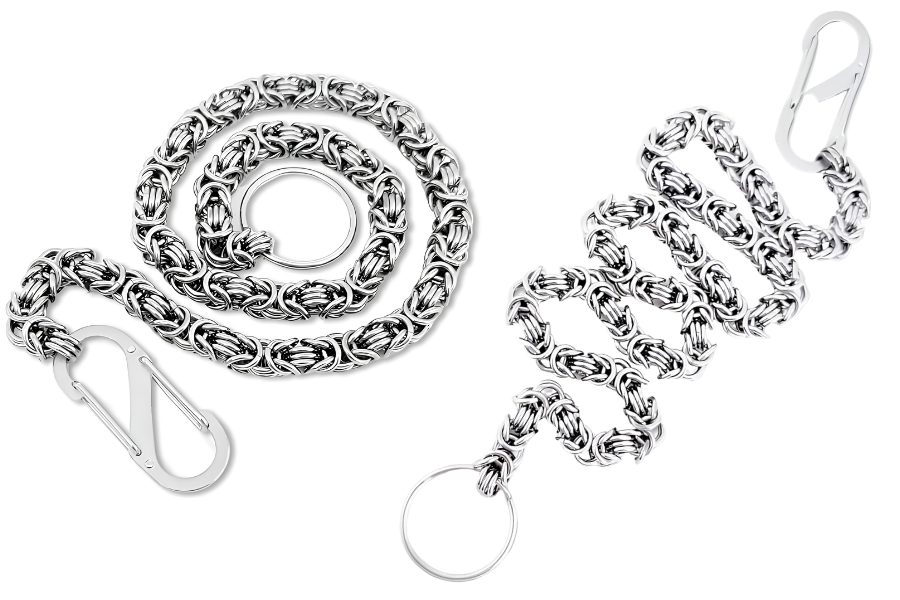
Stainless Steel Mens Wallet Byzantine Chain |
|
|
Discover The Rugged Character Of Stainless Steel Byzantine Chainmail. Tap The Image To Explore This Stainless Steel Mens Wallet Byzantine Chain! |
Stainless steel is generally harder than the gold alloys commonly used in jewelry. It also resists scratches and deformation well. Its corrosion and tarnish resistance make it relatively easy to maintain. These qualities are useful in a Byzantine chain because numerous interlocking links move against one another during wear.
Gold Byzantine chains offer a different appeal. Yellow gold provides a naturally warm color. White gold creates a cooler appearance that can resemble other white metals. A solid gold chain also contains gold throughout the alloy. This differs from gold-tone stainless steel, which relies on a surface coating for its gold color.
Cost is another major distinction. A substantial Byzantine weave requires considerable metal. As a result, a solid gold version can cost significantly more than a comparable stainless steel chain. Your choice therefore depends on your priorities. Stainless steel favors durability and affordability, while gold offers precious-metal content, traditional appeal, and material value.
|
|
7.a) Stainless Steel vs Yellow Gold Byzantine ChainsBack To Table Of Contents |
Stainless steel and yellow gold Byzantine chains create noticeably different visual effects. The stainless-steel version has a cool, silvery-gray appearance, while yellow gold brings a naturally warm golden color to the intricate weave. A Byzantine chain contains many overlapping surfaces. This makes differences in metal color especially noticeable as the links catch the light.
Durability is another important distinction. Stainless steel is generally harder than the gold alloys commonly used in jewelry. This makes it more resistant to scratches and deformation during everyday wear. Yellow gold is softer, although its durability varies with karat. Lower-karat gold alloys generally contain more alloying metals and tend to be harder than higher-karat gold.
The materials also differ fundamentally in value. Yellow gold is a precious-metal alloy, and its gold content contributes substantially to the chain’s price. Stainless steel is far less expensive. This can make wider and heavier Byzantine designs accessible without the cost associated with the same amount of gold.
Gold-tone stainless steel can imitate the warm color of yellow gold, but the two should not be confused. In a solid yellow gold Byzantine chain, gold is present throughout the alloy. A gold-tone stainless steel chain gets its golden appearance from a surface treatment or coating. Therefore, the choice depends on your priorities. Stainless steel emphasizes strength and affordability, while yellow gold offers precious-metal content, distinctive color, and intrinsic value.
|
|
7.b) Stainless Steel vs White Gold Byzantine ChainsBack To Table Of Contents |
Stainless steel and white gold Byzantine chains can look similar at first glance because both belong to the white-metal color family. However, their composition, durability, maintenance requirements, and value are very different.
Stainless steel naturally has a cool, silvery-grey appearance and can be polished to a bright reflective finish. White gold is created by alloying gold with one or more white-colored metals. Many white gold jewelry pieces are also rhodium plated to create a brighter, whiter surface. On a Byzantine chain, either metal can emphasize the highlights and shadows created by the intricate interwoven links.
Stainless steel is generally harder and more resistant to scratches and deformation than the gold alloys commonly used in jewelry. It also requires relatively little maintenance. Rhodium-plated white gold may need periodic replating as the surface coating gradually wears, although the frequency depends on wear and other factors.
The largest difference is material value. White gold is a precious-metal alloy whose price reflects its gold content, while stainless steel is considerably less expensive. This difference can become substantial in a wide or heavy Byzantine chain because the intricate weave requires a significant amount of metal.
For buyers who want durability, low maintenance, and a white-metal appearance at a lower cost, stainless steel can be the more practical choice. White gold is better suited to someone who specifically values precious-metal content, the character of gold jewelry, and is comfortable with its higher cost and potential maintenance requirements.
|
|
7.c) Which Material Is Right for You?Back To Table Of Contents |
Choosing between stainless steel and gold for a Byzantine chain depends on what you value most: durability, precious-metal content, color, maintenance, or budget. The distinctive Byzantine weave works well in all three options, so the material rather than the basic chain pattern becomes the main point of comparison.
Choose stainless steel if you prioritize durability, corrosion resistance, relatively easy maintenance, and affordability. It is particularly practical if you want a wide or substantial Byzantine chain without the considerably higher cost associated with using the same amount of gold.
Choose yellow gold if you prefer a naturally warm gold color and want a Byzantine chain made from a traditional precious metal. Its rich color can make the overlapping links especially prominent, but the chain will generally cost more and may show scratches or wear more readily than stainless steel.
White gold may suit you if you prefer a precious metal but want a cooler white-metal appearance. It provides the intrinsic gold content that stainless steel lacks, although rhodium-plated white gold can require periodic replating to maintain its bright white surface.
Ultimately, there is no single best material for every wearer. Stainless steel emphasizes practicality and value, while yellow and white gold emphasize precious-metal content and traditional fine-jewelry appeal. Your preferred appearance, expected frequency of wear, maintenance expectations, and budget should determine which Byzantine chain material is right for you.
| Feature | Stainless Steel Byzantine Chain | Yellow Gold Byzantine Chain | White Gold Byzantine Chain |
|---|---|---|---|
| Appearance | Cool, contemporary silver-gray appearance | Warm, traditional golden-yellow appearance | Bright, refined white-metal appearance |
| Durability | High; well suited to frequent wear | Good; varies with gold karat | Good; varies with gold karat and alloy |
| Tarnish & Corrosion Resistance | Excellent under normal conditions | Excellent; gold does not readily tarnish | Excellent, although surface appearance may change as rhodium wears |
| Maintenance | Relatively low | Moderate; periodic cleaning and polishing | Moderate to higher if rhodium replating is required |
| Plating or Coating | None for natural stainless steel; gold-tone versions may use PVD or another coating | Not required for solid yellow gold | Often rhodium plated for a brighter white finish |
| Precious-Metal Status | Not a precious metal | Precious-metal alloy containing gold | Precious-metal alloy containing gold |
| Relative Cost | Generally lowest | Significantly higher | Significantly higher |
| Best Suited For | Buyers who prioritize durability, easy maintenance and affordability. | Buyers who prefer the warmth, prestige and intrinsic value of traditional yellow gold. | Buyers who want precious gold with a sophisticated white-metal appearance. |
|
|
8) How to Care for a Stainless Steel Byzantine ChainGo To Table Of Contents |
Stainless steel Byzantine chains are relatively easy to maintain, but regular care helps preserve their appearance and keeps dirt from accumulating within the intricate weave. The numerous overlapping links create small recesses where perspiration, skin oils, soap, dust, and other residue can collect over time.
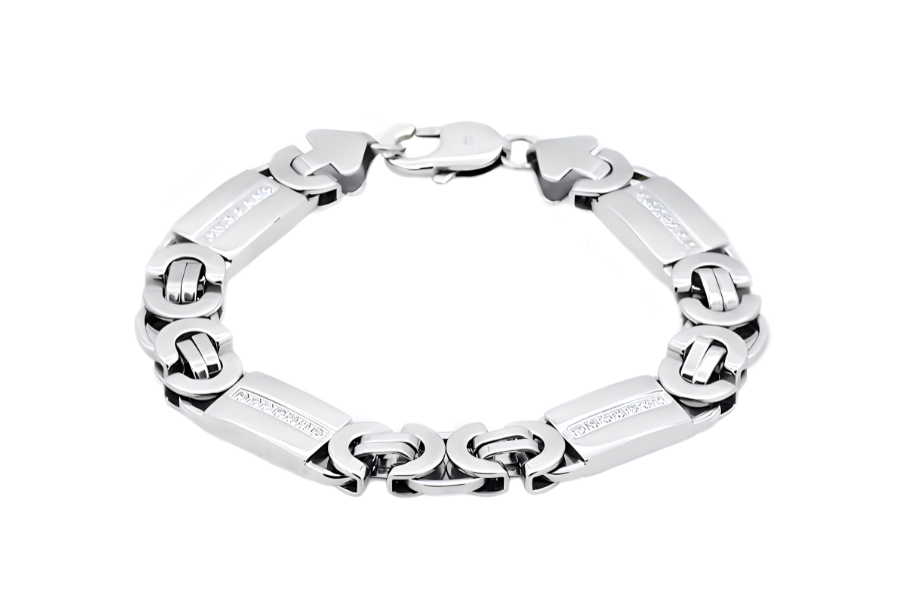
Mens Stainless Steel Flat Byzantine Link Chain Bracelet With Cubic Zirconia |
|
|
Discover The Distinctive Look Of A Flat Byzantine Link Design. Tap The Image To Explore This Mens Stainless Steel Byzantine Chain Bracelet With Cubic Zirconia! |
Routine care begins with simple habits. Wiping the chain with a soft, clean cloth after wearing it can remove surface oils and moisture before they build up. Occasional deeper cleaning can then reach the areas between the interlocking links that ordinary wiping may miss.
Storage is also important. Keeping the chain dry and separated from jewelry that could scratch its surface helps protect both the finish and the complex link structure. The chain should be placed naturally rather than tightly folded or forced into a small space.
Care requirements can differ for coated chains. PVD-coated and gold-tone Byzantine chains have a surface finish over the stainless steel base, so abrasive cleaners, aggressive polishing, and unnecessary chemical exposure should be avoided. Treating the finish appropriately can help preserve both the color and the distinctive appearance of the Byzantine weave.
|
|
8.a) How to Clean a Stainless Steel Byzantine ChainBack To Table Of Contents |
An uncoated stainless steel Byzantine chain can usually be cleaned with warm water, mild soap, and a soft cloth. Regular cleaning helps remove skin oils, perspiration, dust, and other residue that can collect between the chain’s tightly interwoven links.
Start by mixing a small amount of mild soap with warm water. Gently wash the chain, allowing the solution to reach between the overlapping links. If dirt has accumulated in the recesses of the weave, a very soft brush can help loosen it. Avoid aggressive scrubbing, which may leave fine scratches on polished surfaces.
Rinse the chain thoroughly with clean water so that no soap remains trapped between the links. Then dry it carefully with a soft, lint-free cloth. Because the Byzantine weave contains many small spaces, allow the chain to dry completely before storing it.
Avoid abrasive cleaners, harsh chemicals, steel wool, and other materials that can scratch or alter the finish. Coated, gold-tone, and PVD-finished chains may require gentler care than uncoated stainless steel, so their cleaning requirements should be considered separately.
|
|
8.b) How to Store Your ChainBack To Table Of Contents |
Proper storage helps protect a stainless steel Byzantine chain from scratches, tangling, moisture, and unnecessary wear. Although stainless steel is durable, its polished surfaces can still develop fine scratches when repeatedly rubbed against harder jewelry or abrasive objects.
Before storing the chain, make sure it is clean and completely dry. Moisture, perspiration, skin oils, and cosmetic residue can remain within the tightly interwoven links, so putting the chain away immediately after heavy wear without wiping it can allow residue to accumulate.
Store the chain separately in a soft-lined jewelry box, pouch, or individual compartment. Keeping it away from other chains also reduces the chance of the intricate Byzantine links becoming entangled with clasps, pendants, or other jewelry.
Allow the chain to rest in a natural position rather than tightly coiling, twisting, or compressing it into a small space. This is especially important for wider Byzantine chains, where forcing the dense weave into an unnatural position can place unnecessary stress on the links and clasp.
For longer-term storage, choose a clean, dry location away from excessive humidity, heat, and household chemicals. These simple precautions help preserve both the surface finish and the flexible structure that gives a stainless steel Byzantine chain its distinctive appearance.
|
|
8.c) Caring for PVD-Coated and Gold-Tone ChainsBack To Table Of Contents |
PVD-coated and gold-tone stainless steel Byzantine chains require more careful handling than uncoated stainless steel because their color depends on a surface finish. The stainless steel underneath may remain durable, but repeated abrasion or unsuitable cleaning can gradually affect the appearance of the coating.
For routine care, wipe the chain gently with a soft, clean cloth after wearing it. This helps remove perspiration, skin oils, and other residue before they accumulate between the interwoven links. If deeper cleaning is necessary, use mild soap and lukewarm water unless the manufacturer provides different care instructions.
Avoid abrasive polishing compounds, harsh chemical cleaners, stiff brushes, and rough cloths. These may scratch or wear the coating rather than simply cleaning it. It is also sensible to limit contact with chlorine, perfumes, lotions, household cleaning products, and other chemicals that may affect the surface finish.
Store a coated Byzantine chain separately from other jewelry to reduce friction and scratching. Because the links continually contact one another during wear, some gradual surface wear may occur over time, especially at high-friction points within the weave.
PVD coatings can be more wear-resistant than some conventional decorative coatings, but their durability still depends on coating quality, thickness, use, and care. Gentle cleaning and careful storage can help preserve the color and contrast of a PVD-coated or gold-tone stainless steel Byzantine chain for longer.
|
|
9) Frequently Asked Questions About Stainless Steel Byzantine ChainsGo To Table Of Contents |
Stainless steel Byzantine chains raise several practical questions about durability, tarnishing, skin sensitivity, sizing, and everyday wear. Buyers may also want to know how 316L stainless steel performs, whether coated finishes can fade, and how stainless steel compares with sterling silver or gold.
The following frequently asked questions provide concise answers to these common concerns. Where a topic is covered in greater detail elsewhere on this page, the FAQ can also serve as a quick reference before exploring the relevant section in depth.
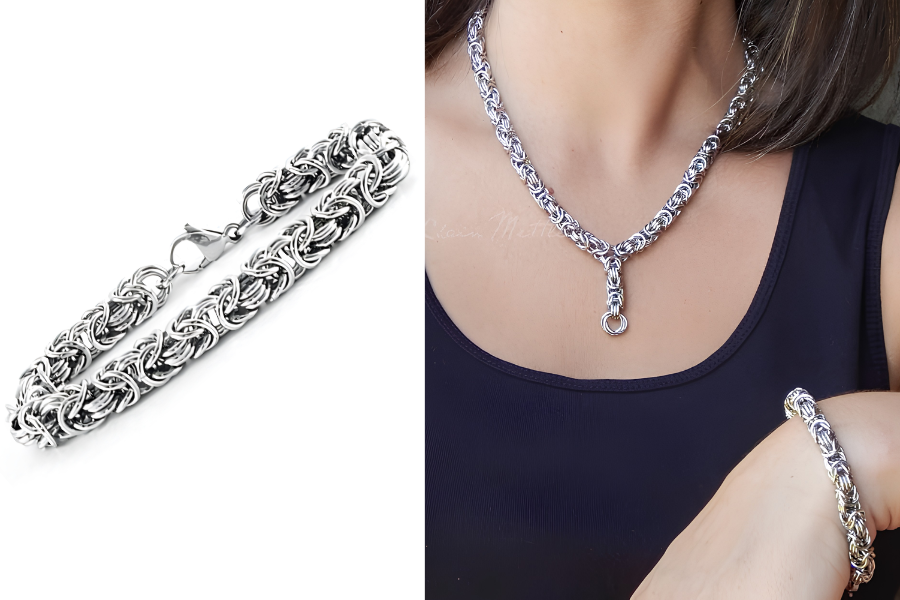
Handcrafted Byzantine Bracelet Stainless Steel |
|
|
Discover The Intricate Craftsmanship Of Stainless Steel. Tap The Image To Explore This Handcrafted Byzantine Bracelet In Stainless Steel! |
|
|
9.a) Does a Stainless Steel Byzantine Chain Tarnish?Back To Table Of Contents |
Stainless steel Byzantine chains are highly resistant to tarnishing, which is one reason stainless steel is popular for everyday jewelry. Unlike sterling silver, stainless steel does not normally develop the same dark surface tarnish when exposed to air and ordinary environmental conditions.
This resistance comes from chromium in the stainless steel alloy. Chromium forms a thin, protective oxide layer on the surface that helps protect the underlying metal from corrosion and discoloration. Grades commonly used for jewelry, such as 316L stainless steel, offer particularly good corrosion resistance.
However, “tarnish-resistant” does not mean completely immune to changes in appearance. Dirt, perspiration, skin oils, cosmetics, chemicals, or mineral deposits can build up on the chain and make its surface appear dull or discolored. Harsh environments can also affect stainless steel under certain conditions.
Regular gentle cleaning usually helps an uncoated stainless steel Byzantine chain maintain its original appearance. Gold-tone or PVD-coated versions require different consideration because their surface coating can gradually wear or fade even when the stainless steel underneath remains resistant to tarnishing.
|
|
9.b) Can a Stainless Steel Byzantine Chain Rust?Back To Table Of Contents |
A good-quality stainless steel Byzantine chain is highly resistant to rust, but stainless steel is not completely rust-proof. Its chromium content forms a thin protective oxide layer on the surface that helps prevent the iron in the alloy from corroding under normal conditions.
The grade of stainless steel matters. 316L stainless steel is particularly valued in jewelry because it offers strong corrosion resistance, including better resistance to chloride-rich environments than some other commonly used stainless steel grades.
Prolonged exposure to salt water, chlorine, harsh chemicals, or other corrosive substances can still damage stainless steel under certain conditions. Dirt and moisture trapped within the many recesses of a Byzantine weave can also make proper cleaning and drying important.
For everyday wear, rust should not normally be a concern with a well-made stainless steel Byzantine chain that receives reasonable care. Rinsing away potentially corrosive residues and drying the chain thoroughly can help preserve both the metal and the intricate interlocking structure.
|
|
9.c) Can You Wear a Stainless Steel Byzantine Chain in the Shower?Back To Table Of Contents |
Yes, you can generally wear an uncoated, good-quality stainless steel Byzantine chain in the shower. Stainless steel has strong resistance to water and corrosion, and occasional exposure to ordinary fresh water should not normally damage the metal.
However, removing the chain before showering is still the better long-term care habit. Soap, shampoo, conditioner, and other personal-care products can leave residue within the many small spaces of the Byzantine weave. Over time, this buildup can dull the chain’s appearance and make cleaning more difficult.
If you do shower while wearing the chain, rinse it thoroughly with clean water afterward and dry it well. Pay particular attention to the interlocking links, where moisture and residue can remain trapped.
Extra caution is appropriate for gold-tone or PVD-coated stainless steel chains. Although the stainless steel underneath may tolerate water well, repeated exposure to water, cleaning products, and friction can affect some surface finishes over time. For coated Byzantine chains, following the manufacturer’s specific care instructions is the safest approach.
|
|
9.d) Will a Stainless Steel Byzantine Chain Turn Your Neck Green?Back To Table Of Contents |
A good-quality stainless steel Byzantine chain should not normally turn your neck green. Green skin discoloration is more commonly associated with copper-containing metals or alloys, where copper compounds can form through reactions with perspiration, moisture, cosmetics, and other substances on the skin.
Stainless steel contains chromium and typically includes iron, carbon, and other alloying elements. Jewelry-grade 316L stainless steel also commonly contains nickel and molybdenum. It does not rely on a high copper content to achieve its appearance, so the familiar green discoloration associated with some copper-rich jewelry is generally less of a concern.
However, the composition and finish of the actual chain matter. Low-quality jewelry sold simply as “stainless steel” may contain different materials, while plated or coated pieces introduce another surface layer that can wear over time. Residue from lotions, soaps, perspiration, or cosmetics can also sometimes leave discoloration that may be mistaken for a reaction with the metal itself.
If a chain repeatedly leaves green marks, check its stated metal composition and whether it has a coating or plating. A genuine, good-quality stainless steel Byzantine chain should generally maintain its metallic surface without producing the characteristic green staining associated with copper-rich jewelry.
|
|
9.e) Is a Stainless Steel Byzantine Chain Hypoallergenic?Back To Table Of Contents |
Stainless steel Byzantine chains are often described as hypoallergenic, but the term should not be treated as a guarantee that every wearer will avoid a skin reaction. The exact stainless steel grade and an individual’s sensitivity to particular metals both matter.
316L stainless steel is widely used in jewelry because it offers excellent corrosion resistance and generally releases relatively small amounts of nickel under normal conditions. However, 316L stainless steel does contain nickel. Someone with a known nickel allergy or strong metal sensitivity should therefore not assume that every 316L stainless steel chain will be suitable.
Surface condition can also matter. Wear, corrosion, coatings, and the quality of the finished jewelry may affect how the chain interacts with the skin. Perspiration and prolonged skin contact can be additional considerations, particularly for a necklace worn throughout the day.
If you have sensitive skin, check the stated stainless steel grade rather than relying only on a “hypoallergenic” label. Anyone with a known metal allergy should consider professional medical advice when choosing jewelry intended for prolonged skin contact.
|
|
9.f) Is 316L Stainless Steel Good for a Byzantine Chain?Back To Table Of Contents |
Yes. 316L stainless steel is a good material for a Byzantine chain, particularly when durability, corrosion resistance, and relatively low maintenance are priorities. These qualities suit the Byzantine weave because the design consists of numerous interlocking links that move and make contact with one another during wear.
316L stainless steel contains chromium, nickel, and molybdenum. The chromium helps create a protective passive layer on the surface, while the alloy as a whole provides good resistance to corrosion. The addition of molybdenum improves resistance to certain forms of corrosion, particularly in chloride-containing environments.
Its strength is another advantage. Compared with softer jewelry metals, 316L stainless steel is relatively resistant to scratches, dents, and deformation. This can help a Byzantine chain retain the shape and definition of its intricate woven structure during regular use.
However, the steel grade alone does not determine the quality of a chain. Link construction, finishing, clasp quality, coatings, and overall workmanship also matter. A well-made 316L stainless steel Byzantine chain combines the practical properties of the alloy with the strength and visual complexity of the Byzantine weave.
|
|
9.g) How Long Does a Stainless Steel Byzantine Chain Last?Back To Table Of Contents |
A well-made stainless steel Byzantine chain can last for many years, but there is no fixed lifespan that applies to every chain. Longevity depends on the grade of stainless steel, quality of construction, thickness of the links, clasp strength, frequency of wear, and how the chain is cared for.
Stainless steel is well suited to long-term use because it resists corrosion, tarnishing, and deformation better than many softer jewelry metals. However, a Byzantine chain contains numerous interlocking links that continually move against one another. Over time, this contact can produce wear at the points where the links meet.
The clasp and connection points also deserve attention because they can experience repeated mechanical stress. Periodically checking the clasp, end links, and overall flexibility of the chain can help identify wear before it develops into a more serious problem.
Surface finishes may have a different lifespan from the underlying steel. An uncoated stainless steel chain can retain its appearance for a long time with appropriate care, while gold-tone or PVD coatings may gradually show wear depending on their quality, thickness, and exposure to friction. Proper cleaning, careful storage, and avoiding unnecessary chemical exposure can help extend the useful life of the chain.
|
|
9.h) What Width Stainless Steel Byzantine Chain Should I Choose?Back To Table Of Contents |
The best width for a stainless steel Byzantine chain depends on your preferred look, body proportions, comfort, and whether you want the chain to appear understated or make a stronger statement. There is no single width that suits every wearer.
Narrower Byzantine chains tend to look more subtle and are generally easier to combine with other jewelry. As the width increases, the intricate interlocking structure becomes more visible and the chain develops a heavier, more substantial appearance.
Wider chains also contain more metal, which increases their weight. Consider how the chain will feel during extended wear rather than choosing width purely for visual impact. Neck size and overall build can also influence how substantial a particular width appears when worn.
If possible, compare several widths before choosing. Measurements in millimeters can appear quite different in photographs than they do around the neck. The right width should provide the visual presence you want while remaining comfortable and proportionate for regular wear.
|
|
9.i) What Length Stainless Steel Byzantine Chain Should I Choose?Back To Table Of Contents |
The best length for a stainless steel Byzantine chain depends on your neck size, body proportions, clothing, and where you want the chain to sit. Chain width also matters because a thick Byzantine chain can feel and appear shorter than a slimmer chain of the same measured length.
For many men, an 18-inch chain sits relatively close to the base of the neck, while a 20-inch chain generally falls around the collarbone area. A 22-inch chain hangs lower and can create a more relaxed look, while longer lengths provide greater visual drop. Exact placement varies with neck size and build.
Consider how you intend to wear the chain. A shorter length can keep the Byzantine weave visible above an open collar, while a longer chain may work better over clothing or when you prefer a more prominent vertical drop.
Whenever possible, measure an existing necklace that sits where you want your Byzantine chain to fall. Alternatively, use a flexible measuring tape or cord to test different lengths around your neck. This provides a more reliable guide than choosing a length from photographs alone.
|
|
9.j) Is a Stainless Steel Byzantine Chain Better Than Sterling Silver?Back To Table Of Contents |
Neither stainless steel nor sterling silver is universally better for a Byzantine chain. The better choice depends on whether you prioritize durability and low maintenance or prefer the appearance and precious-metal character of sterling silver.
Stainless steel is generally harder and more resistant to scratches, deformation, corrosion, and tarnishing. These qualities can make it particularly practical for a Byzantine chain worn frequently, since the design contains many interlocking links that continually move against one another.
Sterling silver offers a different appeal. It is a precious-metal alloy with a bright, distinctive silver appearance, but it is softer than stainless steel and naturally develops tarnish over time. Regular cleaning and occasional polishing can restore its shine, although this means sterling silver typically requires more maintenance.
Choose stainless steel if durability, tarnish resistance, and easy everyday care are your main priorities. Choose sterling silver if you value a traditional precious metal and do not mind additional maintenance. For a detailed comparison of the two materials, see Section 6, Stainless Steel vs Sterling Silver Byzantine Chains.
|
|
9.k) Is a Stainless Steel Byzantine Chain Better Than Gold?Back To Table Of Contents |
Neither stainless steel nor gold is automatically better for a Byzantine chain. The right choice depends on whether you prioritize durability, affordability, and easy maintenance or the intrinsic value, prestige, and distinctive appearance of a precious metal.
Stainless steel is generally harder than the gold alloys commonly used in jewelry and offers excellent resistance to corrosion and everyday wear. It also allows the substantial, intricate Byzantine weave to be produced at a much lower cost than solid gold.
Gold offers advantages that stainless steel cannot replicate. A solid gold Byzantine chain has intrinsic precious-metal value and the characteristic appearance of its chosen alloy. Yellow gold provides a naturally warm color, while white gold offers a lighter, silvery-white appearance. Unlike a gold-tone stainless steel chain, solid gold does not depend on a decorative surface coating for its gold content.
Choose stainless steel if you want a durable, relatively low-maintenance Byzantine chain at an accessible price. Choose solid gold if precious-metal value, luxury, and gold’s distinctive character matter more to you. For a more detailed comparison, see Section 7, Stainless Steel vs Gold Byzantine Chains.
|
|
9.l) Can a Gold-Tone Stainless Steel Byzantine Chain Fade?Back To Table Of Contents |
Yes. A gold-tone stainless steel Byzantine chain can gradually fade or show wear because its gold color usually comes from a surface coating rather than from solid gold throughout the chain. How quickly this happens depends on the type and quality of the coating, frequency of wear, friction, and exposure to chemicals.
PVD coatings are generally designed to provide a durable decorative finish, but they are not indestructible. The Byzantine weave creates many points where adjacent links move against one another. Repeated metal-to-metal contact can eventually produce wear in these high-friction areas, even when the coating remains intact elsewhere.
Perspiration, chlorine, salt water, perfumes, lotions, household chemicals, and abrasive cleaning products may also affect some gold-tone finishes. Gentle cleaning and keeping the chain dry and separate from other jewelry during storage can help reduce unnecessary surface wear.
It is important to distinguish fading of the gold-tone finish from tarnishing of the stainless steel underneath. If the coating eventually wears through, the natural silvery-gray stainless steel may become visible. This does not necessarily mean that the underlying metal has tarnished or corroded; it may simply indicate wear of the decorative surface finish.
See More Byzantine Chains As Follows
| Byzantine Chain | White Gold Byzantine Chain |
| Yellow Gold Byzantine Chains | Sterling Silver Byzantine Chains |
| Yellow Gold Byzantine Earrings | Byzantine Jewelry Necklace |