Alexandrite is a rare gemstone admired for its extraordinary ability to change color—from vibrant green in daylight to deep red under warm light. Discovered in Russia’s Ural Mountains, this natural wonder combines rarity, brilliance, and mystery in one gem. Whether you see it as a collector’s treasure or a symbol of transformation, Alexandrite never fails to leave a lasting impression.
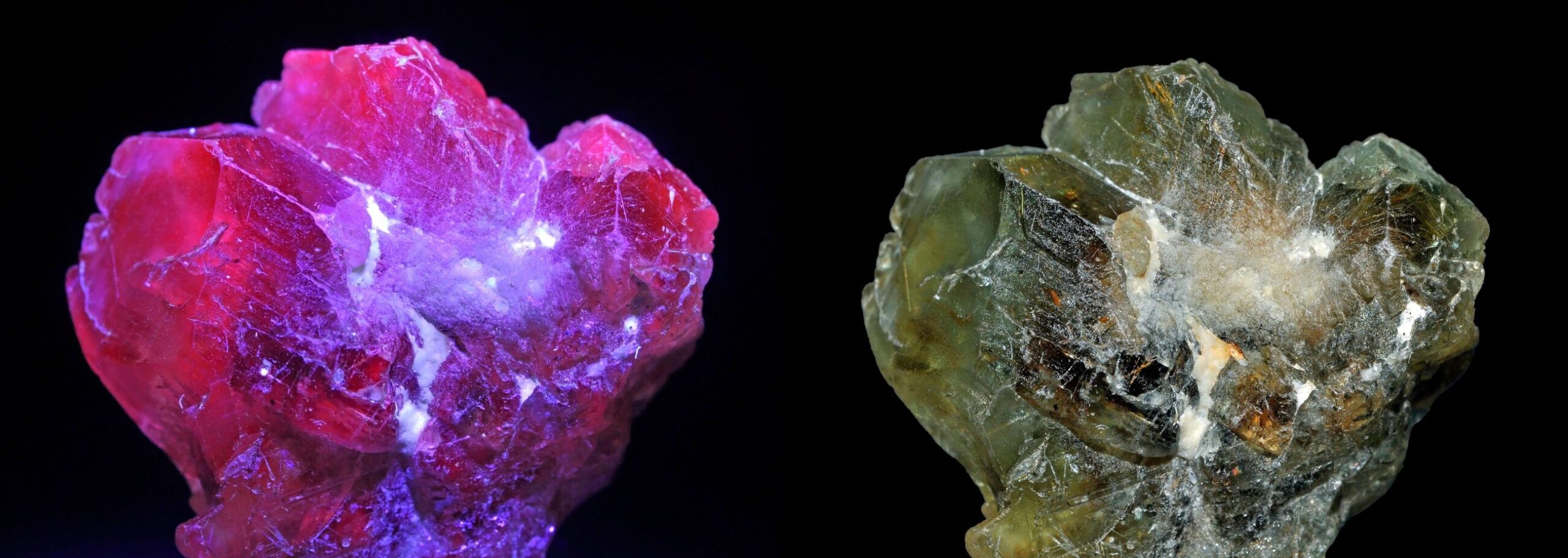
Mined in Espírito Santo, Brazil, this alexandrite crystal appears green in white light, but red in ultraviolet longwave light. Photos by Géry Parent. Licensed under CC By 2.0.

|
1) Alexandrite In a NutshellBack To Top |
| Gem lovers often call alexandrite the “emerald by day, ruby by night” gem for its striking color shift. First discovered in Russia’s Ural Mountains in the 1830s, this rare chrysoberyl variety still comes from Sri Lanka, East Africa, and Brazil. Fine material remains scarce, which is why high-quality alexandrite holds strong value. | |
| Mineral | Chrysoberyl |
|---|---|
| Chemical Composition | BeAl2O4 |
| Color | Bluish green in daylight; purplish red in incandescent light |
| Refractive Index | 1.746 – 1.755 |
| Birefringence | 0.008 – 0.010 |
| Specific Gravity | 3.73 |
| Mohs Hardness | 8.5 |
| Birthstones & Anniversaries | June birthstone (with pearl and moonstone); traditional 55th wedding anniversary gem. |
| Treatments |
|
Table Of Contents
- 1) What Is Alexandrite?
- 2) How to Identify Real Alexandrite
- 3) Global Sources and Mining Localities of Alexandrite
- 4) Putting Alexandrite in Jewelry Designs
- 5) Value, Pricing, and Investment Potential of Alexandrite
- 6) Alexandrite in Culture, Symbolism, and Metaphysical Beliefs
- 7) Conclusion
- 8) Alexandrite Gemstone: Frequently Asked Questions
|
|
1) What Is Alexandrite?Back To Top |
Alexandrite is a rare color-changing gemstone that flashes green in daylight and shifts to red under warm indoor light. This magical transformation makes it one of the most prized and fascinating gems ever discovered. If you’ve ever wondered how one stone can wear two colors, Alexandrite will keep you captivated from the first glance.

|
1.a) Definition and Gemstone Classification of AlexandriteBack To Top |
Scientifically, Alexandrite is a variety of chrysoberyl that owes its unique hues to traces of chromium. It stands apart from most gems because of its dramatic optical shift between green and red. Gemologists classify it as a chrysoberyl variety with exceptional rarity, beauty, and optical performance.
What Is Chrysoberyl and Its Varieties
Chrysoberyl is an aluminum beryllium oxide mineral known for its brilliance and hardness. Within this small but valuable family sit three members—ordinary chrysoberyl, cat’s-eye chrysoberyl, and Alexandrite. The difference lies in trace elements: chromium gives Alexandrite its signature color-change effect, while iron and titanium influence the others. This subtle chemical twist makes Alexandrite the star of the chrysoberyl group.
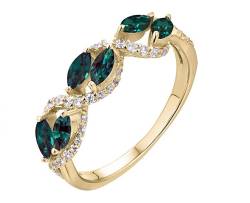
Natural Color Change Alexandrite Diamond Ring in 14K Yellow Gold |
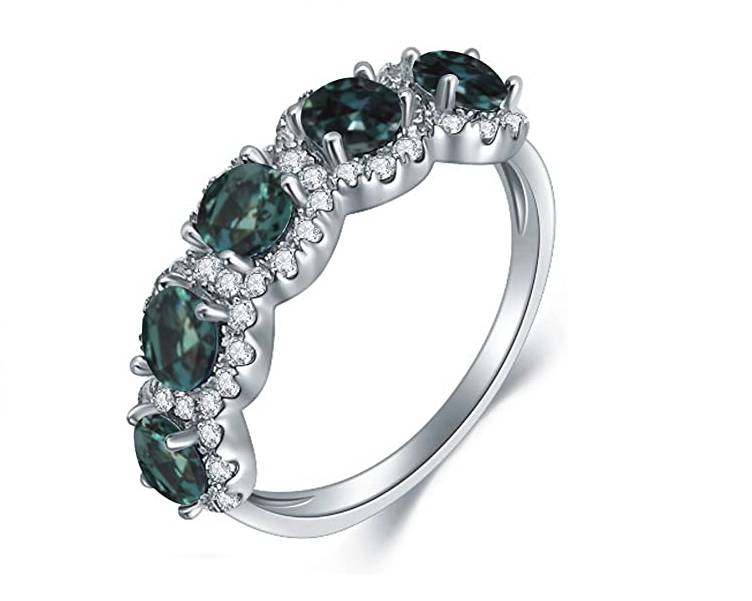
Natural Color Changing Alexandrite Diamond Ring in 14k Gold |
Click On The Images
Why Alexandrite Is Called a “Color-Change Gem”
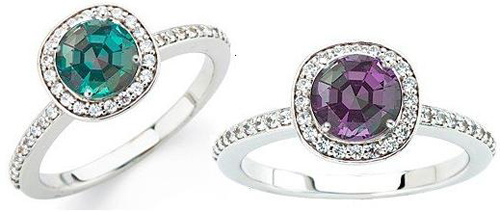
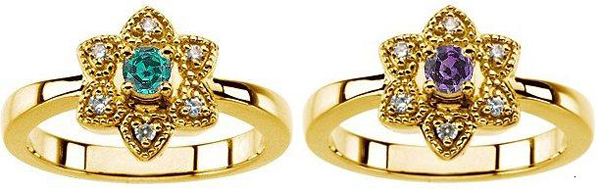
Few gemstones can mimic Alexandrite’s split personality. Under daylight rich in blue wavelengths, it glows greenish-blue or teal. Under candlelight or incandescent bulbs, it transforms into purplish-red or raspberry. This shift happens because chromium inside the crystal absorbs light differently depending on the source—an optical dance known among collectors as “the Alexandrite effect.”
Common Nicknames (Emerald by Day, Ruby by Night, Chameleon Gem)
Collectors gave Alexandrite poetic nicknames that highlight its dual charm. “Emerald by day, ruby by night” captures its sharp contrast under changing light. Some call it the “chameleon gem,” since it adapts to its surroundings with surprising ease. Each name celebrates the same phenomenon—the gem’s power to reinvent itself right before your eyes.
|
|
1.b) Historical Origins and Discovery of AlexandriteBack To Top |
The story of Alexandrite begins in Russia’s Ural Mountains, where it was first identified in the 1830s. Miners mistook it for emerald until candlelight revealed a striking red hue. That moment marked the birth of one of history’s most celebrated gemstones.
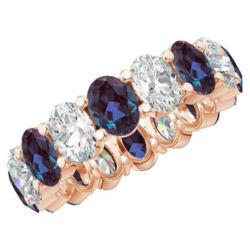
1-7 Carat Oval 14K White Gold Natural
|
|
| Click on the Image To View Details and Current Price |
The Russian Ural Mines and Discovery Story
Early miners found Alexandrite in mica schist deposits near the Tokovaya River. When they noticed its color change, they knew it was unlike anything else they’d seen. The gem was named after Tsar Alexander II, whose coming-of-age coincided with its discovery—a patriotic link that instantly made it Russia’s national jewel.
Evolution of Global Sources (Brazil, Sri Lanka, East Africa, India, Madagascar)
After the Russian deposits dwindled, new sources appeared across the globe. Brazil produced stones with bluish-green to purplish-red hues, while Sri Lankan gems leaned lighter and softer. African and Indian mines later joined the supply, each bringing subtle variations in tone and brilliance. Together, they kept Alexandrite alive in the jewelry trade, even as Ural material became museum-level rare.
Alexandrite in Gem Lore and Culture
In Russian folklore, Alexandrite symbolized luck, renewal, and harmony between opposites. Its green and red colors mirrored the balance between heart and mind. Over time, it became a favorite of royalty and collectors who valued transformation and rarity. Even today, many wear it as a charm for creativity, self-belief, and emotional equilibrium.
|
|
1.c) Physical and Optical Properties of AlexandriteBack To Top |
Understanding Alexandrite’s properties explains why it behaves so dramatically under light. It combines durability, brightness, and complex optical traits that make gem cutters and scientists equally fascinated.
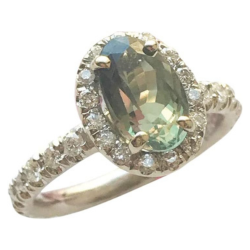
Solid 14k White Gold 2.3 ctw Natural Color Change
|
|
| Click On The Image To Discover More About This Stunning Engagement Ring |
Chemical Composition and Crystal System
Alexandrite’s formula—BeAl₂O₄—identifies it as a beryllium aluminum oxide mineral. Its crystals belong to the orthorhombic system, forming in tight, well-structured lattices. Chromium replaces part of the aluminum, introducing the vivid green and red hues that define its identity. Without chromium, the stone would simply be colorless chrysoberyl.
Hardness, Durability, Specific Gravity, Refractive Index
On the Mohs scale, Alexandrite ranks about 8.5, just below sapphire, making it suitable for daily wear. It has a specific gravity around 3.73 and a refractive index ranging 1.741–1.760, which creates bright reflections. Its toughness and brilliance explain why it remains popular for rings and heirloom jewelry that stand the test of time.
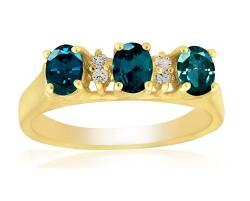
Natural Alexandrite Diamond Ring in 14 K Yellow Gold |

Alexandrite Ring Natural Color Changing Alexandrite Diamond Ring in 14k Gold |
Click On The Images
Pleochroism, Birefringence, and Optical Effects
Alexandrite is strongly pleochroic—it shows different colors from different viewing angles. Depending on orientation, you may see green, orange, or red flashes dancing across its facets. It also exhibits mild birefringence, meaning light splits slightly as it passes through, enhancing sparkle and depth. This interplay gives Alexandrite its lively, almost liquid glow.
What Causes the Color Change (The Alexandrite Effect)
The color change happens because chromium ions absorb specific wavelengths of light. Daylight, rich in blue and green tones, brings out the gem’s green side. Under warm indoor light, red wavelengths dominate, revealing its ruby-like glow. This balance between chemistry and physics gives Alexandrite its rare magic—a phenomenon that still amazes scientists and jewelers.
|
|
2) How to Identify Real AlexandriteBack To Top |
Identifying genuine Alexandrite takes a sharp eye and a bit of science. This gemstone’s value lies in its rare color change, so knowing how to verify its authenticity helps you avoid costly mistakes. With the right checks, you can tell a true Alexandrite from its many imitators.
|
|
2.a) Color Change Intensity and Hue Variations in AlexandriteBack To Top |
The hallmark of real Alexandrite is its strong and crisp shift in color between daylight and incandescent light. The more vivid the contrast, the higher the gem’s value. Even small differences in hue can reveal whether a stone is natural, synthetic, or just an imitation.
Ideal Daylight Green and Incandescent Red
Under daylight, fine Alexandrite glows in shades of bluish-green or mossy green. When you move it under warm light, such as candle or tungsten, it transforms into deep purplish-red or raspberry tones. This balanced color change—vivid yet natural—is a clear indicator of an authentic and high-quality stone.
Oval Natural Alexandrite Loose Gemstones
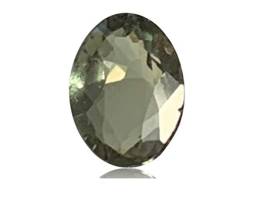
Click On The Image
Weak or Variable Color Change: Yellow-Green to Brownish-Red
Some Alexandrites display weaker color shifts, showing dull yellow-green in daylight and muddy brown-red indoors. These can still be natural, but they sit lower on the value scale. In lab-grown or imitation stones, the color transition often looks uneven or exaggerated, lacking the smooth gradient of real Alexandrite.
Role of Color Saturation, Tone, and Contrast
The most prized Alexandrites combine rich saturation with balanced tone and clear contrast between green and red phases. When the hues appear washed out or overly dark, it usually signals a lower-grade gem. Viewing under multiple light sources helps you see how consistent and symmetrical the change truly is.
|
|
2.b) Inclusions, Clarity, and Internal Features of AlexandriteBack To Top |
Examining a stone’s interior reveals much about its origin. Natural Alexandrites often carry subtle inclusions that act like fingerprints of formation. These tiny features separate genuine gems from synthetic counterparts.
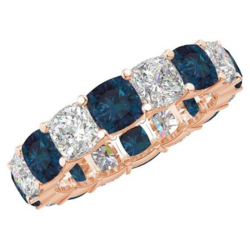
Cushion 14K White Gold Natural
|
|
| Click On The Image To Explore This Exquisite Alexandrite Ring |
Typical Natural Inclusions (Needles, Silk, Feathers)
Natural Alexandrites can contain fine rutile needles, silky threads, or feather-like inclusions. Under magnification, these look soft and wispy rather than perfect or bubble-like. Their natural arrangement proves the stone formed deep within the earth, not in a controlled lab environment.
Growth Lines, Twinning, and Trilling Patterns
Natural crystals frequently show curved growth lines or “twinning” patterns shaped like triangles or hexagons. These geometric marks are typical of chrysoberyl formation. Synthetic Alexandrites may show straight zoning lines or uniform layers, betraying their machine-grown origin.
Distinguishing Signs of Synthetic vs Natural
Synthetic Alexandrites, whether made by flux or Czochralski methods, usually appear cleaner and more consistent than nature’s versions. Real stones show uneven color zoning, slight inclusions, and natural wear patterns. When viewed under magnification, lab-grown material often displays gas bubbles or residue from its growth process.
|
|
2.c) Spectroscopic and Laboratory Tests for AlexandriteBack To Top |
Gemological instruments confirm what the eye suspects. While visual inspection gives clues, lab tests provide proof of authenticity and origin. These tools reveal the gemstone’s optical fingerprint.
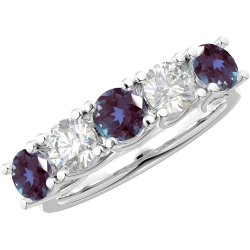
Round Platinum Natural Gemstone
|
|
| Tap The Image To View Complete Details And Pricing |
Using a Spectroscope for Characteristic Absorption Lines
A hand spectroscope shows Alexandrite’s signature chromium absorption bands in the red and green regions of the spectrum. The sharp double lines around 680 nm and a broad band near 580 nm are reliable identifiers. Stones lacking these features may belong to different mineral families, such as spinel or garnet.
Refractive Index, Specific Gravity, and Birefringence Test Methods
True Alexandrite has a refractive index between 1.741 and 1.760, specific gravity around 3.73, and birefringence of 0.008–0.010. Measuring these values with a refractometer or hydrostatic balance confirms the stone’s identity. Variations outside this range usually indicate synthetic material or imitation.
Origin Determination and Trace Element Analysis
Advanced labs like GIA and IGI analyze trace elements to pinpoint where an Alexandrite formed. Chromium dominance points to classic origins such as Russia or Brazil, while vanadium hints at East African or Sri Lankan material. These chemical signatures give the gem its geographic fingerprint.
|
|
2.d) Avoiding Imitations and Simulants of AlexandriteBack To Top |
Because Alexandrite commands premium prices, many imitations exist in the market. Learning how to spot them helps you make confident purchases and avoid being misled by convincing look-alikes.
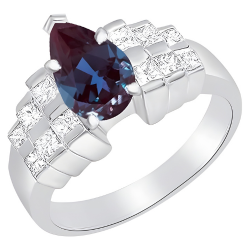
Pear Platinum Natural Gemstone and
|
|
| Click On The Image To Experience Alexandrite’s Beauty |
Synthetic Alexandrite (Flux, Czochralski, Hydrothermal)
Synthetic Alexandrite is grown in laboratories using high-temperature flux or pulling techniques. While chemically similar to natural material, these stones lack geological inclusions and usually display overly perfect color changes. They’re legitimate gems but must be disclosed as lab-created to buyers.
Simulated Color-Change Sapphires, Spinels, and Glass
Imitation Alexandrites are typically made from synthetic corundum (sapphire) or spinel infused with vanadium. Some colored glass pieces even mimic the effect using coatings. Unlike true Alexandrite, these simulants show a sharp, artificial shift between blue and pink without the rich intermediate tones.
How to Spot Fakes with Simple Tools or Visual Tests
You can perform basic checks at home using light sources and a loupe. Genuine Alexandrite shows a smooth, balanced transition between colors and often contains fine natural inclusions. Cheap fakes look flawless yet lifeless, and their “color change” feels abrupt—more like a paint flip than a living stone’s reaction to light.
|
|
3) Global Sources and Mining Localities of AlexandriteBack To Top |
Alexandrite comes from a handful of locations around the world, and each source gives the gem a slightly different look. From the original Russian mines to newer African and South American deposits, every region adds its own character. Understanding these origins helps you judge quality and appreciate how rarity affects price.
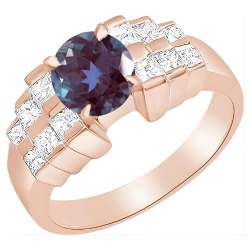
14K Rose Gold Natural Round
|
|
| Tap The Image To Learn More About This Alexandrite Bridal Set |
|
|
3.a) Russian Ural Alexandrite (Historical Benchmark)Back To Top |
The Ural Mountains in Russia mark the birthplace of Alexandrite and remain its gold standard. These early discoveries set the benchmark for quality, color change, and overall rarity. Collectors still consider Ural material the finest and most desirable in the gem market.
Color Quality and Rarity of Ural Material
Ural Alexandrites are famous for their strong, balanced color shift—from rich bluish-green in daylight to vivid raspberry-red under warm light. Their tone and saturation remain unmatched, giving them a depth other sources rarely achieve. Because production from the Ural mines ceased long ago, surviving stones are extremely scarce and command legendary status among gem connoisseurs.
Why It Commands Premium Prices
The exceptional optical clarity, intense color contrast, and historical provenance of Ural Alexandrite push its value far above material from other regions. Stones with documented Russian origin can fetch record-breaking prices at auctions. Their scarcity means most appear only in private collections or estate jewelry.
|
|
3.b) Brazil, Sri Lanka, Madagascar, and East AfricaBack To Top |
After the Russian mines declined, new deposits surfaced across the tropics. Brazil, Sri Lanka, and Madagascar became major suppliers, while East Africa added its own variety of hues. These sources helped keep Alexandrite in circulation, even if their gems differ slightly from the classic Ural look.
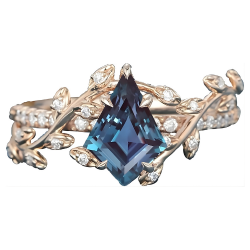
Kite Shape Natural Alexandrite and
|
|
| Click On The Image To View Specifications |
Distinctive Traits of Brazilian Alexandrite
Brazilian Alexandrites often show a slightly bluish-green daylight color and shift to purplish-red under incandescent light. Their clarity is generally high, and large crystals occasionally appear, which is rare for this gemstone. Though the color change may be softer than Ural material, Brazilian stones are admired for their balance of size, brilliance, and affordability.
Sri Lankan and East African Examples
Sri Lankan Alexandrites tend to have lighter tones, leaning toward yellowish-green in daylight and reddish-purple indoors. East African stones, especially from Tanzania, show a stronger red phase but sometimes less vivid greens. Each origin offers its own beauty—Sri Lankan gems sparkle brightly, while African stones emphasize depth and saturation.
Challenges in Yield, Quality, and Consistency
Mining Alexandrite is unpredictable because the gem forms under rare geological conditions. Yields are low, and even within a single deposit, quality varies greatly. This inconsistency makes consistent commercial supply difficult, which is part of why Alexandrite remains a niche gemstone.
|
|
3.c) India, Tanzania, and Emerging Localities of AlexandriteBack To Top |
In recent years, smaller mines in India and Africa have joined the global supply chain. Though these deposits are modest, they’ve expanded access to the gem and introduced new hues and sizes to the market.
Indian Alexandrite — Andhra Pradesh and Beyond
India’s Andhra Pradesh region produces small quantities of Alexandrite, typically showing green to red transitions. The stones are smaller and often included, yet they possess strong color change under varied lighting. Indian gems are increasingly recognized for their character and offer affordable options for buyers seeking genuine natural material.
Tanzania, Zimbabwe, and African Deposits
Tanzania’s Tunduru and Lake Manyara regions have yielded Alexandrites with exceptional color saturation. Zimbabwe has also produced fine specimens showing distinct shifts between teal-green and wine-red. While these deposits are not large-scale, they’ve helped reintroduce vibrant Alexandrite into modern jewelry design.
New Discoveries and Their Impact on Supply
Recent finds in Madagascar and Mozambique hint at untapped potential for future production. However, these locations remain under exploration, and consistent supply is uncertain. As new sources emerge, gemologists continue studying their trace elements to distinguish them from traditional origins.
|
|
3.d) Mining Methods, Yield, and Sustainability in Alexandrite ProductionBack To Top |
Extracting Alexandrite requires patience, precision, and care for the environment. The mining process differs by region, depending on the geology and scale of operations.
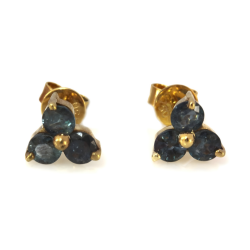
Solid 14k Yellow Gold 0.75 ctw Natural
|
|
| Click On The Image To View This Magical Alexandrite Ring |
Alluvial vs Hard Rock Mining
Alluvial mining targets loose sediments along rivers and streams where Alexandrite crystals have eroded from host rocks. Hard rock mining, by contrast, cuts directly into the mica schists or pegmatites where the gem originally formed. Although more labor-intensive, hard rock mining yields better-quality stones.
Environmental and Ethical Considerations
Mining practices vary widely among countries. Responsible miners now focus on restoring land and ensuring fair labor standards. As eco-conscious buyers grow, demand for ethically sourced Alexandrite continues to increase, prompting transparency throughout the supply chain.
How Scarcity Shapes Market Supply
Because Alexandrite occurs under extremely rare chemical conditions, every deposit is short-lived. Even active mines produce few carats per year, making this gemstone inherently limited. This built-in scarcity is why authentic Alexandrite remains one of the most valuable colored stones you can buy.
|
|
4) Putting Alexandrite in Jewelry DesignsBack To Top |
Alexandrite’s ability to shift colors makes it one of the most exciting gemstones for jewelry design. Whether you’re crafting a classic ring or a modern pendant, this gem adapts beautifully to different metals and settings. The way it transforms under light adds life and surprise to every piece.
|
|
4.a) Popular Jewelry Types Using AlexandriteBack To Top |
Because Alexandrite works equally well in formal and casual pieces, it’s used in many jewelry forms. Rings, pendants, earrings, and even men’s accessories bring out its color-shifting charm. You’ll find it in both luxury collections and meaningful custom designs.
Rings (Engagement, Cocktail, Heirloom)
Alexandrite rings stand out for their color-changing brilliance that shifts from green to red with lighting. Engagement rings with this gem feel deeply personal because the stone symbolizes love that adapts and grows. Cocktail and heirloom rings often feature larger Alexandrites surrounded by accent stones, creating timeless conversation pieces.
Earrings, Pendants, Necklaces
Earrings and pendants let Alexandrite show off its transformation in movement. When light touches each angle, the gem flashes between two contrasting hues, making the jewelry feel alive. In necklaces, designers often pair Alexandrite with diamonds to highlight its glowing transition from day to night.
Bracelets, Cufflinks, and Men’s Jewelry
Men’s designs often use Alexandrite in understated, bold ways—think signet rings or cufflinks that shift color under office lighting. The gem adds refinement without exaggeration. In bracelets, small Alexandrite accents create flashes of green and red that catch the eye without overpowering the design.
|
|
4.b) Metal Choices and Setting Styles for AlexandriteBack To Top |
Choosing the right metal and setting enhances Alexandrite’s dual color play. Since lighting and reflection affect its appearance, the design should emphasize clarity and contrast.
White Gold, Yellow Gold, Rose Gold and Platinum, – Pros and Cons
Platinum and white gold bring out Alexandrite’s cooler green tones, while yellow and rose gold enhance its red phase under warm light. Platinum offers durability and a clean, contemporary finish, whereas gold adds richness and warmth. Your choice depends on whether you prefer the gem’s daylight sparkle or its evening glow.
Prong, Bezel, Halo, Channel, and Tension Settings
A well-planned setting can make Alexandrite appear larger and more radiant. Prong settings allow maximum light exposure, while bezels give extra protection for daily wear. Halo designs highlight its color shift with contrasting gems, and channel settings create sleek modern lines. Tension settings, though rare, offer a floating illusion that complements Alexandrite’s mystery.
Design Tips to Showcase Color Change (Lighting and Orientation)
To reveal Alexandrite’s full personality, jewelers often angle the stone to catch both natural and artificial light. Proper faceting ensures each surface reflects color evenly. If you wear it often indoors, consider warm-toned metals to amplify the red glow; for outdoor wear, cooler metals better show off its green sparkle.
|
|
4.c) Jewelry Design Trends and Alexandrite CombinationsBack To Top |
Designers love Alexandrite because it complements other gemstones beautifully. It can fit vintage looks or blend into clean modern designs. The gemstone’s mood-changing color gives every trend a new story to tell.
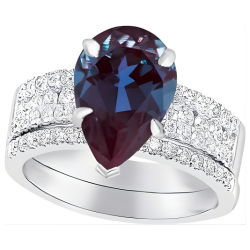
Pear Platinum Natural Gemstone
|
|
| Tap The Image To Discover Its Sparkle And Craftsmanship |
Mixing with Diamonds, Sapphires, and Emeralds
Alexandrite pairs effortlessly with diamonds, creating stunning contrasts between brilliance and color. Sapphires and emeralds deepen the palette, offering a multi-hue design that feels luxurious yet balanced. Jewelers often use small diamond halos or accents to draw attention to Alexandrite’s color transformation.
Vintage and Art Deco Styles
Vintage designs featuring Alexandrite often include filigree details, geometric patterns, and bold contrasts. Art Deco rings and pendants combine symmetry and flash to highlight the gem’s dual hues. These designs have a nostalgic charm that appeals to collectors who value artistry and history.
Contemporary and Minimalist Styles
Modern designers lean toward sleek lines and understated forms that let Alexandrite speak for itself. Clean bezels, asymmetrical layouts, and two-tone metals make the gemstone’s transformation the hero of the piece. Minimalist designs focus on shape and light—perfect for showcasing the gem’s natural personality.
|
|
4.d) Care, Maintenance, and Best Practices for Alexandrite JewelryBack To Top |
Though Alexandrite is durable, it still benefits from mindful care. Regular cleaning and safe storage keep its brilliance intact for years.
Cleaning (Ultrasonic, Steam, Mild Soaps)
Alexandrite usually tolerates ultrasonic and steam cleaners, but gentle hand cleaning is safest. Warm water, mild soap, and a soft brush easily remove oils and dirt. After cleaning, rinse thoroughly and pat dry with a lint-free cloth to restore its glow.
Protecting from Heat, Chemicals, and Physical Shock
Despite its hardness, sudden temperature shifts or exposure to harsh chemicals can dull Alexandrite’s polish. Always remove jewelry before swimming, cleaning, or exercising. Store it separately to prevent scratches from diamonds or harder stones.
Insuring Alexandrite Jewelry
Because natural Alexandrite holds significant value, insuring it is wise. Get an appraisal from a certified gemologist and update it periodically to reflect market changes. Insurance safeguards your investment in case of loss, damage, or theft—especially for one-of-a-kind heirloom pieces.
|
|
5) Value, Pricing, and Investment Potential of AlexandriteBack To Top |
Alexandrite stands among the most valuable colored gemstones in the world. Its rarity, optical magic, and limited supply make it a collector’s favorite and an investor’s dream. Understanding what drives its price helps you choose wisely and appreciate what makes this gem so exceptional.
|
|
5.a) Key Value Drivers for AlexandriteBack To Top |
Several measurable traits determine how much an Alexandrite is worth. The quality of its color change, clarity, size, and origin all play major roles. Knowing these factors helps you evaluate a gem beyond its beauty.
Color Change Strength and Contrast
The power and sharpness of Alexandrite’s color shift define its value more than any other feature. The finest stones show a crisp transition from vibrant green in daylight to rich red under incandescent light. Weak or muddy color changes lower the price, even if the stone looks attractive in one lighting condition.
Size (Carat Weight) and Cut Quality
Large Alexandrites are rare, especially clean ones over one carat. Each added carat multiplies the price because bigger stones display the color change more dramatically. A precise cut enhances brightness and reveals both hues evenly—something poor cutting can easily distort.
Origin, Provenance, and Rarity
Russian Ural Alexandrites remain the gold standard, with Brazilian and Sri Lankan stones following close behind. Gems with verifiable provenance or certificates from top labs command premium prices. Because natural sources are limited, rarity continues to push Alexandrite’s value upward year after year.
|
|
5.b) Price Ranges and Market Benchmarks for AlexandriteBack To Top |
Alexandrite’s pricing varies widely depending on quality, size, and origin. Even small stones with strong color shifts can be worth thousands per carat. The market rewards vividness, purity of tone, and confirmed natural origin.
Natural Fine Alexandrite Price Bands
Top-quality Russian or Brazilian Alexandrites with strong color change can range from USD 15,000 to over USD 70,000 per carat. Mid-range stones with moderate shifts sell between USD 3,000 and USD 10,000 per carat. Gems with weak color contrast or visible inclusions drop significantly in value but still remain collectible.
Lab-Grown and Synthetic Alexandrite Prices
Lab-created Alexandrites mimic the natural color change but cost a fraction of the price. Their value usually falls between USD 100 and USD 500 per carat, depending on quality and cut. While they offer beauty and affordability, they hold minimal resale or investment value.
Auction Records and High-End Sales
Historic Russian Alexandrites with royal provenance have achieved six-figure prices at major auction houses. Fine stones above two carats, showing strong red-green shifts, consistently outperform market expectations. These records highlight the continuing global fascination with this rare color-change gem.
|
|
5.c) Is Alexandrite a Good Investment Gemstone?Back To Top |
Because of its scarcity and global demand, Alexandrite has long appealed to gemstone investors. Yet, like all tangible assets, it balances rarity against liquidity. Understanding this helps you invest with confidence rather than emotion.
Rarity vs Liquidity Trade-Off
High-end Alexandrites are incredibly rare but sell to a niche market. They can take time to resell, especially at full retail value. However, collectors often see them as long-term stores of beauty and wealth rather than quick-profit assets.
Long-Term Appreciation Trends
Over the past few decades, Alexandrite’s prices have steadily climbed, driven by limited mining and rising collector interest. Unlike many gems affected by supply fluctuations, Alexandrite’s scarcity remains constant. Its combination of rarity, durability, and visual magic makes it one of the few gems that consistently gain value over time.
What Collectors Watch: Color, Size, Origin, Certification
Collectors prioritize strong color contrast and stones over one carat from recognized sources. Certification from GIA, IGI, or AGL verifying natural origin and untreated status is critical. Serious buyers often seek gems with documented Russian or Brazilian heritage for long-term investment appeal.
|
|
5.d) How to Buy Alexandrite SafelyBack To Top |
Because Alexandrite is highly valuable and frequently imitated, caution is essential when buying. Knowing where and how to shop helps protect your investment.
Trusted Dealers, Gem Labs, and Reports
Always buy from reputable dealers who provide authenticity certificates from recognized gemological laboratories. A valid report confirms the stone’s natural origin and rules out synthetic or treated material. Trusted sellers also disclose whether the gem has been enhanced in any way.
Due Diligence Checklist (Glass Tests, Light Tests, Reports)
Before purchasing, inspect the stone under daylight and incandescent light to confirm the color change. Ask to see its refractive index or lab report if possible. Simple observations—like viewing under two light sources—often reveal whether you’re seeing real Alexandrite or an imitation.
Return Policies and Warranties
Reputable sellers provide transparent return policies and warranties for buyer protection. These policies reflect confidence in the gem’s authenticity and quality. Always keep copies of receipts, certificates, and correspondence for insurance and resale purposes.
|
|
6) Alexandrite in Culture, Symbolism, and Metaphysical BeliefsBack To Top |
Few gemstones carry as much mystery and spiritual fascination as Alexandrite. Its rare color change has inspired legends, symbolism, and belief systems across cultures. Whether you view it as a healing crystal or a talisman of transformation, Alexandrite connects beauty with meaning.
|
|
6.a) Birthstone and Zodiac ConnectionsBack To Top |
Alexandrite holds a special place among June birthstones, sharing the honor with pearl and moonstone. It’s also linked to astrological signs and energy centers within the body, creating deeper spiritual associations for those who wear it.
June Birthstone (Alternate) and Astrological Links
As an alternate birthstone for June, Alexandrite represents curiosity, adaptability, and emotional balance. It’s often associated with Gemini, reflecting that sign’s duality and flexible nature—much like the gem’s changing colors. Astrologers also link Alexandrite to the planet Mercury, enhancing creativity and mental clarity in its wearers.
Zodiac and Chakras Associations
This gemstone resonates strongly with Gemini and Cancer, blending intellect with emotion. In chakra terms, Alexandrite is believed to stimulate the heart and crown chakras, promoting both empathy and spiritual awareness. Many crystal practitioners suggest wearing it close to the heart to encourage balance between logic and intuition.
|
|
6.b) Symbolism, Myths, and Healing ClaimsBack To Top |
Throughout history, Alexandrite has symbolized transformation, luck, and self-discovery. Its dual colors have been compared to the dual nature of human emotion—light and shadow, reason and passion. Many cultures believe the gem brings harmony and a sense of renewal.
Luck, Love, Creativity, Transformation
Alexandrite is often called the “stone of good fortune” because it’s said to attract prosperity and joy. In relationships, it represents deep emotional bonds that shift and grow with time—just as the gem changes color. Artists and thinkers prize it as a stone of inspiration that fuels creativity and innovation.
Psychic, Emotional, and Spiritual Associations
Spiritually, Alexandrite is thought to open the mind to higher understanding while stabilizing emotional highs and lows. Healers associate it with intuition and insight, helping wearers see truth beyond surface appearances. Emotionally, it’s believed to strengthen self-confidence and encourage a calm response in stressful moments.
Use in Crystal Healing and Skin Belief Systems
In crystal therapy, Alexandrite is said to align body and mind, aiding recovery from fatigue or emotional burnout. Some alternative healing traditions even use it in meditation to restore inner balance and vitality. Though scientific proof is lacking, many still find comfort in its symbolic connection to transformation and renewal.
|
|
6.c) Famous Alexandrite Jewelry and StoriesBack To Top |
Because of its rarity and charm, Alexandrite has found its way into royal jewels, historic collections, and high-profile designs. Each piece tells a story of fascination and prestige that continues to inspire modern collectors.
Historic Pieces in Museums and Royal Collections
The Russian Imperial family prized Alexandrite as a symbol of power and change. Several antique pieces—rings, brooches, and tiaras—still rest in museum collections across Moscow and St. Petersburg. These 19th-century gems remain the benchmark for natural Alexandrite beauty and rarity.
Modern High-Profile Jewelry Featuring Alexandrite
Modern jewelry houses such as Tiffany & Co. and Cartier have used Alexandrite in limited-edition collections. Designers love how its color play gives a single piece multiple personalities. Whether set in platinum or yellow gold, each jewel shifts character with the light, making it irresistibly expressive.
Auction Highlights and Collector Legends
Fine Alexandrites regularly headline major gem auctions in Geneva, Hong Kong, and New York. Stones over two carats with a vivid red-green change often fetch six-figure prices. Collectors chase them not only for beauty but for the sheer thrill of owning something nature made in such tiny quantity.
|
|
7) ConclusionBack To Top |
Alexandrite remains one of those gemstones that never lose their mystery. Its shifting hues and scarce availability make it both an artistic and emotional experience for anyone who owns or studies it. As you’ve seen through its history, symbolism, and craftsmanship, this gem has earned its legendary place in fine jewelry.
|
|
7.a) Summing Up The Majesty Of AlexandriteBack To Top |
Few stones can rival Alexandrite’s natural drama. Its unique ability to change color under different lights captures the idea of transformation and beauty in motion. Every genuine Alexandrite reminds you that nature can still outshine the imagination of man.
|
|
7.b) Why It Still Captivates Collectors & Jewelry LoversBack To Top |
Collectors adore Alexandrite because each stone is one of a kind—no two share the same balance of red and green. Jewelers value it for its rarity, versatility, and timeless appeal in rings, pendants, and heirloom pieces. Whether you’re drawn by science or sentiment, its magic continues to pull at the heart of everyone who sees it shift color.
|
|
7.c) Final Tips For Buyers, Enthusiasts & DesignersBack To Top |
If you’re thinking of buying Alexandrite, always insist on certification from a trusted gem lab. Examine the color change under different lighting before making a decision—it’s the soul of the stone. For designers, Alexandrite offers endless creative scope, from vintage revival to minimalist settings, making it as modern as it is historic.
|
|
8) Alexandrite Gemstone: Frequently Asked QuestionsBack To Top |
|
|
8.a) How can I identify a real Alexandrite?Back To Top |
To identify a genuine alexandrite, focus on the stone’s trademark color shift from green in natural daylight to red under incandescent light. [raregemcollection.com] Under magnification, natural alexandrites often show characteristic inclusions (tiny crystals, liquid “fingerprints,” etc.), whereas synthetic stones may display tell-tale signs like curved growth lines or gas bubbles not seen in natural chrysoberyl [raregemcollection.com]. Given the prevalence of convincing lab-grown and imitation alexandrites, it’s best to have the gem examined or certified by a reputable gemological laboratory to confirm it is natural [raregemcollection.com].
|
|
8.b) Why does Alexandrite change color?Back To Top |
Alexandrite’s remarkable color change happens because of its unique chemistry. Trace amounts of chromium in the crystal structure cause the stone to absorb certain wavelengths of light, resulting in different colors under different light source. In daylight (which is rich in blue-green wavelengths) the gem appears green, but under the redder glow of incandescent light it shifts to a purplish or ruby red. This dramatic optical shift is often called the “alexandrite effect,” and it’s a rare phenomenon among gemstones [borsheims.com].
|
|
8.c) Where does Alexandrite come from?Back To Top |
Alexandrite was first discovered in the early 1830s in Russia’s Ural Mountains [gemsociety.org]. It was named after the future Czar Alexander II, partly because its red-and-green hues mirrored the old Imperial Russian military colors. The Russian mines produced the original famed stones (often of top quality), but those deposits were eventually exhausted. Since then, other sources have been found – notably Sri Lanka, Brazil (with a significant deposit found in 1987), Tanzania, Madagascar, and a few other regions. However, fine natural alexandrite remains exceptionally rare regardless of origin.
|
|
8.d) How rare is Alexandrite?Back To Top |
Extremely rare. Alexandrite is one of the rarest gemstones in the world, which contributes to its high value [raregemcollection.com]. Its formation requires a very unlikely geological occurrence: the element beryllium (found in chrysoberyl) must encounter trace chromium during formation, and these elements rarely occur together in the same location [gemsociety.org]. Consequently, natural alexandrite is hard to find and usually small in size – most stones are under one carat, and anything above a few carats is extraordinarily uncommon [gemsociety.org]. Even lower-quality natural alexandrites are rarer than diamonds and considered scarce and valuable [raregemcollection.com].
|
|
8.e) What should I look for when buying an Alexandrite?Back To Top |
When buying alexandrite, pay attention first to the quality of its color change. The most valuable stones show a vivid green in daylight that shifts to a rich purplish-red under incandescent light – ideally a complete 100% color change from one color to the other [gemsociety.org]. Stones that display a strong, distinct color change (often described as “emerald by day, ruby by night”) command the highest prices [gemsociety.org]. Also examine the gem’s clarity and size: clean, transparent alexandrites above one carat are extremely rare, so some minor inclusions are acceptable in natural stones, and larger specimens carry very high premiums. It’s wise to buy from reputable jewelers and insist on a certification – due to the prevalence of synthetics and lookalikes – so you can verify the stone is natural alexandrite [raregemcollection.com].
|
|
8.f) How do I care for Alexandrite jewelry?Back To Top |
Alexandrite is a fairly hard and durable gemstone (8.5 on the Mohs scale), making it suitable for everyday jewelry wear [gemsociety.org]. Fortunately, it has no special care requirements – normal jewelry cleaning methods are safe for alexandrite. The safest way to clean it is to use warm soapy water and a soft brush [gemsociety.org]. Ultrasonic or steam cleaners are generally also safe for this tough gem, as long as the setting and the stone have no pre-existing cracks. As with any precious piece, it’s best to store alexandrite jewelry separately from other gems to avoid scratches and to cushion it from hard knocks.
|
|
8.g) Are there lab-grown or synthetic Alexandrites?Back To Top |
Yes, alexandrite can also be created in a laboratory – synthetic alexandrites have been produced since the 1960s [gemsociety.org]. Lab-grown alexandrite has the same chemical composition and crystal structure as natural alexandrite, so it displays the characteristic color change. These man-made alexandrites are far less expensive than natural ones, though they’re still relatively costly compared to other synthetic gems [gemsociety.org]. Be aware that many cheap stones advertised as “alexandrite” are actually imitations – often synthetic color-change sapphire or spinel – rather than true chrysoberyl alexandrite. Always verify what you’re buying if the price seems too good to be true [gemsociety.org].
|
|
8.h) Do I need a certification when buying Alexandrite?Back To Top |
Because alexandrite is so rare and valuable, it’s important to get a proper gemological certification for any significant purchase. A certificate from a reputable lab (such as GIA, AGL or IGI) will confirm that the stone is a natural alexandrite and not a synthetic or imitation [raregemcollection.com]. The lab report will also detail the gem’s characteristics – including its weight, measurements, color description, any detectable treatments, and often an opinion on its geographic origin [raregemcollection.com]. This documentation provides proof of authenticity and helps protect the value of your gemstone.
|
|
8.i) Is Alexandrite a good investment?Back To Top |
High-quality alexandrite is considered one of the most valuable gemstones, with top specimens fetching prices comparable to fine rubies, emeralds, or even diamonds. Its extreme rarity (natural alexandrite is even rarer than diamond) and the strong demand from collectors contribute to its investment appeal [raregemcollection.com]. Fine alexandrites that exhibit a superb color change and good clarity tend to hold their value well and may appreciate over time due to limited supply. However, like any gemstone, market prices can fluctuate based on demand and economic factors, so it’s wise to purchase alexandrite because you love the stone – any increase in value over time can be considered a bonus.
|
|
8.j) What is the symbolic meaning of Alexandrite?Back To Top |
Alexandrite has rich symbolism linked to its extraordinary color change. Many associate this gem with transformation, adaptability, and balance, reflecting how it can shift from verdant green to fiery red in different lighting. It’s often viewed as a stone of good fortune, prosperity, and intellect [borsheims.com], believed to bring luck and positive change to its wearer. As one of June’s birthstones (alongside pearl and moonstone), alexandrite is said to inspire creativity, joy, and hope. Its ability to “turn” color is sometimes seen as a reminder of personal growth and embracing change [raregemcollection.com], making it a meaningful choice for jewelry gifts and significant life events.
|
|
8.k) How does Alexandrite compare to other gemstones?Back To Top |
Alexandrite stands apart from most other gemstones due to its dramatic color-changing ability. While a few other gems (such as certain rare garnets or sapphires) can also change color under different lighting, alexandrite’s emerald-green to ruby-red shift is the most famous and striking example [borsheims.com]. In addition, alexandrite is far more rare than almost any other gem – even lower-quality natural alexandrites are rarer than diamonds and are still quite costly. [raregemcollection.com]. Top-quality alexandrites can command prices rivaling the finest rubies or emeralds. These factors, combined with its high hardness and durability, make alexandrite uniquely prized among collectors and gem enthusiasts.
|
|
8.l) Can Alexandrite be worn every day?Back To Top |
Yes. Alexandrite is quite hard (8.5 on the Mohs scale) and durable, which means it holds up well to regular wear [gemsociety.org]. It’s resistant to scratches and has no special care requirements, so an alexandrite ring or pendant can be worn daily without worry in most cases. In general, it’s as suitable for everyday wear as other beloved gems like sapphire or ruby. As with any valuable gemstone, you should still avoid subjecting it to hard blows or harsh chemicals – treating your alexandrite jewelry with a bit of common-sense care will keep it looking brilliant for generations.
Click Here To View Natural Alexandrite Gemstone Jewelry
See More Gemstones As Follows
I m a g e G a l l e r y
 |
 |
|
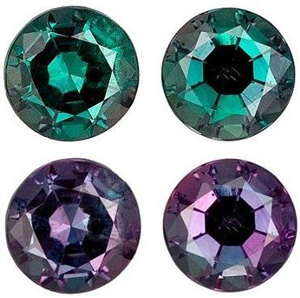
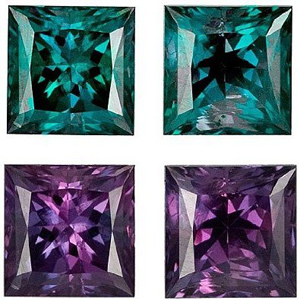
| Unique Fine Alexandrites in Matched Pair Round Cut Dramatic Color Change Clean 1.01 Carats Total | Incredible Fine GEM Alexandrites in Matched Pair Princess Cut 1.73 Carats Total Weight |
Classic Round GEM Grade Brazilian Alexandrite set In Twisted Shank Diamond Ring
 |
Notice The Dramatic Color Change Of The Color Changing Alexandrite
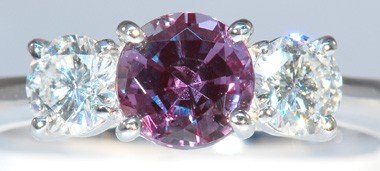
Finest Real Alexandrite and Diamond 3 Stone Ring set with GEM Grade 1 carat Genuine Alexandrite & 0.50 carat Diamond in Platinum
 |
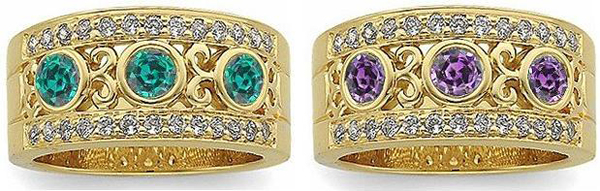
Glorious Alexandrite Vintage Band Featuring Genuine Alexandrite & Diamond in 14 kt Yellow Gold
 |
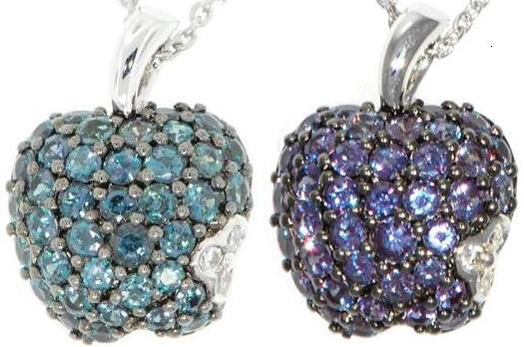
Genuine Alexandrite Apple Pave & Diamond Pendant in 18 kt White Gold
 |
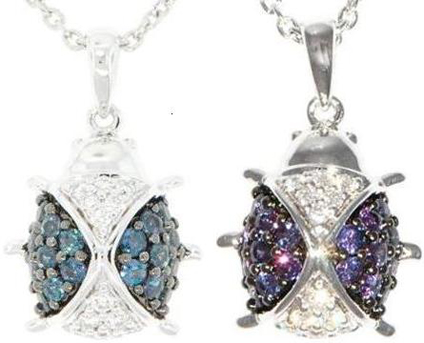 |
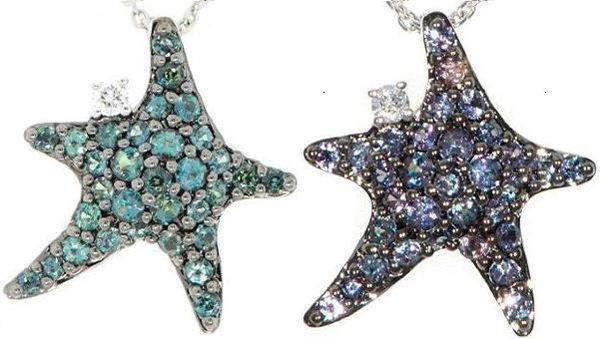
Unique Starfish Jewelry Real Genuine Alexandrite Pave & Diamond Pendant in 18 kt White Gold
 |
 |
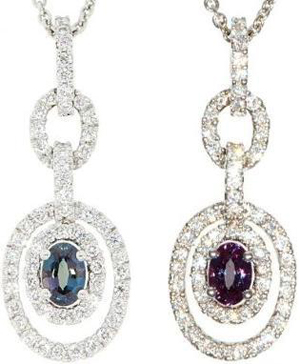
Genuine Oval Cut AAA Brazilian Origin Alexandrite and Diamond Pendant in 18 kt White Gold
 |
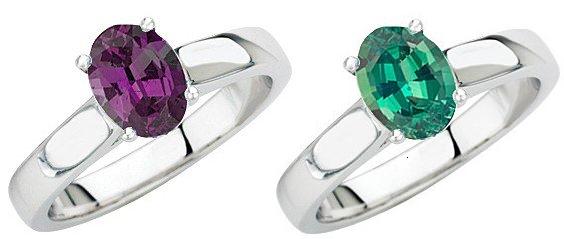
Bold Stunning Large Oval GEM Grade Natural Alexandrite Engagement Solitaire Gold Ring
 |
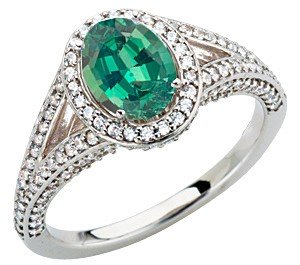
Stunning Oval Cut Genuine Alexandrite GEM Mounted in Custom Made White Gold Diamond Ring
 |
Tiffany Style Custom Made Ring Featuring a Genuine GEM 1 carat Alexandrite Gemstone
 |
Genuine Alexandrite Mounted in Yellow Gold Cluster Ring set with Diamonds
 |