Sapphire is the birthstone of September. It is considered to be a symbol of fidelity. Synonymous with romance and royalty, this gorgeous gemstone is the source of the most beautiful blue hues in the gem kingdom.
Though best known for its beguiling blue colors, sapphire occurs in almost all the colors in the light spectrum. Then again, a ‘red sapphire’ is called ruby, which is a gem sibling to sapphire. These gems are composed of the mineral corundum which is both tough and durable.
Crystallized Aluminum oxide (Al2O3) is known as Corundum. In its pure form, it is perfectly colorless. The scarcity of corundum on the planet makes sapphire a rare gem.
Trace metallic impurities like iron, titanium, or chromium in its crystalline structure impart blue, yellow, pink, purple, orange, or greenish color to corundum. The gemstone thus achieves a number of color variations.
Causes of Color in Sapphire:
The chemical composition of corundum predominantly decides its color. Synthesis of this mineral incorporates certain coloring elements known as chromophores into its crystal lattice. There are six significant chromophores that impart color to natural corundum. They are Chromium [Cr3+, h•-Cr3+], Iron or Ferrum [Fe3+, h•-Fe3+, Fe2+-Ti4+], and Vanadium [V3+]. They are all ions of their respective metals.
The chromophores work individually or collectively in different permutations and combinations. As a result, natural corundum acquires a wide array of colors. A number of colors ranging from pigeon’s blood red of ruby to cornflower blue & lemon yellow of sapphire come to be exhibited. Even moderately intense olive green and teal green corundum can be found in basaltic terrains.
Then again, certain other minerals obtain color from one of the ingredients composing its own molecule. These are idiochromatic or self-colored gems. Turquoise is a good example of an idiochromatic gem. Its formula is CuAl6(PO4)4(OH)8•4H2O. Copper (Cu), which is a primary component of its molecular structure, itself imparts the characteristic blue.
Coming back, pure corundum is completely colorless. It is totally transparent in all regions of the light spectrum from ultraviolet to infrared. The mineral obtains color primarily from small impurities called trace minerals. Color may also arise on account of defects in its crystal lattice.
Thus, we see there are different factors that bestow color to corundum. The presence of the trace element Cr3+ creates pink to red corundum. Trace elements can also react between themselves, giving birth to a new chromophore. The Fe2+-Ti4+ is such a pair that creates splendid blue sapphires.
The six major chromophores and the color they individually impart to the corundum are as follows:
 |
Cr3+: |
Pink, Red. |
|
h•-Cr3+: |
Orange. |
|
Fe3+, h•-Fe3+: |
Yellow. |
|
Fe2+-Ti4+, V3+: |
Blue. |
|
V3+: |
Green, Purple. |
Though it is entirely possible for a single chromophore to be present in a corundum crystal, it is very rare. More often than not, natural corundum carries more than one coloring element. In fact, a natural corundum crystal contains all the aforesaid colorants in quantities large enough to be measured.
The visible color displayed by a natural corundum crystal evolves from the sum of the light absorption by each of the chromophores presents.
The Duchess Of Cambridge Kate Middleton’s Engagement Ring Has A Prominent Sapphire Rather Than A Diamond

Impact of Geological Environment on Color:
Two types of geological environments produce sapphires: Basaltic and Metamorphic. These vastly disparate gem-breeding environments influence color in their own way.
Basaltic Sapphires form (along with Rubies) in extreme depths inside the earth. This chasmic region is the territory of molten magma. When volcanic eruptions bring the magma to the surface, they also bring up the gems. When the magma rapidly cools, it solidifies into basaltic rocks.
Basaltic Sapphires are also called the ‘BGY Suite’ stones. So we have blue, green, and yellow sapphires denoted by ‘BGY’. The gems typically have very dark colors because of their high iron content.
On the other hand, cataclysmic tectonic events create metamorphic sapphires. It happens when the earth’s continents collide. The colossal geological phenomenon creates mammoth mountain ranges composed of metamorphic rocks. And sapphires form here through solid-state recrystallization of preexisting rocks.
These sapphires display a softer color range. The colors are not as dark as those of basaltic origin. You come by more pinks & greens. You also see lighter more delicate yellows and more peachy colors.
So looking at the colors, you get an idea as to what kind of geological environment they formed in.
Blue corundum is simply called Sapphire. Gems of other colors are referred to with their color as a prefix. For example yellow-sapphire, pink-sapphire & so on. Certain specimens of characteristic colors have been given specific names.
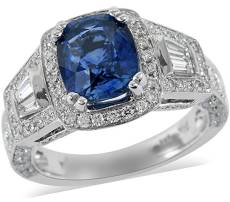
Diamond Halo Ring Real 14K White Gold Cushion Blue Sapphire |
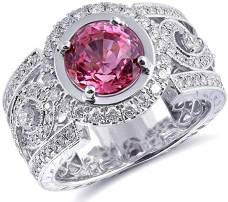
18K White Gold 3.66 ct TGW Pink Sapphire Ring |
Click On The Images
|
Sapphires With Specific Names: |
Padparadscha Sapphires:
The Pink-orange varieties are called padparadscha.
Parti Sapphires:
Parti sapphires are fine Australian beauties and the best examples are unique to Australia. They show both yellow and blue colors and depending upon the facets also throw the green color. Due to the natural mixing of colors, Parti sapphires can’t be artificially produced and offer their owner an exclusive gemstone that is guaranteed to be natural.
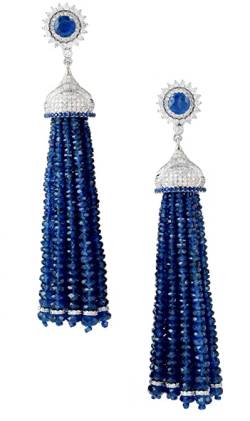
Natural Sapphire Dangle Earrings 18k White Gold Jewelry |
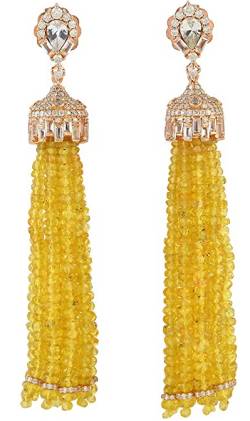
Natural Sapphire Beads Tassel Earrings Pave Natural Diamond 18k Rose Gold |
Click On The Images
Pharaoh’s Eyes Sapphires:
A highly prized Parti sapphire is the “Pharoah’s Eye Sapphire”. These sought-after stones are formed when a blue sapphire grows around a smaller yellow sapphire. Consequently, it is a blue crystal with a yellow core. The gem is so cut that the culet (bottom) of the stone is centered in the yellow core and the crown (top) is in the blue. This is a really spectacular stone.
Teal Sapphires:
Teal sapphire is a distinctive genus of the mineral corundum. The dazzling stone juxtaposes two of the most resplendent colors of nature – ebullient green and ocean blue. This miraculous coloration is causing a huge surge in the popularity of this gemstone.
Teal sapphires that enjoy a near equivalent proportion of green & blue with faint whispers of yellow command the highest values. But most stones display a divergence of color shades. These might range from blue to green to grey.
Brilliant round cut and brilliant oval cut gems allow optimum play of incident light inside the stone. They bring out both the blue and green shades supremely.
This particular species is still relatively unknown. Hence it is not yet as expensive as blue or padparadscha sapphires. But their popularity is soaring and prices are likely to rise.
Connoisseurs prefer teal sapphires from Australia. Yet, they are also found in Nigeria, Ethiopia, Madagascar, and the Montana region of the United States.
Montana Yogo Sapphires:
The central area of Montana state gives us the well-loved Yogo Sapphire. These are light to dark blue in color. They are predominantly flattened tabular crystals. Consequently, they can only yield small faceted stones.
We may find a few color-changing stones. But they are sporadic and scarce. Such stones change color from blue to violet or purple. Faceted Yogo sapphires are usually less than 1 ct. Faceted gems of over 2 ct are extremely rare.
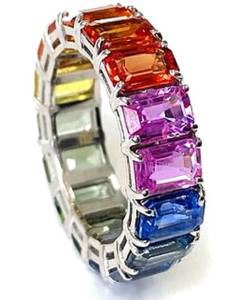
Multicolor Sapphire Band Ring 10.82 Carats |
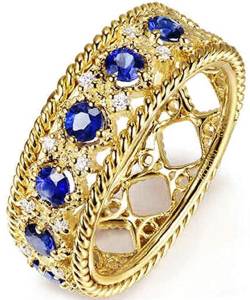
18K Gold Diamond and Sapphire Anniversary Ring Wedding Band |
Click On The Images
|
History & Lore: |
In addition to their enticing colors, these gemstones are also desirable for their abounding history and their metaphysical qualities. Legend has it that the tablets bearing the Ten Commandments were actually crafted out of sapphire. Ancient kings wore sapphires around their necks as protection against harm and to achieve divine favors.
Ancients thought that the power of wisdom is contained within this precious gemstone. They believed that the stone’s energy enables the wearer to uncover correct solutions to difficult obstructions.
The gemstone has been considered to be an emblem of the heavens. It is thought to be the guardian of innocence. People accept it to be imparted with loyalty, sincerity, and truth. The ancient Persians believed that the earth’s crust rested upon an enormous sapphire, whose brilliancy mirrored the sky’s coloration at sunset.
|
Name Origins: |
The name of this gemstone has been derived from the Latin word sapphirus which merely means blue.
Ancient folks believed that all gems grew and ripened with changing seasons like the fruits on a tree. Starting off as white, the gems matured and became perfect as the sun shined. Deep red stones were regarded as fully ripened while paler stones were deemed to have been plucked from the earth too early. Ancient Indian language of Sanskrit called the lovely red ripe stone (ruby) by the name of Kuruvinda. The phrase ‘Corundum’ springs from this ancient Sanskrit word. It encompasses all gems formed of crystallized Aluminum oxide (Al2O3) including Ruby.
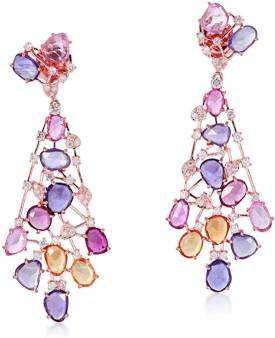
Natural Sapphire Dangle Earrings 18k Rose Gold Jewelry |
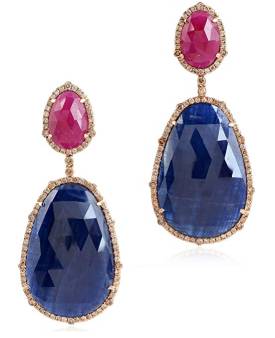
Solid 18k Rose Gold Diamond Ruby Sapphire Dangle Earrings Handmade Jewelry |
Click On The Images
|
Sources Of Sapphires: |
Those From Kashmir:
Along with the coloration, its region of origin has a great influence on the value of this gemstone. The most precious and magnificent sapphires that are intense blue in color with a hint of violet originate from the Kashmir region of India.
Kashmir is also known as ‘the roof of the world.’ And all of us have heard of the legendary cashmere sapphires from this ‘roof of the world’. They were discovered in the 1880s.
When we talk of the classic blue cashmere sapphire, they were all discovered during a very short window of time. A whole lot of extraordinarily fine material was extricated within a decade or so.
The classic cashmere stones are characterized by that incredibly beautiful sleepy blue look. This appearance is caused by very fine distributed particles throughout the stone. Everyone falls in love with the gorgeous Kashmiri appearance.
Kashmir still produces sapphires, but they are not as good as the classic ones. They are lighter in color and look distinctly different.
Those From Burma:
Sapphires that come close to Kashmir sapphires in color tones are those from Burma (Myanmar).
The Mogok mines of Burma are better known for their Rubies. However, Sapphires too occur here in close proximity to rubies in alluvial deposits.
The best ones display a rich, intense, slightly violetish blue. Color saturation in Burma sapphires is high and the coloring is even throughout the stone. Nevertheless, all Burma stones do not display a deep color. some are quite light-colored.
Those From Sri Lanka:
The pinkish-orange sapphires from Sri Lanka are identified as Ceylon sapphires. They are also widely known as ‘Padparadscha’. These sapphires are distinguished by an orange color with a fine pink undertone. The color is comparable to that of a lotus flower which its name represents. Such stones are well-loved and command a premium price.
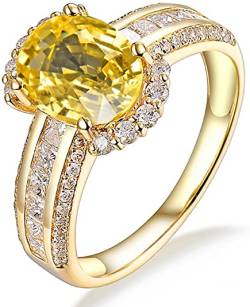
Fancy Design 18k Yellow Gold Natural Diamonds Yellow Sapphire Ring |
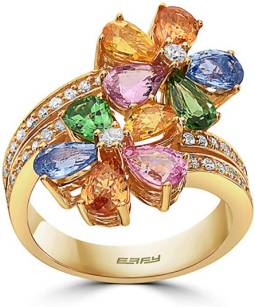
Multicolored Sapphire Flower Ring with Diamonds in 14K Yellow Gold |
Click On The Images
Australia is yet another significant source of sapphires. Stones from this region are deep velvety blue & dark inky in appearance. Some more newly found sources are Madagascar, US, Brazil, Tanzania & Cambodia.
Those From Montana USA:
The USA recognizes Montana as its Treasure State. This is because the state gives us a number of gemstones and minerals. Two particular types of Sapphires are prominent among this mineral wealth viz The Montana Yogo Sapphire and the Montana Fancy Sapphires.
|
Routine Enhancements: |
The history of treating a gem to improve its color, clarity, etc. is as old as the gem trade itself. One of the earliest mentions of gem treatments is seen in Pliny’s History of the World. It is a custom in the gem trade for almost all gems to go through some form of treatment or the other. The clarity and color of sapphires get enhanced significantly with heat treatment.
Nowadays, the supply of heated material exceeds its demand bringing down the price of such stones. In contrast, a meager supply of unheated material has escalated its price.
Most blue sapphires are heated to further boost their blue color by dissolving titanium inclusions. Occasionally, dark sapphires do get lightened by heat.
Fancy-colored sapphires are also often heated in order to cultivate the best color possible. In the case of some sapphires, the heat treatment improves both the clarity and the color.
Heat enhancement is stable and routine and does not require any additional or special care.
Bulk Diffusion Technique:
Bulk Diffusion Technique is another recently devised technique for treating Sapphires. This technique involves heating pale pink, colorless or yellow sapphires in presence of beryl or chrysoberyl which permeate the surface of the gem. Consequently, the yellow color is added. It makes pale yellow gems more intense yellow. Furthermore, it converts pink ones into orange. The color so imparted may either be confined to a thin coating on the surface or in certain cases may completely swamp the entire stone. Bulk diffusion treatment should be revealed in writing on the invoice. It takes a well-equipped gemological laboratory to detect this treatment so be wary of buying a sapphire from questionable sources.
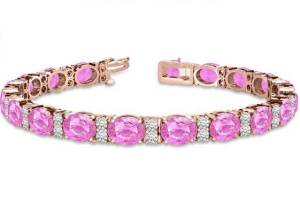
14k Gold Diamond and Oval Cut Pink Sapphire Tennis Bracelet (13.62ct) |
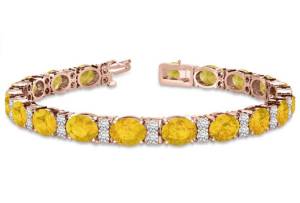
14k Gold Diamond and Oval Cut Yellow Sapphire Tennis Bracelet (13.62ct) |
Click On The Images
If you want a sapphire whose color is natural, insist on a report from an established gem testing laboratory like the GIA or AGTA Gemological Testing Center certifying that the stone shows no evidence of heat alteration. But you also have to be prepared to pay a premium for the pleasure.
|
Quality And Value Of Sapphires: |
Intense medium dark blue is the most desired color for blue sapphires. The value of blue sapphires is determined on the basis of the purity of their primary hue. Purple, violet, and green are the lesser hues found naturally in blue sapphires. Blue stones still lead the sales for this popular gemstone.
Violet and purple hues are deemed positives and contribute to the overall beauty of the gemstone. Conversely, the green hue is regarded as a definite negative. It reduces the value of a sapphire. Blue sapphires with less than fifteen percent violet or purple hues are regarded to be of fine quality. On the other hand, even a trace of green tends to make it inferior in quality.
Yellow and green sapphires are also frequently found.
Chromium content imparts a pink hue to sapphires and the pink color intensifies with the increasing content of chromium. The value of the sapphire increases with the deepening pink color so long as the color deepens in the direction of the red of rubies.
Sapphires are most common in cushion and oval shapes. Other shapes, including rounds, emerald cuts, princess cuts, and trilliants are widely available in sizes under a carat. Fine sapphire is usually more affordable than similar quality ruby, emerald, and diamonds.
All sapphires occur in nature with inclusions though in exceptionally rare cases a sapphire can also be clean. Even valuable sapphires can carry inclusions and completely clean gems make them suspect.
|
Sapphires With Special Optical Properties (Phenomenal Sapphires): |
Color Changing Sapphires are corundum’s chameleons:
Certain unusual color-changing sapphires, display different colors in a different light. The blue in outdoor light changes to purple in incandescent indoor light. The pink in daylight turns greenish under fluorescent light.
Asterism (Star Sapphires):
Sapphires with a sufficiently large number of inclusions of tiny, rutile needles exhibit an optical property called asterism. Rutile is a mineral composed primarily of titanium dioxide. When these inclusions are numerous enough, they make the stone translucent or opaque. When they are properly oriented, they reflect light in such a way that a moving star appears and glides across the top of the stone.
Large fine star sapphires are found at Mogok mines in Burma.
A skilled cutter recognizes this potential in a piece of rough sapphire and cuts it into the dome shape cabochon cut. Typically, the center of the star is near the top of the dome. Faceted stones are less likely to show the effect well. The six-ray “star”-the shaped pattern is seen more often. Twelve-ray star pattern is also occasionally found.
|
Sapphires in Jewelry: |
Sapphire makes a superlative stone for adorning jewelry. This is because of its enthralling range of colors and its brilliance. Its innate hardness -second only to diamonds- is a further ace up the gem’s sleeve. The gem is tough not only because it measures 9.0 on the Mohs scale, but also because it is devoid of any well-defined cleavage. As such it is well-suited for daily-wear rings such as wedding and engagement rings.
Sapphires look fantastic in engagement rings, right-hand rings as also in pendants around the neck. Sapphires come in a riot of colors as well as in an extensive range of prices from reasonably priced to the exclusive. So sapphire jewelry can go with all types of outfits, all types of occasions and they can fit into any class.
4K Gold Diamond & Blue Star Sapphire Matching Earrings, Pendant Necklace and Ring Set
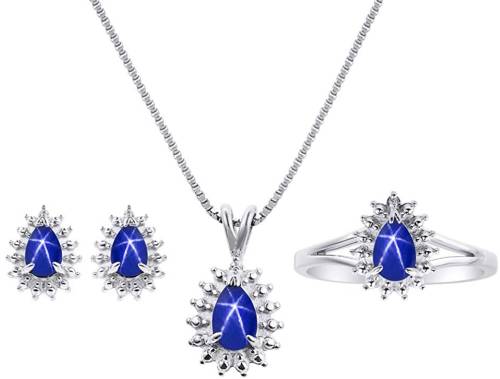
Click On The Image
Sapphire is the original “true blue” and the gem of fidelity. In ancient times, the gift of this gemstone was a pledge of trust, honesty, purity, and loyalty. This tradition makes sapphire a popular choice for engagement rings.
Care & Cleaning
In order to preserve the luster and fire of a sapphire, it is very important that you clean them on a regular basis. The emphasis is on Regular Cleaning. You can do the cleaning with mild detergent or soap and lukewarm water. Scrubbing can be done gently with a soft toothbrush behind the stone where dust can collect.
Artificial Sapphires
It is also worth stating here that today artificial sapphires are manufactured in the lab. These artificial sapphires are similar to the naturally occurring ones in all ways except that they do not have the blemishes and inclusions seen in the latter. They are also available in a much lower price range.
Click Here To View An Amazing Jewelry Collection Featuring This Gorgeous Gemstone
See More Gemstones As Follows